
Design Studio Teaching and Learning
- Introduction
- How this paper is organized
- A short story of studio
- Lens 1: Historic orientations of practice
- A craft of creativity and form-making
- A process of solving problems
- A shared investigative practice
- A driver of strategy and innovation
- Summary
- Lens 2: Demeanors and goals of criticism
- Shared inquiry
- Demonstration
- Expert judgement
- Confrontation
- Summary
- Lens 3: Place, space and privacy
- Presence in a unique space
- Collaboration and competition within a cohort
- Creativity in public
- Challenges to space use
- Demands for territory
- Going to studio
- Summary
- Lens 4: Time, labor and presence
- Rhythms of studio time
- Expectation of hard work and long hours
- Asymmetrical power dynamics
- Summary
- Lens 5: Performance
- Studio is a show
- Studio is improvisational
- Summary
- Lens 6: Risks, rules and identity
- The pursuit of innovation
- Risk-takers and rule-breakers
- A place where rule-breaking behavior is fostered
- Summary
- Conclusion
- References
Introduction
This document is a comprehensive survey and analysis of design education, primarily focused on the nature of studio teaching and learning.
Studio is many things, including:
- A practice of teaching that rejects formal lecture (Orr & Shreeve, 2018)Orr, S. & Shreeve, A., 2018. Art and Design Pedagogy in Higher Education: Knowledge, values and ambiguity in the creative curriculum. New York: Routledge. and instead emphasizes impromptu demonstrations and discussions, one-on-one work with students (Hokanson, 2012)Hokanson, B., 2012. The Design Critique as a Model for Distributed Learning. In: The Next Generation of Distance Education. Boston: Springer, pp. 71-82., and a more casual, unplanned feeling (Goldschmidt, et al., 2010)Goldschmidt, G., Hochman, H. & Dafni, I., 2010. The design studio "crit": Teacher–student communication. Artificial Intelligence for Engineering Design, Analysis and Manufacturing, Volume 24, p. 285–302.
- A type of criticism, which is the practice of an instructor, students, and outside visitors examining and discussing an artifact a student has made, to identify how it can be improved (Dannels, et al., 2008)Dannels, D. P., Housley Gaffney, A. & Norris Martin, K., 2008. Beyond Content, Deeper Than Delivery: What Critique Feedback Reveals About Communication Expectations in Design Education. International Journal for the Scholarship of Teaching and Learning, Volume 2, p. Article 12.
- A dedicated working space (Corazzo & Gharib, 2021)Corazzo, J., 2022. Studio Through Studio: a diffractive reading of the educational design studio. Bilbao, Design Research Society. where students can store their materials and display their work-in-progress on the walls (Fallman, 2007)Fallman, D., 2007. Supporting Studio Culture in Design Research. s.l., s.n. and leave work unfinished—and return to it later—without having to remove it in between
- A casual environment, including domestic areas that are unusual in an education setting, such as lounges or kitchens (Thoring, et al., 2018)Thoring, K., Desmet, P. & Badke-Schaub, P., 2018. Creative Environments For Design Education And Practice: A Typology Of Creative Spaces. Design Studies, Volume 56, pp. 54-83.
- A set of expectations around creation—that students make things, continually, in order to explore and refine ideas, and to prompt discussion with instructors and other students (Shaffer, 1997)Shaffer, D. W., 1997. Design, Collaboration and Computation: The Design Studio as a Model for Computer Supported Collaboration in Mathematics. Toronto, Ontario Institute for Studies in Education, pp. 249-255.
- A project-focused learning approach that extends over long periods of time, with assignments that are often ambiguous in scope, and exist in different phases of completion from student to student (Jones, 2022)Jones, D., 2022. Exploring Studio Proximities: Space, Time, Being. Bilbao, Design Research Society.
- A curriculum for the development of hand-skills, emphasizing the development of craft, process and method while minimizing focus on theory and abstraction—the fostering of a reflective practice (Cross, 1982Cross, N., 1982. Designerly Ways of Knowing. Design Studies, 3(4), pp. 221-227.; Cennamo & Brandt, 2012Cennamo, K. & Brandt, C., 2012. The "right kind of telling": Knowledge building in the academic design studio. Educational Technology Research and Development, Volume 60, p. 839–858.).
These are some of the concepts that differentiate studio from other forms of teaching and learning. In this text, I will examine these concepts, and others, as a way to identify the predominant scholarly perspectives of how design is taught and learned in a studio context.
The goals of this text are to showcase my comprehensive understanding of the educational design studio, and to highlight underdeveloped, latent aspects of studio scholarship that can benefit from additional consideration and, if reasonably explored, have the potential to shift existing studio structures that are generally unchallenged.
How this paper is organized
I examine design studio through a variety of lenses. Each lens can be thought of as a unique analytical investigation, purposefully highlighting different elements of studio in order to challenge the recognized arrangement of teaching pedagogy:
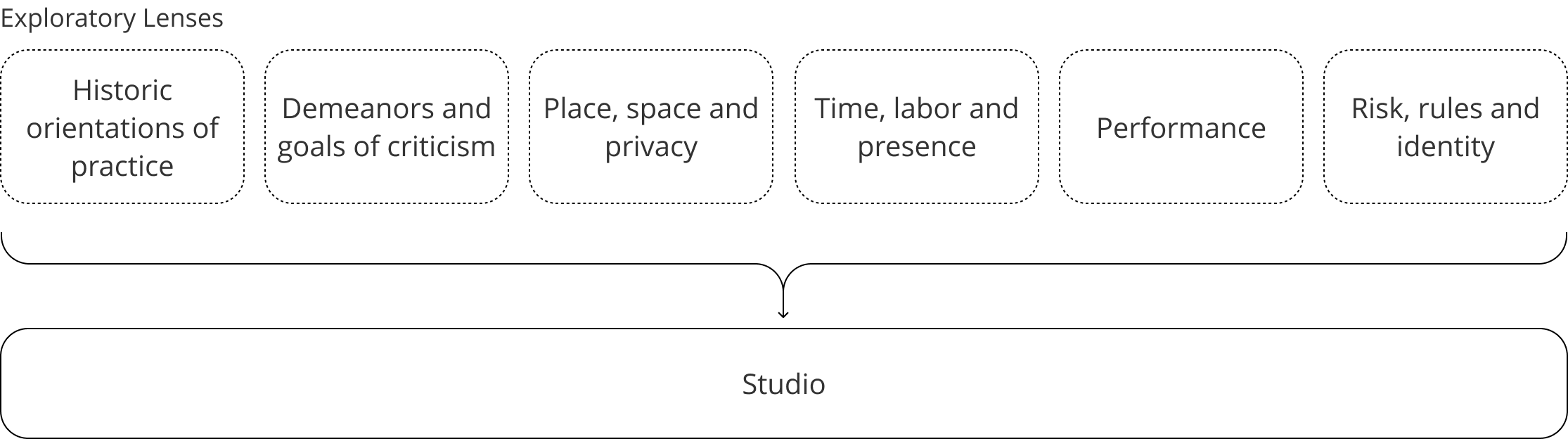
Historic orientations of practice

The first analytic lens is one of historic orientation of practice. This is an examination of design studio as a place for students to learn how to position themselves in relationship to the practice of design, where the history of a given design movement or theory has offered a significantly differentiated pedagogy of learning. The most traditional orientation of design is that of form-giving and craft, and students learned that design is about intimacy with materials and the development of form. Another orientation of practice is that design is a form of solving problems—that design itself is a discipline for identifying things that need to be improved, and creating ways to improve those things. Students also experience design in studio as a shared investigative practice, where they learn to make things as a way of exploring ideas: as a playful and shared process, not as a means to an end. And, design—positioned as design thinking—is taught in studio as a driver of business innovation, in which students learn to view creative success as novelty. Each of these orientations is rooted in strong institutional histories, and I show how studio learning imprints a unique form of that institutional creative thinking onto its students, providing them with a disposition to their work.
Demeanors and goals of criticism
Next, I look at studio through a lens of formalized criticism. Critique is described by researchers as a stance, a practice, and even a pedagogy of its own, and I describe how studio critique has been positioned in scholarly research as a form of expert judgement, a shared inquiry, a form of demonstration, and a form of confrontation. There are a variety of goals an instructor might have for centering their studio pedagogy around critique, and I look at each of these as they relate to the demeanors of criticism. These goals include assessment of student work, a desire to help students improve their abilities, a preparatory study in anticipation of the “harsh realities” of a career, to build a sense of studio community, and to support institutional motives that exist outside of the teaching and learning process itself.
Place, space and privacy
A third lens used in this exploration is that of place, space and privacy. Studio is unique in its emphasis on public creativity. Students are often provided dedicated spaces, but those spaces are in an open environment. The expectation is that students work in the space, exhibit their work on their desks and on the walls around them, and treat the space and their ideas as shared. Various structural decisions attempt to support this, such as encouraging students to work as a cohort and to collaborate with one another. However, as I will show, territoriality and a demand for privacy often conflicts with the instructional desire for a pedagogy of openness.
Time, labor and presence
I next examine studio through a lens of time, labor and presence. Studio has unique temporal rhythms, and studio education places a strong emphasis on long working hours and hard work, both of which become signs of pride for students, and are treated as indications of professional commitment. When viewed as a form of time politics, these rhythms can be seen as structural and purposefully put in place by faculty as a way of enforcing an asymmetrical sense of power. I will explore the way that studio might be considered an oppressive system that is less about fostering creativity and learning, and more about perpetuating the creation of a force of motivated workers.
Performance
Goffman argues that the world is a performance, and this is the next lens I use to look at studio—I examine studio as a literal representation of Goffman’s ideas, and also as a figurative gesture towards performance as improvisation. When viewed literally, students are actors, faculty are an audience, the studio is the stage, and activities like critique follow a preset narrative, practiced and rehearsed, and continually performed. When viewed figuratively, studio is more akin to improv: a space where presentation is a form of shared teaching and learning, and the “show” is jointly enacted, highly contingent on the context and participants, and is provided as a place for students to practice being designers in a low-risk, highly supportive context.
Risks, rules and identity
Finally, I look at studio as a place for cultivating deviance and normalizing risk-taking behavior, where students learn not just to tolerate uncertainty but to treat selective rule breaking as integral to professional competence. Through Becker’s lens of outsiderness, I examine studio as a social setting in which students are inducted into a subculture that rewards disruption, ambiguity and nonconformity, and where these behaviors become markers of disciplinary belonging. This lens frames risk-taking and rule-breaking as things that are socially produced through public labeling and are related to identity formation, helping explain how studio prepares students to occupy the unusual role of outsider within the rule-bound structures of corporate life.
A short story of studio
Prior to exploring studio through these lenses, I’ve included a brief hypothetical but realistic vignette, describing and showing how a student might experience studio. I hope to contextualize what studio feels like at some schools and for some students, so that this image can persist as a point of reference for comparing and contrasting the other approaches that will be described.
Samantha—a junior in industrial design—wakes up at 11:00am. She was in the studio until 3:30am working on her project, and slept in. She gets ready and heads to class. Her first class is Design Studio II, a course that emphasizes the relationship between people and their built environments. She arrives at class, which is held in the studio space—a large open room with desks around the edges.
Samantha is investigating how people consider the furniture they purchase for their homes. She’s been sketching different ideas and forms that focus on materials and ways of sitting.
Class has started, although there’s been no real announcement by Francine, the professor, who is sitting next to another student talking quietly. Samantha begins to work.
After about 30 minutes, Francine sits down next to Samantha and asks her how the project is going. Samantha explains that she’s having trouble visualizing how a specific curve might work for a chair she is designing. Samantha shows her a sketch, and Francine—offering suggestions—draws right on top of it. She tells Samantha that it’s a good time in her process for her to make some physical models, as this may help her better understand the shape and materials she is exploring.
Francine moves on to another student, and Samantha heads into the attached machine shop. She cuts some wire, and, back at her desk, begins to shape an armature.
As she’s working the wire into a form, she overhears the professor explain a shaping approach to another student, one that draws mesh over a template. Samantha builds a template to try it herself.
Samantha works for about two hours. She takes a break and wanders over to see what another student is working on, and the two talk about the project and pass a model back and forth. After her break, she heads back to her desk and continues working.
After about three and a half hours, Samantha hears Francine call the whole class—twelve students—over to see the sketches another student has been working on. They all gather around that student’s desk.
Francine calls attention to a specific part of the design, and asks the class to describe what is and isn’t “working” about it. The class has an informal discussion, with students making comments and Francine asking open-ended questions and occasionally making declarative statements about things the student could do better. The conversation drifts away from a discussion of form and towards the topic of production and purchasing; a student questions if anyone would buy the type of product being discussed. Francine selects a sketch that Samantha made and pins it next to those already on the wall; then, the class discusses the different goals the two students have, and analyzes which idea is more innovative and might perform better in the market.
Francine announces that class is over, but explains that she will remain in studio for another 30 minutes if anyone still wants to speak with her. Samantha shows her the mesh model she has made, and both spend time talking about the way Samantha has worked through the problem. Francine tells her that she’s ready to move on to build a more refined model.
Historic orientations of practice
I begin my analytic exploration of studio by examining it through a lens of orientations of practice: the way historical periods have shaped different definitions of design, and how those definitions in turn influence what students learn and how they learn it. I will focus on some of the more prominent definitional orientations, which include design as craft, design as a process of problem solving, design as a shared inquiry of reflective practice, and design thinking as a driver of business innovation. There are many other orientations of design, such as speculative design, civic design, transition design and adversarial design; yet these are much less prominent in design education, and I will focus on the most common ways students are likely to experience studio.
A craft of creativity and form-making
Perhaps the most traditional view of design is that it is a profession of giving form to ideas, primarily through understanding and manipulating material. This orientation argues that design is an aesthetic profession, where a designer simultaneously considers what something artificial should look like and how it should be made. This aligns design closely with art, and this orientation appears frequently in art and design schools.
While all orientations of a practice are products of their history, design as a creative craft is particularly tied to a specific period of time and movement; Phelan (1981, p. 7)Phelan, A., 1981. The Bauhaus and Studio Art Education. Art Education, 34(5), pp. 6-13. argues that “the basic influence on studio art education in this country in the last fifty years is derived primarily from a single source: the German institution called the Bauhaus.” The Bauhaus was established in Weimer under architect Walter Gropius, moved to Dessau and Berlin, and under director László Moholy-Nagy, relocated to Chicago as the New Bauhaus, and then at the Illinois Institute of Technology (Findeli, 1990)Findeli, A., 1990. Moholy-Nagy's Design Pedagogy in Chicago. Design Issues, 7(1), pp. 4-19..
In all of its iterations, Bauhaus was a school that taught students various aspects of the craft of design. These included architecture, ceramics, weaving, carpentry, printing, and stage design. Prior to the Bauhaus, most artistic exploration was focused on a model for truth, reality, and divine insight, but Bauhaus offered a new approach, one that was “promulgated by science and scientific methodology” (Phelan, 1981, p. 7)Phelan, A., 1981. The Bauhaus and Studio Art Education. Art Education, 34(5), pp. 6-13.. Bauhaus-style education was an extension of earlier one-on-one apprenticeship approaches to learning, in that it continued to focus on a close relationship between students, instructors and craft, but it prescribed a very formal, methodical, and organized way of teaching, learning, and designing. Bauhaus assignments investigated aesthetic problems in the context of art and design, and “introduced the notion that there could be a number of ‘correct’ solutions of ‘problems’” (p. 7)Phelan, A., 1981. The Bauhaus and Studio Art Education. Art Education, 34(5), pp. 6-13..
The Bauhaus attempted to isolate the various elements of aesthetics, and then study each one independently, much like one might study a natural phenomenon. Bauhaus philosophy critiqued current mass-produced products as being lifeless, yet embraced emergent manufacturing and industrialization processes as means for delivering functional design at scale. As a result, students in the Bauhaus were influenced by a philosophy that form and function had meaningful connections to one another. Functionalism and mass-production were not prioritized over aesthetics; instead, students learn that these things must be considered as intertwined.
The Bauhaus curriculum had a foundations course, which remains a common part of most modern design education. The course was analytical in nature, and emphasized both craft and a methodical investigation of separate parts of form-giving. The Bauhaus “formalized those approaches which are now virtually dogma in the teaching of studio” (Phelan, 1981, p. 13)Phelan, A., 1981. The Bauhaus and Studio Art Education. Art Education, 34(5), pp. 6-13.. The object of the foundations course was "the knowledge and proper evaluation of the individual means of expression" and the point was above all "to liberate the creative forces in the student" while "avoiding any binding attachment to any style movement" (Wick & Grawe, 2000, p. 67)Wick, R. K. & Grawe, G. D., 2000. Teaching At The Bauhaus. Ostfildern-Ruit: Hatje Cantz Publishers..
Foundations studies served to wipe the slate clean of existing and uniform sensibilities; they were not, however, intended to replace these with one single certain aesthetic preference, as the purpose “was not primarily direct preparation for the subsequent teachings in one of the workshops but rather a chance for students to discover and develop their own creative abilities, free from any attempt to judge them by other than aesthetic criteria” (Wick & Grawe, 2000, p. 113)Wick, R. K. & Grawe, G. D., 2000. Teaching At The Bauhaus. Ostfildern-Ruit: Hatje Cantz Publishers..
In today’s art and design schools that endorse this orientation of practice, foundations studies have expanded beyond a single course. The names of these courses, indicative of the content, include 2D Design, 3D Design, Color, Form, and so on. These are found in schools that offer fine arts classes alongside design, reinforcing the connection between Arts and Crafts and mass production, and reinforcing the lineage nature of Bauhaus pedagogy.
One notable example of this historic connection can be found in the curriculum at Pratt, developed in large part by Rowena Reed Kostellow in 1934. Kostellow was the chair of the Industrial Design department, which she joined after helping to create the first industrial design program at Carnegie Mellon (then Carnegie Tech). She established Pratt’s program in parallel to Moholy-Nagy’s creation of the New Bauhaus in Chicago, and she focused on aesthetics and beauty as methodical arguments. Pratt differentiated itself from the New Bauhaus by de-emphasizing practical functionalism. Students took classes in Rectilinear Volumes, Curvilinear Volumes, Composition of Fragments, Planar Construction, Lines in Space, Construction, Convexity, Concavity, Abstract Analysis, and Space Design (The Rowena Group, 2026)The Rowena Group, 2026. History. [Online] Available at: https://www.rowenagroup.org/history [Accessed 1 May 2026].. These foundation courses were intended to develop a refined sense of taste and an understanding of the relationship between style, function, and material. Kostellow said, “Our goal is the training of designers so familiar with the principles of abstraction that they automatically think of a visual problem in terms of organized relationships and then feel free to study other aspects of the problem.”
Schools modeled on these types of programs celebrate aesthetics when the connection between form and function is deemed appropriate, and curriculum influenced by Kostellow, such as Rhode Island School of Design, Columbus College of Art and Design, and San Jose State University, emphasize aesthetics as a form of cultural change; they embrace Kostellow’s argument that “pure, unadulterated beauty should be the goal of civilization” (The Rowena Group, 2026)The Rowena Group, 2026. History. [Online] Available at: https://www.rowenagroup.org/history [Accessed 1 May 2026]..
Students are taught to orient themselves around a defensible aesthetic taste. We now see foundations studies at ArtCenter, Savannah College of Art and Design, Parsons School of Design, and other well-respected art and design institutions. In these foundations classes, an emphasis is often placed on aesthetic intention. A “discourse of intentionality downplays intuition” (Fine, 2018, p. 154)Fine, G. A., 2018. Talking Art: The Culture of Practice and the Practice of Culture in MFA Education. Chicago: University of Chicago Press. and students are expected to establish a discursive frame to add structure to an otherwise subjective assessment. While some artists view art and design as unassessable in their subjectivity (Orr & Bloxham, 2012)Orr, S. & Bloxham, S., 2012. Making judgements about students making work: Lecturers’ assessment practices in art and design. Arts and Humanities in Higher Education, December, 12(2-3), pp. 234-253., a form-oriented practice forces students to learn to speak clearly about their work in artistic language.
In a studio oriented around craft and aesthetic form-giving, material competency takes a central role. Students learn to understand artifacts by making them: they create physical prototypes and models. In evaluating the nature of engagement with materiality, Brinck and Reddy (2019, p. 25)Brinck, I. & Reddy, V., 2019. Dialogue In The Making: Emotional Engagement With Materials. Phenomenology and the Cognitive Sciences, July, 19(1), pp. 23-45. identify that in the context of art and design, the relationship between a person and a substance is intimate and almost animate; they describe that “pottery is an embodied, nonlinear process that includes working with its dedicated materials openly and without intermediaries.” Students learn this intimacy through the development of attention to detail and a pursuit of craftsmanship. Craft-based projects offer multiple benefits to students (Kolko, 2011)Kolko, J., 2011. Craftsmanship. Interactions Magazine, 18(6), pp. 78-81.. These include developing a “muscle memory” related to visual acuity and fine motor skills and forcing students to “look closer” and consider visual details related to a specific medium.
When focusing on material, craftsmanship is intertwined with workmanship, or what McCullough (1998, p. 201)McCullough, M., 1998. Abstracting Craft: The Practiced Digital Hand. Cambridge: MIT Press. describes as “the quality with which a design vision takes form in a specific medium.” Pye (1995)Pye, D., 1995. The Nature and Art of Workmanship. London: The Herbert Press. argues that workmanship has two extremes, a workmanship of certainty and one of risk. Workmanship is risky when quality is indeterminate, as when it is dependent on hand-skills and dexterity. It becomes more certain when tools of production are created prior to making, as with jigs or injection molding, and so production is repeatable and predictable. A workmanship of risk allows a potential for failure—such as making an incorrect cut with a saw—to remain during the making process, while a workmanship of certainty shifts creative decision-making to the front, as strategic decisions that occur prior to beginning a production effort.
In a studio oriented around craft and form-making, students must learn a workmanship of risk in order to effectively design with a workmanship of certainty. As they directly engage with materials, they begin to understand both potential and limitations as constraints upon their designs; these are what Charles Eames describes as “one of the few effective keys to the Design problem: the ability of the Designer to recognize as many of the constraints as possible; his willingness and enthusiasm for working within these constraints” (Design Q & A, 1972)Design Q & A. 1972. [Film] Directed by Charles Eames, Ray Eames. s.l.: Herman Miller.. Eames is referring to how far a given material can be manipulated in pursuit of a creative vision, as with his transformation of bent plywood in order to produce new furniture and furniture-making techniques.
Stults (2009, p. 245)Stults, R., 2009. Media Space, After 20 Years. In: S. Harrison, ed. Media Space 20+ Years of Mediated Life. London: Springer, pp. 233-259. describes the material and output of this manipulation, in the studio, as being a “design medium”—a “good enough replacement for the thing being designed that the designers can look at and act on it in the studio as if they are acting on the thing in its actual location.” Studio becomes a source of imaginative approximation, in the sense that students learn to anticipate how a form that is made once will exist when it is made many times. The studio itself becomes something that is manipulated by the artifacts that are in it, a medium between “designer and the object of design… [and] between well-defined, structured, repeatable process and irregular, impulse-driven, spontaneous, primary activities of discovering, understanding, and making form” (p. 246)Stults, R., 2009. Media Space, After 20 Years. In: S. Harrison, ed. Media Space 20+ Years of Mediated Life. London: Springer, pp. 233-259.. In a learning environment oriented around the practice of creativity and form-making, the studio is the literal room in which design occurs, and is also a material itself where the people that are doing the design are working and being with one-another.
A process of solving problems
A second orientation of practice centering design studio education is one of problem solving. Instead of learning that design is about making beautiful objects, students learn to view design as an effective process for solving complex, ill-defined problems. This often presents itself either as a rational and cognitive approach, as a set of repeatable and rigorous methods, or as a designerly way of knowing through framing, synthesizing, and ideating.
Rationality
Rationality in design is a perspective often traced to Herb Simon. Simon is celebrated for his view that “everyone designs who devises courses of action aimed at changing existing situations into preferred ones” (Simon, 1988, p. 67)Simon, H. A., 1996. The Sciences of the Artificial. 3 ed. Chicago: MIT Press.. The idea that the human experience has an optimal state, and design is a process of reaching it, grounds design firmly in a positivist tradition. Simon continues in describing the flexibility of design as a transformative problem-solving approach: “the intellectual activity that produces material artifacts is no different fundamentally from the one that prescribes remedies for a sick patient.”
This view makes sense in the context of Simon’s larger body of work. His research at Carnegie Mellon University focused on “detailed theories for human problem solving… using computer programs embodying these theories to simulate human behavior” (Simon & Newell, 1976, pp. 113-114)Simon, H. A., 1988. The Science of Design: Creating the Artificial. Design Issues, 4(1/2), pp. 67-82.. In working to develop a unified theory of cognition related to problem solving—ultimately, with a goal of mirroring the process computationally—Simon identified that a common form of problem is “ill-defined” in that it has no discrete edges or container. Life is, of course, lacking edges and clean boundaries, and Simon acknowledged that any framing of a rationality of problem-solving had to recognize that the problem is solved only in the context of known information. This is his theory of bounded rationality: people solve problems satisfactorily rather than optimally, given the limited information they have available (Simon, 1996, pp. 25-27)Simon, H. A. & Newell, A., 1976. Computer Science as Empirical Inquiry: Symbols and Search. Communications of the ACM, 19(3), pp. 113-126..
Not all agree with Simon, viewing the positivist intention as missing a core purpose of design. Victor Margolin (2002, pp. 236-237)Margolin, V., 2002. The Politics of the Artificial: Essays on Design and Design Studies. Chicago: University of Chicago Press. notes that “Simon’s essay, with its deceptively catholic definition of design activity, became the impetus for a direction in research activity that has focused more on creating objective models of the design process than on developing a critical theory of practice.” For Margolin, and others, design and designing are social and embodied, not cognitive or computational. Yet Simon’s perspective has been echoed by other influential designers and educators, even those who found an orientation of practice closer to the form-giving previously described. For example, Jay Doblin—a graduate of the above mentioned Pratt in 1942, and former director of the Illinois Institute of Technology’s Institute of Design (which emerged from the “New Bauhaus” in 1937)— stated that a simple model of design process is the transition of an existing state that has “some fault that ought to be fixed,” resulting in “a more desirable state” (Doblin, 1987)Doblin, J., 1987. A short, grandiose theory of design. STA Design Journal, pp. 6-15..
Methods
The idea that life is full of problems and that the problems can be solved came to life in professional design practice most recognizably during the methods movement of the 1960s and 1970s. The goal of this movement was to establish design as a science (following Simon) and to methodize the problem solving process, much like a view of the scientific method that can be followed precisely to produce objective, grounded understandings of the world around us. There was a strong effort, notably by Christopher Alexander and John Chris Jones, to make fields like industrial design and planning more methodical, rational, predictable, and repeatable.
Alexander has become known for his work in pattern languages, adopted by computer scientists. But in the late ’60s and early ’70s, his work focused more on discrete and formal ways of doing things—mathematical ways to solve human design problems. Alexander, Jones, and other practitioners advocated for methods like Synectics (“to direct the spontaneous activity of the brain and the nervous system towards the exploration and transformation of design problems”), Ranking and Weighting (“to compare a set of alternative designs using a common scale of measurement”), and Morphological Charts (“to widen the area of search for solutions to a design problem”) (Jones, 1992, pp. 279, 292, 377)Jones, J. C., 1992. Design Methods. 2 ed. New York: Wiley.. Methods like these assert that we are in control and that we can tame the complex world around us. Employing this seemingly scientific approach adds a sense of sophistication to design activities, separating them from art—a discipline still with a reputation for being less serious or less important—and elevating the perception and value of design in the eyes of business and government.
When methods are experienced by students as prescriptive—as in the methods movement—design students sometimes find them unsatisfying (Salazar, 2014)Salazar, S. M., 2014. Educating Artists: Theory and Practice in College Studio Art. Art Education, 67(5), pp. 32-39.. Pivonka et al.’s research (2022, p. 8)Pivonka, A., Makary, L. & Gray, C. M., 2022. Organizing Metaphors for Design Methods in Intermediate HCI Education. Virtual, Design Research Society. with design students showed that students embrace methods most when they are presented as tools for framing and making rather than as a formalized playbook for designing. One student in their research viewed methods as mechanisms for continuity and progress—a means to stay “on track” and remain “a few steps ahead,” yet also defined methods as “flexible, fluid ways to achieve a desired outcome,” revealing inconsistency in the student’s own understanding. A second student distinguished between formal and informal methods: “Methods and methods,” where uppercase Methods are “formal, well-established processes” and lowercase methods are “informal, less definitive, and more personal ways to engage with the design process,” often grounded in ethical concerns such as being in “constant fear [of] misrepresenting someone.” Still another student used methods as communicative devices, describing a method as “a way of structuring your thinking about a certain subject” and emphasizing the need for “constant and clear communication of the design rationale.”
These reactions may point to the shortcomings of design as science, at least when considered in education. Alexander eventually recognized this and rejected the entire methods movement, declaring “I have been hailed as one of the leading exponents of these so-called design methods. I am very sorry that this has happened, and want to state, publicly, that I reject the whole idea of design methods as a subject of study, since I think it is absurd to separate the study of designing from the practice of design. In fact, people who study design methods without also practicing design are almost always frustrated designers who have no sap in them, who have lost, or never had, the urge to shape things” (Alexander, 1971, p. vi)Alexander, C., 1971. Notes on the Synthesis of Form. Boston: Harvard University Press..
Framing and making
An alternative view of design as a form of problem solving examines the negotiation between structure and expression, and between prescribed technique and individual interpretation. This is the design knowledge that Cross and Dorst (2001, p. 426)Cross, N. & Dorst, K., 2001. Creativity in the Design Process: Co-Evolution of Problem–Solution. Design Studies, 22(5), pp. 425-437. argue is inseparable from acts of making, framing, and iterative judgement. Across multiple studies, they show that designers do not begin with a fully specified problem and then apply methods to reach a solution. Instead, design competence develops through active engagement with ill-defined situations, where “problem and solution co-evolve together” as designers work.
What distinguishes design from other forms of problem solving, they argue, is the designer’s ability to frame a problem through action. They note that creative design outcomes are strongly correlated with the time designers spend “defining and understanding the problem,” using their own frames of reference rather than accepting the brief as given (Cross & Dorst, 2001, p. 431)Cross, N. & Dorst, K., 2001. Creativity in the Design Process: Co-Evolution of Problem–Solution. Design Studies, 22(5), pp. 425-437.. Expert designers tend to view all problems as ill-structured, even when the problem is presented as fixed (Mohanani, et al., 2019)Mohanani, R., Turhan, B. & Ralph, P., 2019. Requirements Framing Affects Design Creativity. IEEE Transactions on Software Engineering, April, 47(5), pp. 936-947., and so the creation of a frame becomes “something to hold on to and to focus on while designing” (Dorst & Valkenburg, 1998, p. 255)Dorst, K. & Valkenburg, R., 1998. The reflective practice of design teams. Design Studies, 19(3), pp. 249-271.. This framing (and reframing) process then acts as a container for developing new ideas. Cross (1997, p. 314)Cross, N., 1997. Creativity in Design: Analyzing and Modeling the Creative Leap. Leonardo, 30(4), pp. 311-317. argues that a “bridging concept” between a problem, its frame, and a solution occurs, and it is the “recognition of a satisfactory bridging concept that provides the illumination of the creative flash of insight.”
As with Simon, Alexander and Jones, this iterative framing, solutioning, and reframing process has a rigorous style of working. But this process is different, and relies on phenomenological ways of thinking about design work. The construction of a decision-making frame is based on several strategies, which include “anchoring and adjustment, relying on the prominent dimension, eliminating common attributes, discarding nonessential differences, adding new attributes into the problem frame in order to bolster one alternative, or otherwise restructuring the decision problem to create dominance and thus reduce conflict and indecision” (Slovic, 1995, p. 369)Slovic, P., 1995. The Construction of Preference. American Psychologist, May, 50(5), pp. 364-371.. These activities are methodical, but are not discrete methods.
A shared investigative practice
A similar but less process-driven orientation of practice that is instilled in design studio is that of a shared, reflective, and embodied style of working. Donald Schön’s theory of reflection-in-action is foundational to this view. Reflective practice is an ongoing creative conversation with a situation, in which the designer frames a problem, acts, encounters consequences, and revises their understanding in response in a very short period of time (in “real-time”). Much of Schön’s work is based on research conducted by Simmonds (1980)Simmonds, R., 1980. Limitations in the decision strategies of design students. IPC Business Press, 1(6), pp. 358-364.; Simmonds spent time with architecture students, observing how, under the guidance of a master architect, they learned to make sense of an architectural challenge. He observed several levels of working that were common.
Linear strategies often began with explicit planning, deductive reasoning, or pragmatic problem-solving. Simmonds observed that some students used these frameworks loosely, demonstrating what he called the “rare ability to let go of early decisions if it transpired that subsequent phases could not be accomplished” (Simmonds, 1980, p. 360)Simmonds, R., 1980. Limitations in the decision strategies of design students. IPC Business Press, 1(6), pp. 358-364.. Others committed fully to linear methods as a way of establishing structure, without realizing that the problem itself could be reframed to provide that starting point. Holistic students, by contrast, delayed commitment and began with the activities they “most valued and/or were most skilled at” (p. 360)Simmonds, R., 1980. Limitations in the decision strategies of design students. IPC Business Press, 1(6), pp. 358-364. but once a strategy was chosen, they often struggled to abandon it.
At a second level, how students moved between phases, Simmonds again observed differences between those who held ideas lightly and those who clung to initial assumptions. Some students used what he called a “separate entity mechanism” (Simmonds, 1980, p. 360)Simmonds, R., 1980. Limitations in the decision strategies of design students. IPC Business Press, 1(6), pp. 358-364. generating solutions temporarily detached from judgements of correctness. Others adopted bottom-up approaches that “required firming up on nothing” (p. 361)Simmonds, R., 1980. Limitations in the decision strategies of design students. IPC Business Press, 1(6), pp. 358-364.. Most, however, selected one method and stayed with it, even when it proved ineffective, either because they lacked alternative strategies or because they found it “greatly difficult … to carry out the rather limited operational advice they tended to get.”
At the third level—the translation of strategy into actual design content—Simmonds found that many students’ limited results stemmed from deficiencies in performing basic operational skills. Weaknesses in intuition, for instance, led to an overreliance on rationalism, and an inability either to push back on new ideas or to integrate them effectively. He concluded that “while students showed some ability to accommodate or adjust their substantive knowledge to new evidence, only two were willing to accommodate their operational knowledge” (Simmonds, 1980, p. 361)Simmonds, R., 1980. Limitations in the decision strategies of design students. IPC Business Press, 1(6), pp. 358-364.. Comfort with ambiguity was also uneven; students who tried to force abstraction into concreteness too quickly often lost creative momentum.
For Simmonds, this willingness to adjust one’s process was central to effective learning: strong students were able to “decide how to decide and learn how to learn” (Simmonds, 1980, p. 358)Simmonds, R., 1980. Limitations in the decision strategies of design students. IPC Business Press, 1(6), pp. 358-364.. He argues against separating decision-making from discussions of content and context. He found that capable students altered their strategies based on situational needs, while weaker students modified only the content of their work but not the structure of their decisions. This distinction revealed a hierarchy of strategy, where higher-level decision-making frameworks responded to context and subsequently guided lower-level activities. The strength of a student’s process lay not in rigid adherence to method but in the ability to move fluidly between abstraction and execution.
These activities can feel personal or invisible, and an instructor plays a role that is less about lecturing to a large group, and more about demonstrating to and with a single student at a time—the levels above are enacted as shared and investigative intimately between an instructor and a student. In synthesizing Simmonds’ research, Schön argues (1987, pp. 157-158)Schroeder, R. G., Linderman, K., Liedtke, C. & Choo, A. S., 2007. Six Sigma: Definition and underlying theory. Journal of Operations Management, Volume 26, pp. 536-554. that the aim of design education is to help students experience and understand the tacit dialogue that occurs between thought and material. For educators, the challenge lies in finding ways to make this implicit process visible and teachable, and this works best through close collaboration. Schön explains that designerly creativity can only be developed through practice; he argues that “designing, both in its narrower architectural sense and in the broader sense in which all professional practice is design-like, must be learned by doing... there is a substantial component of design competence—indeed, the heart of it—that [students] cannot learn [through lecture.]”
The primary point of shared practice occurs when an instructor responds to a student’s work in a one-on-one desk interaction. This is where a student progressively grows their skills and internalizes what they are doing, with the help of someone who already has established an understanding of action (Shaffer, 2007)Shaffer, D. W., 2007. Learning in design. In: Foundations for the future in mathematics education. s.l.:Erlbaum, pp. 99-126..
Responding to a student’s work, the “professor explores the implications of various design choices, suggesting alternative possibilities, or offering ways for the student to proceed in his or her exploration of the problem” (Shaffer, 1997, p. 252)Shaffer, D. W., 1997. Design, Collaboration and Computation: The Design Studio as a Model for Computer Supported Collaboration in Mathematics. Toronto, Ontario Institute for Studies in Education, pp. 249-255.. A design professor is rarely an expert in any particular problem or content of a student’s project, and “when students embark on a project in response to a brief, they can find themselves in territory uncharted by the teacher… [this is] called ‘reverse transmission’ because the students appear to be transmitting the knowledge they have created to the lecturer rather than vice versa” (Orr & Shreeve, 2018, p. 117)Orr, S. & Shreeve, A., 2018. Art and Design Pedagogy in Higher Education: Knowledge, values and ambiguity in the creative curriculum. New York: Routledge.. Instead, professors are experts in a designerly way of working—framing problems, managing ambiguity, applying various methods, and solving problems creatively (Rauth, et al., 2010)Rauth, I., Köppen, E., Jobst, B. & Meinel, C., 2010. Design Thinking: An Educational Model towards Creative Confidence. Kobe, Design Society.. Learning happens through a shared interaction among the student, the artifact, other students, and the instructor, and the artifact becomes the medium through which knowledge is constructed; Fleming (1998, p. 61)Fleming, D., 1998. Design Talk: Constructing The Object in Studio Conversations. Design Issues, 14(2), pp. 41-62. explains that “while it is the students who present their ideas and artifacts in the conversations… it is the professor who responds to these presentations, endorsing, interrogating, and pushing the designs towards increased or decreased stability.” Making things, then, “unlocks” a number of teaching strategies related to reflection and introspection.
Sawyer (1997, p. 106)Shaffer, D. W., 1997. Design, Collaboration and Computation: The Design Studio as a Model for Computer Supported Collaboration in Mathematics. Toronto, Ontario Institute for Studies in Education, pp. 249-255. emphasizes that when faculty meet with students one-on-one, they encourage them to experiment, to make mistakes, and to embrace uncertainty as a condition of creative learning. Within the studio, this ethos translates into a tolerance for ambiguity and a willingness to treat the design process as exploratory. Designing and discussion are intertwined in this process. While a large amount of design research has focused on the cognitive and perceptual dimensions of creative reasoning, Murphy et al. (2012, p. 533)Murphy, K. M., Ivarsson, J. & Lymer, G., 2012. Embodied reasoning in architectural critique. Design Studies, Volume 33, p. 530–556. propose that reasoning in a studio context is fundamentally social; it is “a consequential achievement embedded in the rich textures of social interaction.” Studio reasoning, they suggest, is not about logical proof but about conversational sensemaking.
Through the use of metaphor, educators connect a single student’s design-in-progress to other designs or familiar situations. During context-based teaching as observed by Simmonds, this reasoning often takes the form of real-time designing. An educator “reanimates some feature of a student’s design, casting the work in a different context from what the student has presented by redescribing details in new historical or conceptual terms” (Murphy, et al., 2012, p. 537)Murphy, K. M., Ivarsson, J. & Lymer, G., 2012. Embodied reasoning in architectural critique. Design Studies, Volume 33, p. 530–556.. This re-description typically concerns what needs improvement—the “bad news” of feedback—and the instructor “must offer an account for the negative assessment.” Metaphor, through abductive reasoning, serves as the means of justification: it is “one of the central accounting mechanisms that critics use for justifying their assessment of student work” (p. 538)Murphy, K. M., Ivarsson, J. & Lymer, G., 2012. Embodied reasoning in architectural critique. Design Studies, Volume 33, p. 530–556..
Murphy et al. (2012)Murphy, K. M., Ivarsson, J. & Lymer, G., 2012. Embodied reasoning in architectural critique. Design Studies, Volume 33, p. 530–556. continue to describe a typical metaphor-based sequence in one-on-one studio teaching. The professor begins by identifying a problem, then “establishes the interpretive framework for seeing this detail critically.” That framework is first applied to the student’s work, then to a real-world example, and finally to the overall project, which is “reanimated in relation to the source comparison.” The professor, they write, is “appealing to a basic form of mundane sense-making, the presumed shared understanding of what we all plainly see before us” (p. 550)Murphy, K. M., Ivarsson, J. & Lymer, G., 2012. Embodied reasoning in architectural critique. Design Studies, Volume 33, p. 530–556..
This collaborative working requires more than simply an instructor and a student; it also requires that an artifact is made, which acts as the centerpiece for the moment of instruction. Making things serves many purposes, but one of the most fundamental reasons to make things in an educational studio context is to act as a prompt for discussion and critique. In non-studio classes, students often experience a lecture-style approach to learning with a one-way transmission of knowledge (Schmidt, et al., 2015)Schmidt, H. G. et al., 2015. On the Use and Misuse of Lectures in Higher Education. Health Professions Education, 1(1), pp. 12-18.. Professors hold specialized disciplinary expertise, and their role is to convey this expertise to students through lectures, readings, and exams. Learning, in this model, is measured by how effectively students can reproduce and apply what they have been taught. The assumption is that knowledge exists prior to instruction and can be transferred from teacher to learner. This structure reinforces a hierarchy, where the professor knows, the student learns, and understanding is largely based on what the student does with the information after receiving it. But in studio, learning is prompted largely by making things rather than by the professor proactively saying things. Studio reflection often begins with a material prompt: a drawing, model, or prototype. Ochsner (2000)Ochsner, J. K., 2000. Behind The Mask: A Psychoanalytic Perspective On Interaction In The Design Studio.. Journal of Architectural Education, 53(4), pp. 194-206. notes that the prompt for a great deal of studio interaction is not spoken, and instead is prompted by what a student has made.
Students must produce tangible work to initiate conversation and critique; reflection is intertwined with creation. Sawyer (1997)Shaffer, D. W., 1997. Design, Collaboration and Computation: The Design Studio as a Model for Computer Supported Collaboration in Mathematics. Toronto, Ontario Institute for Studies in Education, pp. 249-255. describes that instructors focus both on the process of making things and on the thing that is made, and that students value this focus, particularly when experimenting or when the work remains unfinished. “Unconstrained, sometimes low-fidelity representations afford usual and unusual designs equally, limited only by the designer’s imagination” (Goree, et al., 2021)Goree, S., Doosti, B., Crandall, D. & Su, N. M., 2021. Investigating the Homogenization of Web Design: A Mixed-Methods Approach. Virtual, ACM., and describing their process and narrating its evolution becomes a central form of reflection, linking doing to thinking. Ultimately, as Salazar (2014, p. 38)Salazar, S. M., 2014. Educating Artists: Theory and Practice in College Studio Art. Art Education, 67(5), pp. 32-39. concludes, students “learn how to live a creative life through the act of making itself.”
Design students do not simply learn tools or processes—they learn ways of organizing their thinking about design. Pivonka et al. (2022, p. 2)Pivonka, A., Makary, L. & Gray, C. M., 2022. Organizing Metaphors for Design Methods in Intermediate HCI Education. Virtual, Design Research Society. conducted interviews with students to examine how they understood and applied design methods during their early development as designers. The study concludes that the way students structure or describe their understanding of methods directly influences how they practice design.
The researchers note that how students build procedural knowledge remains poorly understood. Existing literature often relies on vague terms—such as “metamorphosis”—to describe the transformation of student learning, offering placeholders rather than explanations. In practice, students must learn to make design moves, to broaden their perspectives through engagement with the social sciences, and to develop a coherent professional identity. One of the ways educators scaffold this process is through the introduction of design methods, broadly defined as any “intellectual or practical support that a practitioner might use to support the design process in a positive way” (Pivonka, et al., 2022, p. 2)Pivonka, A., Makary, L. & Gray, C. M., 2022. Organizing Metaphors for Design Methods in Intermediate HCI Education. Virtual, Design Research Society..
The things that are made are generally process artifacts rather than “final answers.” It is expected that they provoke the next thing to be made, and so they are transient and disposable. The process assumes that each idea must be externalized to be understood, and that progress comes from revision, not perfection (Vallée-Tourangeau, et al., 2024)Vallée-Tourangeau, F., Green, A., March, P. L. & Steffensen, S. V., 2024. Objects as knowledge: A case study of outsight. Possibility Studies & Society, 3(3).. In this sense, ideas cannot be seen as precious, and students are taught to make lots of things, not just one thing. The fidelity and level of completeness of what a student makes are related to the maturity of the idea being explored. Students begin to understand when a thing is “done enough” to move forward; Corazzo (2019, p. 1256)Corazzo, J., 2019. Materialising the studio: A systematic review of the role of the material space of the studio in Art, Design and Architecture Education. The Design Journal, Volume 22, p. 1249–1265. describes the studio as a place where the “ongoing act of making, renders the material dimension of learning visible.”
Cennamo (2014, p. 66)Cennamo, K. & Brandt, C., 2012. The "right kind of telling": Knowledge building in the academic design studio. Educational Technology Research and Development, Volume 60, p. 839–858. notes that in one of her studies, more senior design students saw ideas as flexible and provisional. One student explained, “the second I put something out there, it’s not mine.” This perspective captures one of the most fundamental aspects of studio pedagogy: that ideas are not possessions. The value lies not in the idea itself but in the process of exploring, refining, and building with it. This is an acknowledgment of the concept that ideas are free.
The practice of reflection is not always natural or comfortable for students. In Simmonds’ research described above, some students were unwilling or unable to develop flexible, higher-level strategies because of emotional and dispositional barriers. Fear played a significant role, and students “tended to identify their own sense of uniqueness in a fixed operational style. To ask these people to change their mode of operation in response to context, even for a moment, was like asking them to commit suicide” (Simmonds, 1980, p. 358)Simmonds, R., 1980. Limitations in the decision strategies of design students. IPC Business Press, 1(6), pp. 358-364.. Others resisted adaptability because they had already formed strong ideological commitments about design, architecture, or the role of the architect in society. These commitments shaped their decision-making processes and constrained their responsiveness to feedback. The most successful students were those who recognized and addressed their strategic weaknesses, allowing them to work with greater openness and fluidity.
Design education depends on trust and on a distinctive kind of questioning that, as Ochsner (2000, p. 199)Ochsner, J. K., 2000. Behind The Mask: A Psychoanalytic Perspective On Interaction In The Design Studio.. Journal of Architectural Education, 53(4), pp. 194-206. notes, must remain “neutral.” The neutrality of question and answer is essential to creating safety, but it is also difficult to sustain, since students bring their personal histories and insecurities into the learning relationship. Transference can occur when a student “regresses” to a childlike mode of play, re-experiencing dependency and exposure. Professors, too, may encounter countertransference, re-living elements of their own education. The design studio, like therapy, becomes an emotional ecology where power, care, and vulnerability circulate together.
Mewburn (2012)Mewburn, I., 2012. Lost in translation: Reconsidering reflective practice and design studio pedagogy. Arts and Humanities in Higher Education, Volume 11, p. 363–379. revisits Simmonds’ work, discussed above, that informed Schön’s The Reflective Practitioner. Schön’s primary case—the interaction between “Quist” and his student “Petra”—became the foundation for his theory of reflection-in-action. In Schön’s account, Quist is portrayed as the expert guiding a subordinate learner, modeling design processes so that Petra might emulate them. But as Mewburn notes, this dynamic marginalizes Petra’s agency. The student’s notebook, which documents her independent interpretations, suggests that she was learning only a single, authoritative way of thinking. Mewburn questions the ethics of this model, implying that it reinforces hierarchy rather than co-creation. She contrasts this with her own teaching experience, describing a desk crit with a student who resisted her professional framing of an assignment. The student argued that this was one of the few opportunities he would have to actually reject requirements purposefully. Mewburn recognized that she was enacting a Schön-like coaching role and asked, “Is it possible to be an effective design teacher if you don’t try to coach at all?” (pp. 373-374)Mewburn, I., 2012. Lost in translation: Reconsidering reflective practice and design studio pedagogy. Arts and Humanities in Higher Education, Volume 11, p. 363–379. Her reflection underscores the pedagogical paradox: to teach creative autonomy, an educator must still perform a role of structured guidance.
An alternative to coaching is a more Socratic approach, where guided questioning becomes an instructional skill for encouraging creativity. Salazar (2014, p. 36)Salazar, S. M., 2014. Educating Artists: Theory and Practice in College Studio Art. Art Education, 67(5), pp. 32-39. argues that exploration, play, and existential inquiry stimulate deep learning, and that dialogue is the key mode through which this occurs. Her argument is grounded in a mixed-method study of college studio art education that combines observational research, survey data, and a broad synthesis of art education literature. Based on a survey of ninety first-year art students at two institutions, along with classroom observation, she analyzes how students experience teaching and learning in foundations-level studio courses. She identifies inquiry, exploration, play, and existential questioning as central pedagogical mechanisms that support design learning.
Oo et al. (2025)Oo, T. Z., Kadyirov, T., Kadyjrova, L. & Józsa, K., 2025. Enhancing design skills in art and design education. Frontiers in Education. describe design education as integrating “principles of design thinking into the learning process, with a focus on hands-on, experiential tasks where students confront genuine design dilemmas.” The teacher’s role is “to inspire and share experiences, to ask probing questions,” and to “prompt students to articulate engineering concepts… fostering reflective practices to elucidate the rationale behind technical design decisions” (p. 3)Oo, T. Z., Kadyirov, T., Kadyjrova, L. & Józsa, K., 2025. Enhancing design skills in art and design education. Frontiers in Education..
Dialogue emerges as the primary instructional mode, and instructors try to encourage curiosity, reflective practice, and student-created understanding. Instructors are facilitators who pose questions that open reflection and provoke introspection, which is a defining feature of studio learning; introspection emerged through a complex interaction of dialogue, artifact, and emotion. Ochsner (2000, pp. 194-195)Ochsner, J. K., 2000. Behind The Mask: A Psychoanalytic Perspective On Interaction In The Design Studio.. Journal of Architectural Education, 53(4), pp. 194-206. draws an analogy between the architecture studio and psychotherapy, suggesting that “design is fundamentally related to the activity of creative play,” and that “the interaction of studio instructor and student and the interaction between analyst and patient share some important characteristics.” Phenomena known to occur in analytic relationships—projection, transference, and the search for meaning—”may also occur in the design studio environment.”
Cennamo & Brandt (2012)Cennamo, K., 2014. In Education We All Want To Be Nice: Lessons Learned From A Multidisciplinary Design Studio. In: Design in Educational Technology. Cham: Springer, pp. 57-73. emphasize that the value of interactions with faculty lies precisely in this prompting of reflection. Their conclusion comes from an ethnographic, qualitative study of five studio classrooms spanning architecture, industrial design, and human–computer interaction across three universities. Using classroom ethnography, they collected over one hundred hours of video recordings of studio interactions, alongside student artifacts, instructor journals, design projects, surveys, and reflective student writing, and analyzed these materials through comparative methods.
In studio, the instructor becomes a listener. Mirroring describes the act of making students feel heard and understood. In Ochsner’s account (2000, p. 200)Ochsner, J. K., 2000. Behind The Mask: A Psychoanalytic Perspective On Interaction In The Design Studio.. Journal of Architectural Education, 53(4), pp. 194-206., this involves “responding to the student by describing precisely what the student has offered,” acknowledging both the dialogue and the artifact that accompanies it. The studio becomes a site of engagement, where the instructor’s responsiveness signals recognition and validation. Cennamo and Brandt (2012, pp. 854-855)Cennamo, K., 2014. In Education We All Want To Be Nice: Lessons Learned From A Multidisciplinary Design Studio. In: Design in Educational Technology. Cham: Springer, pp. 57-73. extend this view based on their research, arguing that “rather than providing answers to the problems the student faced, the instructor instead encouraged more reflection by the student.”
Ultimately, Simmonds argues that “it is possible to teach students to be operationally flexible by helping them address the problems they have in performing elementary skills” (Simmonds, 1980, p. 364)Simmonds, R., 1980. Limitations in the decision strategies of design students. IPC Business Press, 1(6), pp. 358-364.. Teaching, in his view, is not about prescribing the essence of an activity but about “helping them get into the right frame of mind for it.” The emphasis shifts from method to mindset—from describing what design is to cultivating the disposition required to do it. This resonates with a view of creative pedagogy as “flexible, open-ended, and improvised” (Shaffer, 1997, p. 105)Shaffer, D. W., 1997. Design, Collaboration and Computation: The Design Studio as a Model for Computer Supported Collaboration in Mathematics. Toronto, Ontario Institute for Studies in Education, pp. 249-255.. In such an environment, course content is not predefined; it evolves through student engagement and the artifacts they produce. Learning has “flow.” It is “negotiated,” and it takes an “open-ended” form. The studio, viewed through this lens, becomes less a site of instruction and more a platform for discovery—where decision-making, reflection, and adaptation intertwine in the ongoing performance of design.
A driver of strategy and innovation
A more recent orientation of practice is one that views design as a driver of strategy and innovation. In studio, design students learn to refer to design as “design thinking,” purposefully pushing away from materiality, craft, form-giving, and problem solving and instead embracing a way of discussing innovation and newness, often in groups of people that might consider themselves “non-designers.” Design thinking is argued to be a way for generating new, strategic ideas. This orientation explicitly extends design beyond its roots of products and images, and instead positions design as a way of examining systems, policies, and strategies. In this context, designers are often cast as facilitators and futurists.
Design scholars have historically viewed design thinking as an examination of the internal reasoning and meaning-making of designers, not, as described below, a process for creating innovations. Narváez (2000, p. 7)Narváez, L. M. J., 2000. Design's Own Knowledge. Design Issues, 16(1), pp. 36-51. refers to design thinking as a form of Noesis, a “configurative influence that becomes an internal consciousness of reasoning and the passage of time… design thinking blends intuitive, analytic, creative, imaginative thinking… design thinking is a holistic, synergetic, and continuous whole shaped according to the designer’s personality and social influence which also relies directly on the sensible, expressive or communicative abilities required to accomplish an idea.” For Narváez, design thinking is a style of rationality and is positioned almost as the default stance a designer takes in the world, even when they are not designing.
Buchanan (1992)Buchanan, R., 1992. Wicked Problems in Design Thinking. Design Issues, 8(2), p. 5–21. uses the language of design thinking to describe a unique form of reasoning in and with the artificial that makes up the world around us, and proposes a framework of placements to help people understand the human-built world they experience. This framework can be applied specifically, as a craft, but also liberally, as with reframing situations. His perspective begins to move design thinking into a realm of action, and this is extended by Wylant (2008, p. 14)Wylant, B., 2008. Design Thinking and the Experiment of Innovation. Design Issues, 24(2), pp. 3-14. who describes design thinking as “more of a process of raising (several) good questions versus one for finding right answers… that one entertains a placement is indicative of the playful quality inherent in the design pursuit.”
Common in these considerations is design as a unique type of reasoning about all situations, not just new ones. Yet over the last 30 years, newness has come to be considered a primary driver of business innovation, and design thinking as a way of addressing it. The thoughtfulness of the design thinking discussion was funneled into a perspective that largely hinges on design thinking as a driver of innovation. Designers have claimed a strategic role in business as far back as 1985, as The New York Times, quoting Steven Holt, managing director of Industrial Design magazine, shows: “The more competition there is, the more important design is. Not only design of a product but design of the corporate image. I think design can really make or break many a business” (Kleinfield, 1985)Kleinfield, N., 1985. Industrial Design Comes Of Age. The New York Times, 10 March, pp. Section 3, Page 4..
The language of design thinking, however, became intertwined with innovation explicitly in the early 2000s. It is hard to imagine an entire industrial shift being caused by one organization, yet many indicators of this claimed relationship with innovation have been attributed to the design consultancy IDEO. Founded in the early 1990s as an industrial design firm, IDEO evolved its offerings and messaging around design as a unique driver of innovation, publishing and publicizing their toolkit of innovation methods. This was an effort to move upstream in the product development process and be considered as a more strategic contributor to business, and is evidenced by the cover story of the May, 2004 issue of BusinessWeek featuring IDEO, called “The Power of Design: IDEO refined good design by creating experiences, not just products. Now it’s changing the way companies innovate” (Nussbaum, 2004)Nussbaum, B., 2004. The Power of Design: IDEO refined good design by creating experiences, not just products. Now it’s changing the way companies innovate.. BusinessWeek, 16 May.. The positioning of design thinking as a process, and a process suitable for innovating, was later amplified in scholarly business venues, as when Harvard Business Review elevated design thinking to its own cover (Kolko, 2015)Kolko, J., 2015. Design Thinking Comes of Age. Harvard Business Review, Volume September, pp. 2-7.. IDEO developed an intimate relationship with Stanford’s d.school, helping launch their program in 2004 (Roethel, 2010)Roethel, K., 2010. Stanford's design school promotes creativity. SFGate, 26 November., and the d.school has since published a free website of design thinking tools that promise to help a learner “Unleash your creative capacity and thrive at any stage of your career” (Stanford d.school, n.d.)Stanford d.school, n.d. Innovate. [Online] Available at: https://dschool.stanford.edu/innovate [Accessed 6 May 2026]..
As a result of these efforts, and others, design thinking purposefully emerged as a connector between design, innovation, strategy, and business. This is clear in IDEO’s definition of design thinking as a “human-centered problem-solving approach that drives innovation by deeply understanding customer needs, rapidly prototyping ideas, and iterating based on real-world feedback. This design thinking methodology helps teams develop products, services, processes, and organizations that are not only creative but also practical and impactful” (IDEO, n.d.)IDEO, 2025. The 7 Steps of the Design Thinking Process. [Online] Available at: https://www. [...] [Accessed 2 May 2026].. Design, it is argued, is a way for a business to “gain a knowledge advantage for an individual practice to compete with other firms” (Tan, et al., 2023, p. 10)Tan, L., Kocsis, A. & Burry, J., 2023. Advancing Donald Schon's Reflective Practitioner: Where to Next?. Design Issues, 39(3), pp. 3-18..
Design thinking as a practice gained popularity because it made the process of innovation accessible through simple process definitions. It is positioned as a seven-step process that is nearly always effective, and is commonly offered as a process diagram that can easily be shown on a single slide. These steps are described as “framing a question, gathering inspiration, synthesizing for action, generating ideas, making ideas tangible, testing to learn, and sharing the story” (IDEO, 2025)IDEO, n.d. Design Thinking. [Online] Available at: https://www.ideou.com/pages/design-thinking [Accessed 2 May 2026]..
A variant of this process was branded and popularized by another design agency, the Design Council, as a “double diamond,” one that “enables us to support the public, private and third sector organizations we work with transform the way they develop and deliver their services” (Design Council, n.d.)Design Council, n.d. Framework for Innovation. [Online] Available at: https://www.designcouncil.org.uk/our-resources/framework-for-innovation/ [Accessed 3 May 2026].. This framework reduces the process to four linear steps: discover, define, develop, and deliver. Scholarly research perpetuates this stepped-process view of designerly innovation, as with Rauth et al (2010, p. 2)Rauth, I., Köppen, E., Jobst, B. & Meinel, C., 2010. Design Thinking: An Educational Model towards Creative Confidence. Kobe, Design Society.: “The elements underlying the process of design thinking are the mindsets of empathy, an attitude of prototyping, collaboration, iteration, and feedback.”
A clear relationship between design thinking and studio education emerged. In preparing students for jobs, some academic programs embrace the popularized processes of design thinking described above, and even structure entire courses or programs of study around these frameworks. These are often found in or tangential to schools of business and product development, and have related names: Design Thinking and Innovation at Harvard (Harvard University, n.d.)Harvard University, n.d. Design Thinking and Innovation. [Online] Available at: https://pll.harvard.edu/course/design-thinking-and-innovation [Accessed 6 May 2026]., Mastering Design Thinking at MIT (MIT Management Executive Education, n.d.)MIT Management Executive Education, n.d. Mastering Design Thinking. [Online] Available at: https://executive-ed.mit.edu/mastering-design-thinking [Accessed 6 May 2026]., and the Accelerated Certificate Program in Creativity & Product Development at University of California, Irvine (UC Irvine Division of Continuing Education, n.d.)UC Irvine Divis Education, n.d. ACP Creativity & Product Development. [Online] Available at: https://ce.uci.edu/[...] [Accessed 6 May 2026].. This brings studio into the context of the business school.
One of the primary focus areas in design studio education that embraces an orientation of design thinking is a focus on qualitative research and the development of insights. Empathy, used broadly in design as an attempt to “feel what it’s like to be another person” (Kolko, 2014, p. 75)Kolko, J., 2014. Well-Designed. Boston: Harvard Business Review Press., is taught through immersion, often in the form of contextual interviews or home studies. For example, Leonard and Rayport (1997, p. 103)Leonard, D. & Rayport, J. F., 1997. Spark Innovation Through Empathic Design. Harvard Business Review, Volume November-December, pp. 102-113. describe empathic “techniques” that involve “observation—watching consumers use products or services. But unlike in focus groups, usability laboratories, and other contexts of traditional market research, such observation is conducted in the customer's own environment—in the course of normal, everyday routines… empathic design pushes innovation beyond producing the same thing only better.” Observing people in their own spaces, it is claimed, provides a view into things these people need but are unable to articulate. These needs can be filled through a new product or service.
Schools and programs that are aligned with this idea of qualitative research feature the word “ethnography” heavily in their courses. For example, in advocating for ethnography to be included in design curricula in Europe, Rodgers and Anusas (2008)Rodgers, P. A. & Anusas, M., 2008. Ethnography and Design. Barcelona, Design Society, pp. 186-191. describe that “ethnography has recently been recognized as a creative process that is about discovering cultural patterns and developing models to explain those patterns. Used in this way, ethnography is employed as a front-end design research method to investigate everyday social life and culture as a context for innovation and creativity… a significant differentiator amongst product design graduates, then, will be the ability to conduct ethnographically-oriented research during the design process which potentially has the power to unlock new and untapped areas for product development.” Similarly, Mohedas et al. (2014, p. 899)Mohedas, I., Daly, S. R. & Sienko, K. H., 2014. Design Ethnography in Capstone Design: Investigating Student Use and Perceptions. International Journal of Engineering Education, 30(4), pp. 888-900. argue that ethnography should be a core part of design education, but has not been thoroughly translated into pedagogical approaches. These approaches should “help students conduct more effective interviews, be able to recognize opportunities to involve stakeholders, synthesize large amounts of conflicting information, and to identify the correct stakeholders for their design task” and this pedagogy “would significantly improve students’ perceptions of design ethnography and the outcomes of their design projects.”
Once ethnographic research has identified latent needs, a pedagogy centered around design thinking calls for students to generate large quantities of creative ideas. In The Standard Definition of Creativity, Runco and Jaeger explain that, for an idea to be creative, “originality is undoubtedly required. It is often labeled novelty, but whatever the label, if something is not unusual, novel, or unique, it is commonplace, mundane, or conventional. It is not original, and therefore not creative” (Runco & Jaeger, 2012, p. 92)Runco, M. A. & Jaeger, G. J., 2012. The Standard Definition of Creativity. Creativity Research Journal, 24(1), pp. 92-96.. Design thinking courses teach “lateral thinking” methods to arrive at these new and novel ideas. This builds on the early cognitive psychology research of Guilford, where he “began to feel the need to develop a system for classifying the many mental abilities that had been and were continuing to be discovered” (Comrey, 1993)Comrey, A. L., 1993. Joy Paul Guilford. Biographical Memoirs, Volume 62, p. 199.. He viewed this as a periodic table of elements, but for human traits. In his 1950 article called Creativity (Guilford, 1950)Guilford, J., 1950. Creativity. American Psychologist, 5(9), pp. 444-454., he asserted that “the creative person has novel ideas. The degree of novelty of which the person is capable, or which he habitually exhibits… can be tested in terms of the frequency of uncommon, yet acceptable, responses to items” (p. 452)Guilford, J., 1950. Creativity. American Psychologist, 5(9), pp. 444-454.. Guilford viewed a trait of creativity as something that can be measured, and it is measured primarily by counting how many novel ideas someone has. One of the most well-known and, again, well-cited and widely used examples of this measurement is his “Unusual Uses” test, which asks participants to think of as many possible uses as they can for a simple object, such as a brick (Guilford, 1967)Guilford, J., 1967. The Nature of Human Intelligence. New York: McGraw-Hill.. Guilford created over thirty similar tests, all aimed at measuring creative potential. Some examples of these tests instruct the test taker to “Write clever-rated titles for a story plot,” “Find hidden faces in a scene,” and “List impossible events in quantity.”
These types of exercises are common in design thinking educational experiences, where creativity becomes associated with divergent thinking, effusive group brainstorming, and clever ideation. They are inspired by the work of psychologist Edward de Bono, also influential in the types of ideation activities common in design thinking practice. He describes vertical thinking as a conventional logical process, one that "has always been the only respectable type of thinking. In its ultimate form as logic, it is the recommended ideal towards which all minds are urged to strive… computers are perhaps the best example" (de Bono, 1967, p. 11)de Bono, E., 1967. The Use of Lateral Thinking: Break the stranglehold of logical thinking. Middlesex: Penguin Books Ltd... de Bono describes this as high probability thinking, as sound logical analysis has a high probability of leading to a predictable outcome. He juxtaposes this with lateral thinking. Lateral thinking is about purposefully looking at a situation from an unexpected and sometimes “crazy” perspective. This form of thinking may be explicitly driven by a provocation (the use of a random word prompt or image stimuli), or implicitly shaped by a playful attitude that attempts to surprise, shock, or disrupt a situation. He likens it to "temporary madness" but describes that the difference is that "with lateral thinking the whole process is firmly controlled… it is chaos by direction, not chaos through absence of direction" (p. 15)de Bono, E., 1967. The Use of Lateral Thinking: Break the stranglehold of logical thinking. Middlesex: Penguin Books Ltd...
Design thinking rhetoric emphasizes creativity as a ubiquitously valuable skill, and is often framed as a process that is implicitly democratic. This positions a designer as a facilitator, one who is able to bring groups together in creative workshops, and structure meetings in ways that encourage people to lean into the lateral thinking exercises in ways they may not be comfortable with. These workshops are described as participatory, using language rich with history but in simplified ways, much as the design thinking process was collapsed into a five-step framework. Some have argued that applied qualitative research as taught to students does not do justice to the history and grounding of these approaches. For example, DiSalvo (2022, p. 17)DiSalvo, C., 2022. Design as Democratic Inquiry. Cambridge: MIT Press. states that “much of what is touted as ‘participatory’ involves simply enrolling potential users into facile activities of cocreation, without committing to the politics and values embedded in the philosophies of participatory design.” Nevertheless, these approaches of interviews, contextual inquiry, and participatory design, combined with divergent, lateral, “out of the box” thinking, have found their way into academic programs that center around design as a driver of strategic innovation.
Summary
When examined through a lens of orientations of practice, it becomes clear that there are at least four prevailing approaches to educating design students in a studio environment. These approaches are often intertwined with the history of individual educational institutions. While not comprehensive, these examples help illustrate how a school evolves to both embrace and distribute a way of considering the creative aspects of design; the orientations of practice include creativity and craft, problem-solving, shared and reflective investigation, and innovation and strategy:
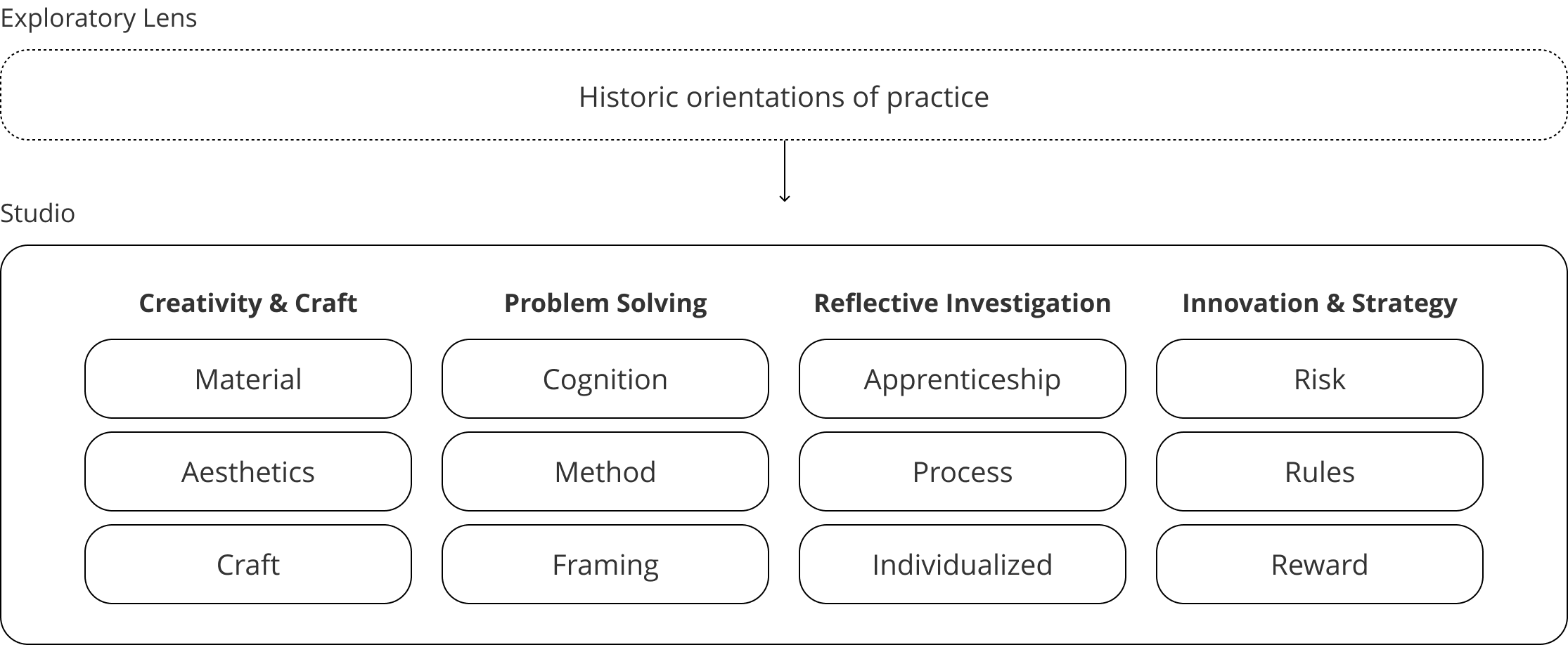
I have described that an orientation of practice that emphasizes form, craft, and materiality is commonly found in schools of art and design, as with the spread of Bauhaus-inspired approaches into the curriculum at Pratt. When oriented around problem-solving, schools like Carnegie Mellon emerge with a unique combination of Simon’s positivist views and Buchanan’s perspective of design as a liberal art, where Buchanan ran Carnegie Mellon’s School of Design during Simon’s tenure at CMU’s School of Computer Science. Institutions like The Open University in the UK—where Cross taught for much of his career—advance views of design as a unique way of thinking. Design as a reflective practice is pervasive at most art and design schools, while the orientation of design thinking has been championed at schools with intimate relationships with business, such as Stanford’s d.school.
In each case, the studio becomes a vehicle for imprinting a sort of “DNA” onto a student, one that a school has inherited, shaped, and refined into specific intellectual commitments. A student enrolling in a course of study at a school is essentially committing to a particular orientation of practice before they have even begun learning. When they select an institution, they are selecting a form of studio practice centered around a way of working and a way of being.
Demeanors and goals of criticism
Art and design education have a shared practice called critique. This practice is considered a fundamental part of learning to be a practitioner, on equal footing with the acquisition of technical skills. Some scholars feel that critique isn’t just an isolated practice; instead, it defines the entire educational experience, where “the tradition of ongoing and reciprocal performance punctuated by criticism is so central to the pedagogy of the design studio that it is not considered assessment at all. Rather, it is the essence of instruction” (Cossentino, 2002, p. 44)Cossentino, J., 2002. Importing Artistry: further lessons from the design studio. Reflective Practice, 3(1), pp. 39-52.—it is the “active pedagogy of the studio” (Hokanson, 2012, p. 74)Hokanson, B., 2012. The Design Critique as a Model for Distributed Learning. In: The Next Generation of Distance Education. Boston: Springer, pp. 71-82.. This may be because, as Fleming (1998, p. 45)Fleming, D., 1998. Design Talk: Constructing The Object in Studio Conversations. Design Issues, 14(2), pp. 41-62. has noted, crits are “often the only contact the students have with their professor once the course has begun.”
In this section, I will examine critique as a form of idea development, a style of identity formation, and a reinforcing mechanism for maintaining history and established ideology. These are demeanors of critique: the postures or dispositions of the instructor and how these influence the critique experience. Instructors differ in how they engage in critique with students; they hold different dispositions about how critique shows up in their studio.
Scholarly research describes several unique demeanors of critique. These include:
- Encouraging shared inquiry, where a balance of Socratic and collaborative discussion leads to growth.
- Demonstrating skills, where a professor models a corrective behavior or approach in real-time.
- Providing expert judgement, where a professor takes a declarative stance directed towards the “right way of doing things.”
- Confrontation, where critique is blunt and direct in order to reinforce urgency or power.
Each of these demeanors is explored below.
Shared inquiry
A shared critique is a conversational studio experience where meaning is negotiated, ideas are explored, and learning emerges through back-and-forth exchange. In this form of critique, the professor’s role is to question, probe, compare, and provoke discussion. Rather than declaring judgements, the professor asks why a student made a choice, what alternatives they considered, or how the work might be understood differently. This has been described as an improvisational mode of coaching—teaching as improvisation, where the critic says “yes, and…” to extend a student’s reasoning or deliberately breaks the fourth wall to redirect their thinking (Adams, et al., 2017)Adams, R., Forin, T. R. & Joslyn, C. H., 2017. Approaches to Coaching Students in Design Reviews. Columbus, American Society For Engineering Education..
Students in these shared, exploratory, and dialogue-centric critiques are positioned as co-participants. They are expected to articulate intentions, respond to questions, and give room to changing their opinions and reasoning, in real time. This isn’t just with a professor; peer critique functions in this way: students test ideas, negotiate interpretations, and learn to balance subjectivity and objectivity within the context of their unique worldview (Gray, 2013). Inquiry may also take the form of structured debate, with students actively arguing strengths and weaknesses in their peers’ work. This debate framing is felt to minimize defensiveness, offset tension, and reduce embarrassment in responding to negative comments (Crolla, et al., 2019)Crolla, K., Hodgson, P. & Ho, A. W. Y., 2019. ‘Peer Critique’ in Debate: A pedagogical tool for teaching Architectural Design Studio. International Journal for the Scholarship of Teaching and Learning, Volume 13..
The mechanics of inquiry-based critique vary. They can occur at a student’s desk, in instructor-to-student discussions, or in small groups. Critique often includes comparative discussions in which a professor highlights a problem, establishes a framework for interpreting it critically, applies that framework to the student’s work, and then relates it to a real-world example—“reanimating” the student’s work in the process (Murphy, et al., 2012, p. 537)Murphy, K. M., Ivarsson, J. & Lymer, G., 2012. Embodied reasoning in architectural critique. Design Studies, Volume 33, p. 530–556.. This style is critique as collaboration, emphasizing values of trust, specificity, and integrity as conditions for genuine dialogue and describing critique as a “generous and generative collaborative practice” (Forlano & Smith, 2018, p. 295)Forlano, L. & Smith, S., 2018. Critique as collaboration in design anthropology. Journal of Business Anthropology, Volume 7, p. 279–300..
Inquiry-based critique is valuable because it builds critical evaluation and communication skills alongside design skills. Students learn not just what to change but how to reason about change. Critique socializes students into disciplinary communication practices—managing interaction, demonstrating design evolution, and advocating intent (Dannels, et al., 2008)Dannels, D. P., Housley Gaffney, A. & Norris Martin, K., 2008. Beyond Content, Deeper Than Delivery: What Critique Feedback Reveals About Communication Expectations in Design Education. International Journal for the Scholarship of Teaching and Learning, Volume 2, p. Article 12.. Sawyer’s (2017)Sawyer, R. K., 2017. Teaching creativity in art and design studio classes: A systematic literature review. Educational Research Review, Volume 22, pp. 99-113. systematic review of studio pedagogy reinforces the point: exploratory, improvisational teaching is one of the defining features of creative learning environments, balancing open-ended inquiry with structure.
Dialogue requires trust and time, both of which are often scarce in studio settings. Faculty may intend conversation but slip back into monologue, dominating the discussion despite their intentions (Goldschmidt, et al., 2010, p. 300)Goldschmidt, G., Hochman, H. & Dafni, I., 2010. The design studio "crit": Teacher–student communication. Artificial Intelligence for Engineering Design, Analysis and Manufacturing, Volume 24, p. 285–302.. Students may also find shared inquiry frustrating when they desire clarity or objectivity, perceiving open-ended and Socratic feedback as evasive, pedantic, or contradictory (Blair, 2007, p. 86)Blair, B., 2007. At the end of a huge crit in the summer, it was crap I’d worked really hard but all she said was fine and I was gutted. Art Design & Communication in Higher Education, Volume 5, p. 83–95.. Dialogue can also privilege articulate or confident students, leaving quieter students marginalized. And it assumes students already know how to contribute meaningfully; peer critique is often expected to help socialize students into professional norms (Healy, 2016, p. 7)Healy, J. P., 2016. The components of the "crit" in art and design education. DOAJ: Directory of Open Access Journals., yet others question this assumption, pointing out that students often lack the skills of argumentation or the grounding in ideology and history to make their contributions valuable (Percy, 2004, p. 147)Percy, C., 2004. Critical absence versus critical engagement: Problematics of the crit in design learning and teaching. Art Design & Communication in Higher Education, Volume 2, p. 143–154..
A shared-inquiry style of critique is one of the most generative styles of design pedagogy. It aligns with contemporary emphases on reflective practice, peer learning, equitable learning experiences, and safe spaces for growth. This type of critique is often intended to foster a sense of community among students. Because much of design education occurs in the only semi-private spaces of the studio, critique serves as one of the most visible collective practices. Its function is not only about working with one individual student, but also about strengthening the bonds of a learning cohort through collective or simultaneous learning.
Through critique, students see how their peers approach problems, and ideally, they learn to work collaboratively rather than competitively. As a ritual, critique signals that students are all “on the same team,” and while students are pursuing their own independent growth, it gives a sense of a shared outcome. Community-oriented critique also creates opportunities for students to learn how to work through disagreement in a constructive way, watching others negotiate feedback and participating themselves.
Curiously, provoking disagreement and differences is a positive way of encouraging growth and community development; Forlano and Smith (2018, p. 285)Forlano, L. & Smith, S., 2018. Critique as collaboration in design anthropology. Journal of Business Anthropology, Volume 7, p. 279–300. note that “it is important to give participants opportunities to disagree with one another.” If students trust one another, it’s reasonable that disagreement will be perceived with positive intent and taken at face value, rather than being interpreted as holding hidden meaning.
Cennamo (2014)Cennamo, K. & Brandt, C., 2012. The "right kind of telling": Knowledge building in the academic design studio. Educational Technology Research and Development, Volume 60, p. 839–858. characterizes the most unique aspect of studio culture as one of a pursuit of idea refinement, which is fostered by a desire for criticism and a democratic perspective of idea ownership. This means that the way someone else worked through a problem is a shared resource: critique offers a chance for students to learn and borrow from approach and output. Following Brown & Robinson’s (2007)Brown, G., 2009. Claiming A Corner At Work: Measuring Employee Territoriality In Their Workspaces. Journal of Environmental Psychology, 29(1), pp. 44-52. investigation into territoriality, it is likely that students will initially experience infringement over ideas, and so a goal of critique may be to proactively establish an atmosphere of ownership-free idea generation.
Demonstration
In a demonstration-based critique, dialogue is grounded in a process of modeling: the professor shows what to do, and the student learns by observing, doing, and being corrected in real time. This approach is professor-centric, but also heavily emphasizes artifacts, as the thing being made becomes a central focus. The professor in a tangible critique like this takes on the role of master craftsperson. This is cognitive apprenticeship, where the professor articulates, models, and critiques (Adams, et al., 2017)Adams, R., Forin, T. R. & Joslyn, C. H., 2017. Approaches to Coaching Students in Design Reviews. Columbus, American Society For Engineering Education.. They may correct a student’s work by literally drawing over it. Professional designers who teach often rely on this way of teaching, building on their own practices to exemplify how design gets done in a real job context (Sawyer, 2017, p. 107)Sawyer, R. K., 2017. Teaching creativity in art and design studio classes: A systematic literature review. Educational Research Review, Volume 22, pp. 99-113..
Demonstration critiques are often side-by-side, informal, held at a student’s desk or computer, and occur during a project. Hokanson (2012, pp. 78-79)Hokanson, B., 2012. The Design Critique as a Model for Distributed Learning. In: The Next Generation of Distance Education. Boston: Springer, pp. 71-82. describes this as an “intense personal engagement” and that, because a studio is an open environment, other students who overhear the demonstration occurring are “developing an understanding of the value of critique through incidental learning.”
Demonstration-based critique remains one of the most recognizable forms in design education—it is the popular culture view of an art school education, appearing from the outside to be poorly structured, as no lecture is occurring and few students are quietly taking notes. It is one of the closest remaining models of a master/apprentice approach to learning, at scale. The role of the student is to watch closely, to imitate, and to internalize the moves demonstrated by the instructor. Students in desk demonstration crits absorb the “teacher as coach” mode, where correction dominates (Goldschmidt, et al., 2010, p. 286)Goldschmidt, G., Hochman, H. & Dafni, I., 2010. The design studio "crit": Teacher–student communication. Artificial Intelligence for Engineering Design, Analysis and Manufacturing, Volume 24, p. 285–302.. Students may feel reassured, because the path forward is shown rather than left ambiguous. They can see the expert at work, and this makes expectations tangible. The value of demonstration-based critique is in making tacit knowledge visible, which may be difficult or impossible for an expert to describe rather than show.
One of the most widely assumed goals of critique is to help students make better work, refine their craft, and develop more thoughtful or effective processes. While some of the more confrontational and aggressive forms of critique attract attention, Cennamo and Brandt’s (2012)Cennamo, K., 2014. In Education We All Want To Be Nice: Lessons Learned From A Multidisciplinary Design Studio. In: Design in Educational Technology. Cham: Springer, pp. 57-73. research showed that “project critiques, instead of being merciless, provided key opportunities for students to learn the knowledge, skills, and attitudes of a design discipline.” With a focus on improvement of project work, critique can draw focus to what is effective or ineffective in a student’s artifact and offer suggestions for revision. Students likely respond positively when feedback is actionable, when it points to something concrete that can be changed, rather than when it is vague or taste-driven.
When critique is aimed more at improving craft rather than improving an artifact, it recognizes that individual projects are simply means toward larger learning ends. Design educators typically aren’t encouraging students to make one thing (only toasters) or one type of thing (only kitchen appliances); instead, they are trying to teach students a way of working across content. This means they need to develop skills, processes, and methods that can be learned specifically, but evolved to become patterned and broadly applicable. Critique, in the context of improving the maturity of a student’s abilities, is about developing transferable practices.
But this form of critique introduces learning challenges, too. Students may copy without understanding, and because this approach relies so much on instructor skills, they may end up duplicating poor examples and adopting poor practice, particularly if the professor is not current with methodology or skilled in practice. Demonstration-based teaching must balance showing with encouraging independent exploration, or this form of critique may train technical skills but not larger strategic or critical thinking. And as demonstration-based critique is frequently conducted in a close, intimate setting, it demands respect, trust, specificity, clarity, insight, and integrity (Forlano & Smith, 2018, p. 284)Forlano, L. & Smith, S., 2018. Critique as collaboration in design anthropology. Journal of Business Anthropology, Volume 7, p. 279–300.. If that trust was never formed, a demonstration-based critique may quickly turn defensive.
Expert judgement
A critique demeanor that likely is confusing for students who emerge from a traditional secondary school, where grading is thought to be about being correct or incorrect, is one based on expert judgement, where the professor’s role is that of master and the professor delivers assertions about what is good or bad.
The professor speaks from a position of expertise, assessing quality and projecting a sense of responsibility to maintain disciplinary standards. The assumption of mastery may not be accurate, as not all professors are practicing designers or architects. They may claim mastery of teaching, but not of the act of designing itself. But even in these cases, the professor is positioned as an autocratic source of truth.
For students, this expert-oriented critique can feel both clarifying and disempowering. Students may appreciate the decisiveness of declarative feedback, seeking objective and clarifying criticism in what is often an ambiguous creative context. But expert-led critique can position students as passive receivers of knowledge who simply listen, take notes, and accept judgements without debate. Students develop coping strategies in response: over-preparing, listening passively, and agreeing with comments they may not fully understand (Webster, 2007, p. 24)Webster, H., 2007. The Analytics of Power. Journal of Architectural Education, Volume 60, p. 21–27.. This reinforces their position as receivers of knowledge rather than active participants in shaping it, leaving “little space for students to communicate through critique” (Gray, 2013, p. 196)Gray, C. M., 2013. Informal peer critique and the negotiation of habitus in a design studio. Art Design & Communication in Higher Education, Volume 12, p. 195–209.. Even pedagogical models often cited as progressive reinforce the imbalance. Schön’s reflective practice described previously, for instance, is criticized for case studies where the professor primarily disseminates knowledge one way (Mewburn, 2012)Mewburn, I., 2012. Lost in translation: Reconsidering reflective practice and design studio pedagogy. Arts and Humanities in Higher Education, Volume 11, p. 363–379.. Similarly, there is “little evidence of students being taught the skills of critical reflection and argument,” which leaves student comments ignored (Percy, 2004, p. 147)Percy, C., 2004. Critical absence versus critical engagement: Problematics of the crit in design learning and teaching. Art Design & Communication in Higher Education, Volume 2, p. 143–154..
Mechanically, expert-led critique is often conducted in large groups with work pinned to the wall. In larger settings, many students sit in the background—sometimes unable to see what is being discussed—and remain disengaged, while the professor speaks with little interruption (Blair, 2007, p. 84)Blair, B., 2007. At the end of a huge crit in the summer, it was crap I’d worked really hard but all she said was fine and I was gutted. Art Design & Communication in Higher Education, Volume 5, p. 83–95.. Such critiques tend to be held at key moments of assessment (such as midpoint milestones or at the end of a project), and their efficacy depends heavily on the personality and communicative ability of the teacher (Goldschmidt, et al., 2010)Goldschmidt, G., Hochman, H. & Dafni, I., 2010. The design studio "crit": Teacher–student communication. Artificial Intelligence for Engineering Design, Analysis and Manufacturing, Volume 24, p. 285–302.. Authoritative critiques also often mix formative and summative goals, simultaneously guiding and evaluating in ways that confuse students about purpose (Healy, 2016)Healy, J. P., 2016. The components of the "crit" in art and design education. DOAJ: Directory of Open Access Journals..
The value of an expert judgement critique lies in its efficiency and potential for clarity. It allows experienced practitioners to transmit knowledge quickly, to model standards, and to ensure that students are exposed to professional norms. When time is limited, or when students need to become “unblocked,” authority can provide decisive guidance. It can also lend a sense of seriousness to the studio: what the professor says carries weight, and students may feel more motivated to align their work with professional expectations. And when a professor is familiar with the hiring expectations of industry, career-minded students will likely value this expert judgement, as it gestures towards job readiness.
However, this form of critique privileges the professor’s voice over the student’s. It provides a monologue rather than encourages dialogue, where judgements are framed as objective but rest on subjective criteria such as whether work is “interesting” or “compelling” (Blair, 2007, p. 84; Orr & Bloxham, 2012, p. 236). The persistence of this model reflects its familiarity to other forms of teaching, such as traditional lectures, and its assumption that the professor’s role is to “know” while the student’s role is to “learn.” As a style of critique, it highlights the tension between disciplinary authority and the pedagogical need for students to find their own voices within that authority.
Dannels et al. (2008)Dannels, D. P., Housley Gaffney, A. & Norris Martin, K., 2008. Beyond Content, Deeper Than Delivery: What Critique Feedback Reveals About Communication Expectations in Design Education. International Journal for the Scholarship of Teaching and Learning, Volume 2, p. Article 12. recorded an extensive number of video recordings of student critiques at various academic levels and design disciplines; they captured between 9 and 12 critiques in each of five studios, of 2 to 4 hours each, and then transcribed and analyzed a subset of the data. They observed that faculty may not be aware of the lasting aspect of their words, and call for teachers “to consider carefully, reflectively and perhaps strategically, the broader implications of what we say when students speak” (p. 12)Dannels, D. P., Housley Gaffney, A. & Norris Martin, K., 2008. Beyond Content, Deeper Than Delivery: What Critique Feedback Reveals About Communication Expectations in Design Education. International Journal for the Scholarship of Teaching and Learning, Volume 2, p. Article 12.. The public and intense nature of the critique may lead to negative sentiment, which causes a student to shut down (Al Maani & Roberts, 2023)Al Maani, D. & Roberts, J. A., 2023. An attempt to understand the design studio as a distinctive pedagogical setting. The International Journal of Design Education, Volume 17, p. 31–44..
Often, this form of critique also acts as formalized grading. Here, critique is primarily about evaluating what a student has designed or, more rarely, their ability to design. As Healy (2016, p. 5) notes, end-of-project critiques are more formal and “focus more on product or outcome as opposed to process.” At that stage, the educational value is limited because students may be too fatigued to integrate feedback, or the project may already be concluded. Artifact-based assessment shifts a burden of translation to a student: they must find ways to translate points of criticism from one artifact and project to their next, which requires fairly significant styles of abstraction and pattern building.
Formal grading systems tend to overemphasize end results rather than the creative process that leads to them. Al Maani & Roberts (2023, p. 37)Al Maani, D. & Roberts, J. A., 2023. An attempt to understand the design studio as a distinctive pedagogical setting. The International Journal of Design Education, Volume 17, p. 31–44. note that grading may negatively impact learning, as a studio overemphasizes the end output rather than the creative process that led to it. The artifact becomes a proxy for learning, obscuring the iterative experimentation and risk-taking that are central to design practice. Students are often rewarded for completion rather than exploration and reflection.
Orr & Bloxham (2012, p. 248)Orr, S. & Bloxham, S., 2012. Making judgements about students making work: Lecturers’ assessment practices in art and design. Arts and Humanities in Higher Education, December, 12(2-3), pp. 234-253. call this an assessment dilemma. Quality in design, they argue, is best understood through the journey of a student over time—the evolving relationship between student, work, and process—rather than through a single output. Yet process-based evaluation is difficult to standardize; they explain that “this fuzziness is relatively uncontentious in the field of art and design but is more problematic for those who may be seeking total transparency” (p. 249)Orr, S. & Bloxham, S., 2012. Making judgements about students making work: Lecturers’ assessment practices in art and design. Arts and Humanities in Higher Education, December, 12(2-3), pp. 234-253.. Blair (2007, p. 83)Blair, B., 2007. At the end of a huge crit in the summer, it was crap I’d worked really hard but all she said was fine and I was gutted. Art Design & Communication in Higher Education, Volume 5, p. 83–95. agrees, noting that design critique is “the main formal point for formative assessment… [it] cannot be prescriptive. There is no one right answer, known final destination or conclusion to a given problem or project.”
Many professors leverage critique as the only site of assessment, offering “no standardized test at the end of the semester” (Shaffer, 2007, p. 120)Shaffer, D. W., 2007. Learning in design. In: Foundations for the future in mathematics education. s.l.:Erlbaum, pp. 99-126.. Large-group critique acts as a form of customized or personalized assessment, but in public; it is common for a professor to invite other professors or working practitioners to participate in the critique. They may instruct these guests on the assessment criteria, and may distribute grading forms for reviewers to use. Yet Webster (2006, p. 15)Webster, H., 2006. A Foucauldian look at the Design Jury. Art, Design & Communication in Higher Education, 5(1), pp. 5-19. describes how reviewers in these public critiques, even when given assessment forms with “so-called objective” outcomes, largely ignored them. “The official aims failed to acknowledge the inherent complexities involved in talking about levels of objective achievement when the definition of what is and is not architecture is a contested concept.” In practice, aesthetic preferences dominated, and “harsh epithets” were common, producing emotionally charged reactions among students. Some students, however, learned to adapt—to “align the presentation of themselves and their work with the paradigm of the atelier” (Webster, 2006, p. 17)Webster, H., 2006. A Foucauldian look at the Design Jury. Art, Design & Communication in Higher Education, 5(1), pp. 5-19..
Goldschmid, et al. (2010, p. 285)Goldschmidt, G., Hochman, H. & Dafni, I., 2010. The design studio "crit": Teacher–student communication. Artificial Intelligence for Engineering Design, Analysis and Manufacturing, Volume 24, p. 285–302. observe that crits “are of great importance to students who are eager to be positively assessed by their teachers and therefore listen carefully to their comments and suggestions.” Blair (2007, p. 86)Blair, B., 2007. At the end of a huge crit in the summer, it was crap I’d worked really hard but all she said was fine and I was gutted. Art Design & Communication in Higher Education, Volume 5, p. 83–95. found that students prefer “straightforward, honest, constructive feedback given in a clear objective way.” They seek affirmation, but also concrete, actionable guidance. Crolla et al. (2019, p. 4)Crolla, K., Hodgson, P. & Ho, A. W. Y., 2019. ‘Peer Critique’ in Debate: A pedagogical tool for teaching Architectural Design Studio. International Journal for the Scholarship of Teaching and Learning, Volume 13. suggest that reframing critique as a debate—where comments balance “potential and limitations” rather than assigning quantitative scores—may offer a more acceptable model for students, allowing assessment to function as dialogue rather than verdict.
When assessment is formalized with both rubrics and critique, the translation between critique and grade becomes confusing for students. They often find the final grade misaligned with the verbal feedback they received during critique. Williams, Ostwald, and Askland (2010, p. 135)Williams, A., Ostwald, M. & Askland, H. H., 2010. The Design Studio, Models of Creativity and the Education of Future Designers. Aarhus, DESIRE Network., pp. 131-137. note that grading, particularly when expert panels are brought in, can occur with “no preset criteria and that rely on the assessors’ implicit understanding of the task at hand and of creativity.”
A rubric-based assessment can, theoretically, reassure a student that it is their work and not themselves that is being judged, and can offer the clarity they are looking for. The use of a rubric signals professionalism and impartiality, embedding design education in broader academic systems of grading, accreditation, and accountability. For institutions, objectivity is essential, because standards must be seen as transparent, equitable, and reproducible, even in creative fields.
Healy (2016, p. 7)Healy, J. P., 2016. The components of the "crit" in art and design education. DOAJ: Directory of Open Access Journals. argues that feedback is most effective when it is “clear, actionable… that they can implement in the next phase of their project or in future projects.” Yet institutional expectations of rigor and fairness often push toward rubric-based systems that imply objectivity. For students, such systems can be reassuring: they signal professionalism and ensure that it is the work, not the person, being judged. Feedback framed in terms of external conventions—“this drawing is not in perspective,” or “this interface violates accessibility standards”—is more actionable and less personal than being told that work is “uninspired” or “weak.” Students often ask for feedback that feels “straightforward, honest, [and] constructive” (Blair, 2007, p. 86). When assessment can point to agreed-upon standards, it positions critique as a tool for learning rather than as an arbitrary judgement.
But much of design is subjective, and translating a professor’s observations into a grade is never straightforward. The “translation” from what is said in critique to the score that appears on a transcript is often disappointing or confusing to students. Williams, Ostwald, and Askland (2010)Williams, A., Ostwald, M. & Askland, H. H., 2010. The Design Studio, Models of Creativity and the Education of Future Designers. Aarhus, DESIRE Network., pp. 131-137. argue that in practice, student work is graded without criteria, and Orr and Bloxham (2012) show that many artists and designers see their fields as un-assessable, due to their subjectivity.
Rubrics and learning outcomes may be used to clarify expectations, but many instructors find them reductive. Sawyer (1997, p. 109)Shaffer, D. W., 1997. Design, Collaboration and Computation: The Design Studio as a Model for Computer Supported Collaboration in Mathematics. Toronto, Ontario Institute for Studies in Education, pp. 249-255. observes that instructors have “complex feelings” about rubrics: they may be useful but fail to capture the “richness” of a student’s work and growth.
Burgess and Burgess (2020)Burgess, A. & Burgess, L., 2020. Social Class and Art & Design Education: A Significant Omission. In: Debates in Art and Design Education. London: Routledge. indicate that a rubric-style assessment culture also makes it more difficult for faculty to take risks in their classroom. They argue that “the current neoliberal education system, with its emphasis on standards [and] assessment… has led to teaching to the test and prescribed pedagogies—which can be seen to privilege fixed knowledge, conformity, and conservatism” (p. 174)Burgess, A. & Burgess, L., 2020. Social Class and Art & Design Education: A Significant Omission. In: Debates in Art and Design Education. London: Routledge.. This, in turn, causes art and design educators to “resist creative risk-taking and ‘disobedient pedagogies’ which embrace a ‘non-compliance that opens up new ways of thinking and acting.’” These educators encourage different forms of self-expression in the art and design work itself, but not in the ways in which students learn.
Confrontation
The lore of critique is often grounded in the confrontational crit, where the professor and invited practitioners establish a presence of a true “critic”—someone to challenge and point out things that are flawed. This tests the student’s capacity to defend their ideas, or even ignores the student as a relevant participant entirely. A professor may feel a sense of duty in this role, believing that design students must develop resilience to thrive in the professional world; they may even repeat the adversarial modes they themselves experienced, seeing them as authentic to the discipline.
Students, however, consistently feel this differently. This form of critique is not viewed positively by students, who describe it as high-stress and “nerve-wracking” and recall all-night preparation that left them too tired and anxious to absorb feedback. They feel that confrontational critiques do not result in actionable feedback; instead of learning how to improve their work, they learn only that it is bad. This highlights the subjectivity of taste, likely privileging the professor’s own preferences. Scholars frame this as an exercise of disciplinary power rather than teaching: the crit produces subjects who accept professional authority (Webster, 2007, p. 21)Webster, H., 2007. The Analytics of Power. Journal of Architectural Education, Volume 60, p. 21–27.. Adversarial discussion may disengage weaker students, who perceive the attack as confirmation of failure (Blair, 2007)Blair, B., 2007. At the end of a huge crit in the summer, it was crap I’d worked really hard but all she said was fine and I was gutted. Art Design & Communication in Higher Education, Volume 5, p. 83–95.. Even stronger students may come away from the experience confused by conflicting criticism. In a survey by Sara and Parnell (2013, p. 113)Sara, R. & Parnell, R., 2013. Fear and learning in the architectural crit. Field, Volume 5, p. 101–126., students valued critique in principle, but remembered fear and humiliation in practice, suggesting that adversarial critique undermines the learning it intends to enable. They also pointed to educators themselves as a problem, who may change their opinions to match that of an invited guest, act unengaged, interrupt, show a lack of respect, and show a lack of understanding.
Fine (2018, p. 113)Fine, G. A., 2018. Talking Art: The Culture of Practice and the Practice of Culture in MFA Education. Chicago: University of Chicago Press. explains that, in the confrontational critiques he observed, “students are encouraged to be authentic and dramatic, and deviance is tolerated.” This creates a tenuous presentation of self, where “fear and anxiety are magnified… especially given the public humiliation of critiques” (p. 114)Fine, G. A., 2018. Talking Art: The Culture of Practice and the Practice of Culture in MFA Education. Chicago: University of Chicago Press.. These critiques are constant and evaluation is continuous and often negative, as “one is haunted by failure, and some students are judged as failures.” Anxiety in a studio is high, and anxieties “are intensified immediately before critiques… stress is common… failure is not merely technical, but a failure of self.”
Advocates for a confrontational approach might argue that critique should be preparation for the realities of professional practice, where clients and stakeholders may not be kind or thoughtful in delivering their opinions. This confrontational style has been framed as building strength in preparation for the “real, harsh world of the consultancy or corporation. In these environments, clients and creative directors pull no punches, and there's rarely time for sugarcoated feedback” (Kolko, 2011)Kolko, J., 2011. Endless nights: learning from design studio critique. Interactions Magazine, 18(2), pp. 80-81.. It forces students to defend their work under pressure, to withstand scrutiny, and to respond to hostility. Through conflict may come resolution, which can improve creative output.
Undergraduate design education is increasingly aimed at preparing students for careers, and critique is often positioned as a rehearsal space for professional practice. In this framing, the goal is not simply to improve a project but to help students acquire the habits, skills, and dispositions needed to function as professional designers. Healy (2016, p. 7)Healy, J. P., 2016. The components of the "crit" in art and design education. DOAJ: Directory of Open Access Journals. views that "students providing feedback to their peers is a key aspect in the development of professional norms that are expected of design graduates," and providing feedback, and handling feedback, becomes a central focus of a critique intended to help students become professionals. Students learn to handle the mechanics of critique in ways that mirror professional workflows: clearly describing the problem they are trying to solve, taking notes, asking clarifying questions, and avoiding unproductive argument. They also learn that they don’t actually have to implement every piece of feedback, and it may be important to show that they have listened and that others have been heard.
Professionalism also includes the language and demeanor of creative practice. Critique helps students learn how to talk about design work, to use (or avoid the use of) discipline-specific vocabulary, and to frame creative choices with confidence. Students learn to treat their work not as a precious artifact but as something always open to revision. They also learn how to deliver constructive criticism, how to accept it, and how to participate in conflict productively rather than defensively.
Critique also prepares students for the political dimensions of creative practice. In professional settings, ideas rarely succeed on their merits alone; they must be presented, defended, and socialized among diverse stakeholders. Critique offers a space to practice telling the story of a design. Students learn to view presentation as a form of influence: controlling a room, soliciting opinions selectively, shaping perceptions, and slowly guiding others to integrate new ideas into their worldviews. These rhetorical and political skills are learned, not innate, and critique provides a place to rehearse them.
This preparation for the “real world” sometimes runs into the realities of the increasingly political academy, as the modern university focuses on "quality assurance standards for teaching and learning," and values the emotional satisfaction of students. Students feel stressed when they receive subjective feedback, and since creativity is viewed as overly subjective, the design studio concept is challenged, as it now "emphasizes quality assurance, transparency, and objectivity" (Williams, et al., 2010, p. 136)Williams, A., Ostwald, M. & Askland, H. H., 2010. The Design Studio, Models of Creativity and the Education of Future Designers. Aarhus, DESIRE Network., pp. 131-137.. When studio education is treated transactionally, it becomes more difficult to prepare students for the often irrational nature of professional practice.
This form of critique persists because it is woven into the traditions of design education and because it aligns with cultural narratives of toughness, authenticity, and professional initiation. It can create strong memories for students who experience it; faculty draw on their own experiences, as they “have been initiated themselves” (Fine, 2018, p. 140)Fine, G. A., 2018. Talking Art: The Culture of Practice and the Practice of Culture in MFA Education. Chicago: University of Chicago Press.. But more often it serves to alienate, silence, or harm. As a style of critique, it reveals the problem of nostalgia at the heart of historical pedagogy: the desire to induct students into the discipline’s ways of knowing and the temptation to exercise authority through confrontation. Some have gone as far as to call critique a highly emotionally charged pedagogical approach to teaching and learning that may not actually be effective at all (Webster, 2006)Webster, H., 2006. A Foucauldian look at the Design Jury. Art, Design & Communication in Higher Education, 5(1), pp. 5-19..
Summary
Critique has been described in scholarly literature as a large part of design studio, and has even been equated to design studio. There are a variety of demeanors to critique; these range from inquiry and demonstration to confrontation and judgement. These demeanors are in service to goals of critique, which include helping students improve their work and their skills, building a sense of community and trust among a cohort of students, and preparing students for the direct, less supportive “real world” of design practice:
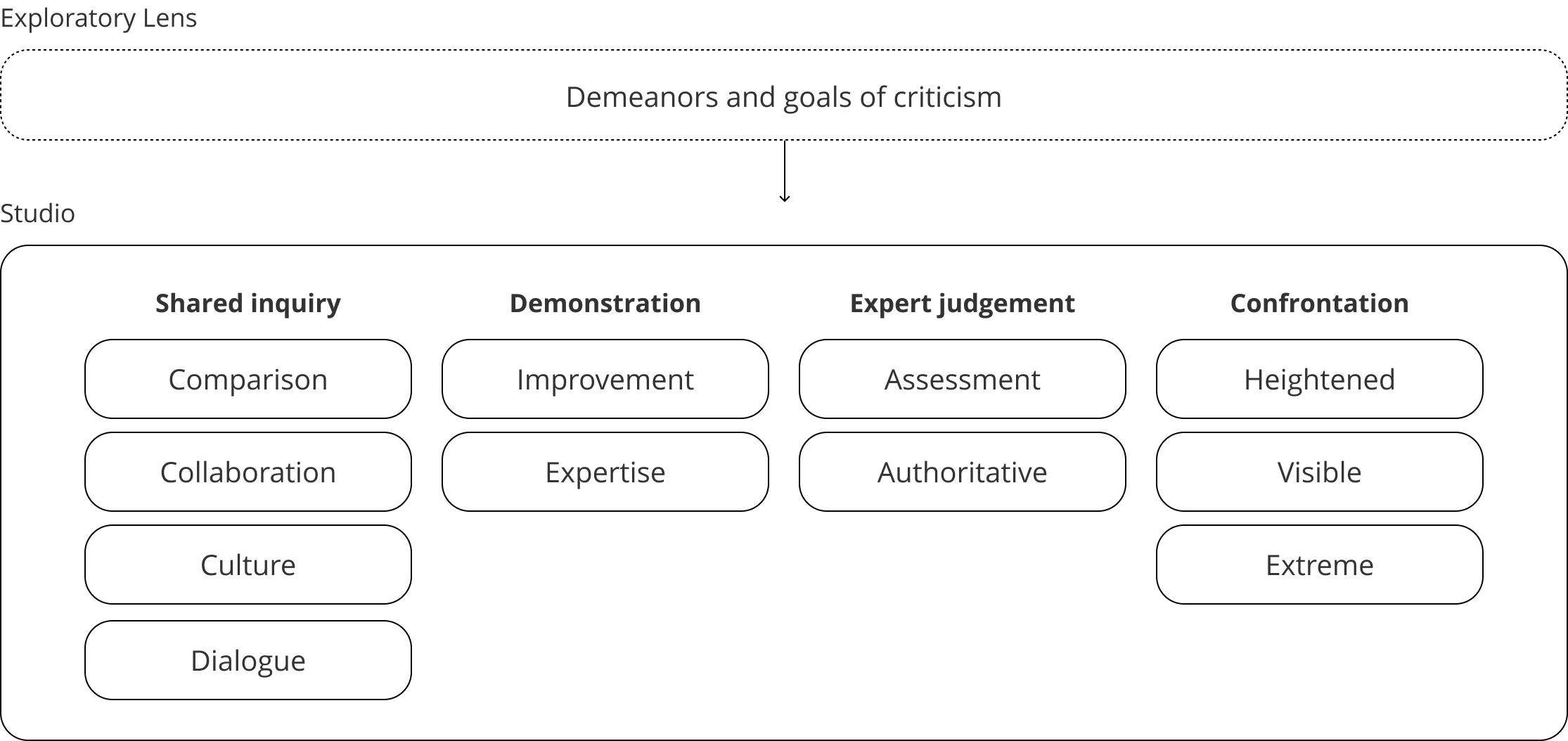
The demeanors and goals of criticism described provide the way a professor and a student experience critique. Often, argues Sara and Parnell (2013, p. 122)Sara, R. & Parnell, R., 2013. Fear and learning in the architectural crit. Field, Volume 5, p. 101–126., the nature of the crit is unclear to both faculty and students, as "the crit commonly appears to be trying to be all things to all people, rarely being particularly successful in any one aspect of learning." Above, the approaches to critique have been described discretely; in practice, they may blend, not always intentionally.
Place, space and privacy
Studio is a place negotiated around a set of attributes. These include physical space, community, collaboration, and creative externalization, and as these qualities intermingle, studio becomes a place that challenges views of privacy as a static and purposefully determined set of boundaries. In this section, I will show that, when taken as a whole, studio is a backdrop for a constant struggle over creative privacy, a place where the lines between privacy and the publicness of creativity are poorly delineated and continually in flux.
Presence in a unique space
One of the most immediate signals that studio is unique, and comes with unique expectations, is that it has a unique physical footprint. Thoring et al. (2018)Thoring, K., Desmet, P. & Badke-Schaub, P., 2018. Creative Environments For Design Education And Practice: A Typology Of Creative Spaces. Design Studies, Volume 56, pp. 54-83. identify several distinct spatial archetypes within studio education, many of which are not typically found in a university classroom or lecture hall. Personal spaces allow for heads-down focus. This often occurs at a dedicated workspace, rather than a small desk that might be found in a lecture hall. Collaboration spaces afford dialogue and shared work. These may be large working tables or desks pushed together. Presentation spaces structure the one-directional exchange of critique or instruction. These often take the form of a pin-up-style wall or a more traditional digital projection. Making spaces support hands-on experimentation, noise, and mess, and these are often the most iconic elements of a studio environment. Intermission spaces—corridors, stairwells, kitchens—enable informal social interaction.
None of these spaces are lecture spaces, with rows of seats aimed at the front of the room. Many of these spatial architectures are open and dynamic, and an educational design studio often looks more like a messy open-plan modern office than a place of learning. This type of messy studio signals that it is where designing should take place. Studio as a differentiated way of working becomes even more noticeable to students when they are given, at least temporarily, their own desk: a dedicated, delineated part of the room that they can use for the duration of a project or semester. It is at these desks that a great deal of in-class learning happens. The main educational activities of critique and shared making that were previously described happen in the studio, not in a separate classroom. Research into educational design studios has generally focused on the interaction between a professor and a student, emphasizing the nature of a desk crit, and positioning instructors as the driving force for learning; Corazzo (2022, p. 2)Corazzo, J. & Gharib, L., 2021. Everyday Routines and Material Practices in the Design Studio: Why Informal Pedagogy Matters. Design and Technology Education: An International Journal, 26(4), pp. 144-164. notes in his literature review of studio that “many of these studies focus on the interactions between tutors and students… the sheer volume suggests that researchers believe these interactions are critical to how students learn to design.”
The spatial dimension of the studio reinforces this climate of trust and close learning: social reasoning and the reanimation work described earlier are happening one-on-one with a student, but is in the larger context of the public, shared space of studio, where other students are free to listen. The pedagogy of studio is not defined solely by its problem-solving orientation or its use of critique, but by the relationship between space, collaboration, and creative emergence. Studio-centric teaching and learning occur in the interplay between physical setting and social practice, where ideas can be generated, discussed, and ignored without fear. Cennamo (2014, p. 71)Cennamo, K. & Brandt, C., 2012. The "right kind of telling": Knowledge building in the academic design studio. Educational Technology Research and Development, Volume 60, p. 839–858. captures this nuance by proposing that educators “can work to establish social norms that value generating and discarding ideas freely.”
The studio’s physical differences from a traditional classroom signal both creative freedom and very little hierarchy. For example, a studio often has no clear front, which challenges the conventional alignment of power between instructor and student. Spatial design implies behavior, as a room’s organization suggests expected conduct, and its qualities reflect institutional culture. As Thoring et al. (2018, p. 64)Thoring, K., Desmet, P. & Badke-Schaub, P., 2018. Creative Environments For Design Education And Practice: A Typology Of Creative Spaces. Design Studies, Volume 56, pp. 54-83. note, the unique creative physical environment of studio acts as “a source of stimulation,” shaping not only what students learn but how they think about learning itself.
Students, then, work at their own desks in close proximity with their instructors; students and instructors collaborate to solve problems that are specific to a given student and that student’s work. This creative intimacy occurs in an open environment, and this is evidence of “a shift from learning as an individual cognitive activity… towards a socially distributed activity” (Corazzo, 2022, p. 3)Corazzo, J. & Gharib, L., 2021. Everyday Routines and Material Practices in the Design Studio: Why Informal Pedagogy Matters. Design and Technology Education: An International Journal, 26(4), pp. 144-164.. Studio is an open room, and students hear the discussions. Cennamo & Brandt (2012, p. 849)Cennamo, K., 2014. In Education We All Want To Be Nice: Lessons Learned From A Multidisciplinary Design Studio. In: Design in Educational Technology. Cham: Springer, pp. 57-73. describe how students engage in “listening-in,” observing one-on-one work-based discussions between peers and instructors. This practice allows students to gather feedback indirectly, broadening their understanding of what constitutes effective work and how evaluative dialogue unfolds.
Collaboration and competition within a cohort
Listening in is one reason that faculty encourage students to “work in the studio, rather than at home” (Brandt, et al., 2013, p. 3)Brandt, C. et al., 2013. A theoretical framework for the studio as a learning environment. International Journal of Technology and Design Education, Volume 23, pp. 329-348.; instructors feel the sense of proximity offers a number of additional benefits as well. Jones (2022, p. 9)Jones, D., 2022. Exploring Studio Proximities: Space, Time, Being. Bilbao, Design Research Society. distinguishes between proximity and physical nearness, describing semi-proximate studio environments as those that “depend on arranged or semi-formal local organization.” Proximity, he suggests, is relational rather than physical and is constructed through patterns of interaction and degrees of access. Presence, for Jones, requires commitment beyond physical attendance. “Being present is to be engaged cognitively, emotionally, and/or bodily in space and time” (Jones, 2022, p. 13)Jones, D., 2022. Exploring Studio Proximities: Space, Time, Being. Bilbao, Design Research Society.. Engagement can shift among these dimensions, and students may inhabit presence differently across moments of work. Studio encourages this by supporting alternative modes of participation—observation, listening, making, reflecting—that expand what counts as being there.
Faculty want students to be present in the studio, but students experience studio space without necessarily understanding how to use it beyond the work that occurs in class. Modell and Gray (2011)Modell, M. G. & Gray, C. M., 2011. Searching For Personal Territory In A Human-Computer Interaction Design Studio. Journal for Education in the Built Environment, 6(2), pp. 54-78. conducted an exploratory case study of a design studio space for students in a graduate design program, analyzing their use of the studio space over six weeks. They observed that an absence of explicit instruction means that students must learn through observation, imitation, and experimentation how to inhabit a studio as a workspace and a cultural space. Corazzo (2019, p. 1249)Corazzo, J., 2019. Materialising the studio: A systematic review of the role of the material space of the studio in Art, Design and Architecture Education. The Design Journal, Volume 22, p. 1249–1265. conducted an analysis of 38 empirical research studies in art and design, where in each, “some attention to the material space formed part of the study.” He concluded that the studio is “a space of ambiguity with few actual clues to expected behaviors,” which must therefore be “made coherent by the tutor,” but if that coherence isn’t provided, students must learn when to speak, where to sit, and how to occupy the space (p. 1257)Corazzo, J., 2019. Materialising the studio: A systematic review of the role of the material space of the studio in Art, Design and Architecture Education. The Design Journal, Volume 22, p. 1249–1265..
Students may find themselves unsure about how to engage with studio. Williams (2017, p. 93)Williams, J., 2017. Design Studio: A Community Of Practitioners?. Charette, 4(1), pp. 88-100. identified through their research a unique quality of how students experience studio. Students “held in tension two often conflicting desires: to create an equipped space of creative potential, free from practical and time constraints; and the need to work or simply ‘be’ in the presence of others.” Instructors work aggressively to foster both at once, and one way they try to make the space coherent is through a studio culture of community. That is in part established by a consistent cohort of students. In a cohort, students work with the same small set of peers for the duration of their multi-year course of study, and, often, with the same faculty as well (Loy & Ancher, 2013)Loy, J. & Ancher, S., 2013. Creative Camaraderie: Promoting A Shared Design Culture For Staff And Students. Dublin, Griffith University, pp. 550-555.. Camaraderie can emerge from extended and trusting collaboration, with a goal of locking in a sense of belonging and the pursuit of shared goals.
The group climate of a cohort depends on trust. Climate, in the sense of studio learning, refers to the collective conditions that enable students to pursue challenging work with confidence in one another. Climate frames a space where ideas are treated seriously, where team members feel heard, and where high standards coexist with psychological safety. Cennamo (2014)Cennamo, K. & Brandt, C., 2012. The "right kind of telling": Knowledge building in the academic design studio. Educational Technology Research and Development, Volume 60, p. 839–858. describes this climate as involving criticality, comparison of ideas, intrinsic motivation, and beneficial competition.
Trust allows for both openness and rigor, ensuring that critique and collaboration occur in a spirit of shared purpose rather than judgement. When trust is established, students are more willing to let ideas circulate freely. In research with industrial design students, Cennamo (2014)Cennamo, K. & Brandt, C., 2012. The "right kind of telling": Knowledge building in the academic design studio. Educational Technology Research and Development, Volume 60, p. 839–858. observed that they had become familiar with the particular climate and processes of studio, while students in other disciplines—such as education—had not. When students from these two groups worked together, the difference led to mutual misunderstanding. The education students, who had very little experience in studio, were surprised when the design students received negative criticism after spending so much time producing something creative, and even more surprised when, following the critique, “the students simply resumed work reconceptualizing the project” (p. 60)Cennamo, K. & Brandt, C., 2012. The "right kind of telling": Knowledge building in the academic design studio. Educational Technology Research and Development, Volume 60, p. 839–858.. For the industrial designers, ongoing discussion was not a formal event but “an expected and desired way of working in a studio.” In contrast, the education students viewed these discussions as confrontational.
Group work can deepen that sense of community. Working in a group allows students to try out ideas with peers and to gather immediate, frequent, and unfiltered criticism on their projects. Over time, “strong cohesion among students and a sense of responsibility for one another over years of collegial enterprise” (Hill, 2016, p. 305)Hill, G., 2016. Drawn together: student views of group work in design studio. Journal of Architectural and Planning Research, 33(4), pp. 293-308. can create an environment of trust. This peer-based trust changes the structure of learning, offering “a difference in structure than the normal asymmetrical power relation between student and teacher” (p. 301)Hill, G., 2016. Drawn together: student views of group work in design studio. Journal of Architectural and Planning Research, 33(4), pp. 293-308.. Being in the same space provides students with a way to learn from one another. Iterations—creating another version of a design—are “only good so far as they function in terms of eliciting feedback from peers” (Brandt, et al., 2013, p. 3)Brandt, C. et al., 2013. A theoretical framework for the studio as a learning environment. International Journal of Technology and Design Education, Volume 23, pp. 329-348.. Their work is externalized and acts as a public audit trail, visible to all other students. “What has been a very private process for the student is made public” (p. 4)Brandt, C. et al., 2013. A theoretical framework for the studio as a learning environment. International Journal of Technology and Design Education, Volume 23, pp. 329-348., which leads to students gaining greater self-awareness of who they are as designers.
For some, the design studio functions as a space of friendship and mutual care. Because studio education is known to be demanding and time-intensive, students spend long hours together in close quarters, often late into the night. This extended proximity fosters both social connection and shared purpose. As Broadhead (2018, p. 17)Broadhead, S. J., 2018. Friendship, Discourse And Belonging In The Studio: The Experiences Of 'Non-Traditional' Students In Design Higher Education. In: Continuity and Discontinuity in Learning Careers. s.l.:Brill, pp. 17-28. describes, “virtuous acts of friendship” become a fundamental part of the communal experience of studio, with studio friendships influencing the development of creative virtuosity. Some students actively seek feedback as a way of escaping what Svensson & Edström (2011, p. 10)Svensson, L. & Edström, A.-M., 2011. The Function Of Art Students' Use Of Studio Conversations In Relation To Their Art Work. International Journal of Education & the Arts, 12(5). describe as “solitary studio work” that can feel isolating or demoralizing. The studio is recognized as a social space, where socializing between students is viewed as essential to the learning process. McDonald et al. (2018)McDonald, J. K., Rich, P. J. & Gubler, N. B., 2018. The perceived value of informal, peer critique in the instructional design studio. TechTrends, Volume 63, p. 149–159. note that students identify social interaction as one of the most important benefits of this form of teaching and learning. Fine (2018, p. 168)Fine, G. A., 2018. Talking Art: The Culture of Practice and the Practice of Culture in MFA Education. Chicago: University of Chicago Press. observed that “it is the cohort that counts.” Students work through their educational experience with the same group of peers, and some consider this to be the cornerstone of a creative education. It is intimate, and faculty work to establish that intimacy; “building a culture of commitment is central to graduate student life, and as a result, art school permits many forms of intimacy” (p. 169)Fine, G. A., 2018. Talking Art: The Culture of Practice and the Practice of Culture in MFA Education. Chicago: University of Chicago Press.. Some of this comes from the amount of work students have to do and the limited time they have to spend on it. “Students often work late, hanging out together and commiserating… a sense exists that students share a common fate.”
Rosa and Ferreira (2023)Rosa, C. & Ferreira, J., 2023. The distant studio: a survey of design students’ experience with distance educational formats. International Journal of Technology and Design Education, Volume 33, p. 2019–2043. echo the concept of shared rhythms that rely on the close physical proximity of the studio. The authors describe the results of a study that focuses on student sentiment related to online versus in-person design education. The study indicates that design students prefer in-person formats, and one of the reasons is related to the culture of studio that emerges. Students “wander the room, talk to each other, listen to music, and make the space their own,” and this relies heavily on “different types of oral communication” (p. 2206)Rosa, C. & Ferreira, J., 2023. The distant studio: a survey of design students’ experience with distance educational formats. International Journal of Technology and Design Education, Volume 33, p. 2019–2043..
A loss of cohort structure, due to student conflicts, short-term program structures, or staggered enrollment pacing, can weaken this sense of connection. Loy & Ancher (2013)Loy, J. & Ancher, S., 2013. Creative Camaraderie: Promoting A Shared Design Culture For Staff And Students. Dublin, Griffith University, pp. 550-555. point to several factors—budget constraints, modular and customizable curricula, and reliance on part-time faculty—that make cohort-based learning less common. These conditions “develop a lack of cohesive identity for the cohort” (p. 551)Loy, J. & Ancher, S., 2013. Creative Camaraderie: Promoting A Shared Design Culture For Staff And Students. Dublin, Griffith University, pp. 550-555.. Without a shared identity, both students and faculty experience reduced motivation, increased isolation, and a loss of “an overtly expressed shared vision that all are committed to.” The authors propose that studio pedagogy should be developed collaboratively with students to counteract or prevent this loss. A shared vision of the curriculum should be co-created and made visible to all participants, communicating the “ethos of the programme [and] its scope and intent” (p. 551)Loy, J. & Ancher, S., 2013. Creative Camaraderie: Promoting A Shared Design Culture For Staff And Students. Dublin, Griffith University, pp. 550-555.. When students help define the values and goals of the program, they also strengthen their identification with it.
Collaboration is evident in the way students discuss each other’s work. McDonald et al. (2018, p. 154)McDonald, J. K., Rich, P. J. & Gubler, N. B., 2018. The perceived value of informal, peer critique in the instructional design studio. TechTrends, Volume 63, p. 149–159. found that, for newer students, “their greatest perceived benefit was the concern [that fellow student] reviewers showed for their learning.” This concern took the form of individualized attention and new perspectives. Beginning students “enjoyed working with reviewers who were in similar situations to themselves” and gained introspection into their working habits, especially related to time management; the “enthusiasm and interest that advanced students showed helped build confidence in the beginners, which was at least as important (if not more so) than the actual substance of the feedback that was given” (McDonald, et al., 2018, p. 154)McDonald, J. K., Rich, P. J. & Gubler, N. B., 2018. The perceived value of informal, peer critique in the instructional design studio. TechTrends, Volume 63, p. 149–159.. This informal exchange created a sense of belonging and affirmation within the cohort, and Forlano & Smith (2018, p. 288)Forlano, L. & Smith, S., 2018. Critique as collaboration in design anthropology. Journal of Business Anthropology, Volume 7, p. 279–300. note that one of the most important conditions for that collaboration is “access to physical studio space and desk space for informal critiques.”
Students in design studios continually compare themselves to one another. A comparative studio is, as Corazzo & Gharib (2021, p. 152)Corazzo, J., 2022. Studio Through Studio: a diffractive reading of the educational design studio. Bilbao, Design Research Society. describe, “used by students to benchmark themselves against their peers and observe each other’s workings.” Dannels (2005, p. 151)Dannels, D. P., 2005. Performing tribal rituals: A genre analysis of "crits" in design studios. Communication Education, Volume 54, p. 136–160. observes that studio is about “noticing other students’ work,” and comparative discussion plays a role in helping one student see how their work is progressing relative to that of another student. Each student’s progress becomes part of a shared reference system through which others learn. These comparisons are often informal and peer-driven, allowing students to calibrate their progress and understand quality through observation. Because the professor-as-judge is not present during hours spent in the studio, this kind of comparison is described as relatively low-risk. This comparison is a form of reflection, and, for most students, occurs at a time in their lives where they “establish new identities and when peer groups exert particular influence and are motivated to comply with group norms” (Ashton & Durling, 2000, p. 4)Ashton, P. & Durling, D., 2000. Doing the right thing. Social processes in design learning. The Design Journal, 3(2), pp. 3-14.. While students may enter school with an expectation that there is a right answer to a design problem, the “right thing” in a social group is created by the group’s dynamics. This is a social reality, and students “establish correctness by discovering what the shared understanding of right and wrong is in that particular context” (Ashton & Durling, 2000, p. 5)Ashton, P. & Durling, D., 2000. Doing the right thing. Social processes in design learning. The Design Journal, 3(2), pp. 3-14..
Creativity in public
As students gain confidence going to studio, the space of studio begins to act as a backdrop for a form of shared creative exploration. Radzikowska et al (2019, p. 2)Radzikowska, M., Ruecker, S. & Roberts-Smith, J., 2019. Forget To Clean Up When You're Done.. Ankara, s.n. argue that “Design studios require information permanence” and call spaces that support this “manifest spaces.” Students leverage these manifest spaces; they make their work visible by pinning it to walls, spreading it across tables, and displaying it in progress. These actions show a sense of progression, shape the dynamic of the studio, build shared ownership of space, and reveal both individual and shared processes. The space is material; the walls have images, sketches, and other content, and it may “appear slightly chaotic to an outsider” (Fallman, 2007, p. 5)Fallman, D., 2007. Supporting Studio Culture in Design Research. s.l., s.n.. Material artifacts such as sketches and models take on multiple roles. They are “coordinative artifacts,” objects that hold and transfer meaning and “translate certain intangible work practices into more visible work information” (Vyas, et al., 2013, p. 415)Vyas, D., van der Veer, G. & Nijholt, A., 2013. Creative practices in the design studio culture: Collaboration and communication. Cognition, Technology and Work, Volume 15, pp. 415-443.. The studio provides that context: it is a “visually rich ecology” that serves as both organizational memory and distributed cognition. Vyas et al. describe these artifacts as one of the richest means for engaging with collaborative work, indicating that “use of artefacts can be seen as externalization of thoughts, ideas, and concepts” (p. 421)Vyas, D., van der Veer, G. & Nijholt, A., 2013. Creative practices in the design studio culture: Collaboration and communication. Cognition, Technology and Work, Volume 15, pp. 415-443..
These artifacts exist within a designed environment that supports social and cognitive activity. Studio space provides artful surfaces—surfaces that “designers create by externalizing their work-related activities, to be able to effectively support their everyday ways of working” (Vyas, et al., 2013, p. 429)Vyas, D., van der Veer, G. & Nijholt, A., 2013. Creative practices in the design studio culture: Collaboration and communication. Cognition, Technology and Work, Volume 15, pp. 415-443.. These are not display surfaces in a traditional gallery sense but tools that track design thinking. They allow designers to visualize the history of their decisions, see current trajectories, and immerse themselves in a problem. These surfaces are used to orient design activities to a present moment, acting as planning tools, and often serve as evidence of design choices that have already been made; they provide a “cognitive benefit to students being able to pick up where they left off quickly and efficiently” (Radzikowska, et al., 2019, p. 6)Radzikowska, M., Ruecker, S. & Roberts-Smith, J., 2019. Forget To Clean Up When You're Done.. Ankara, s.n..
Artful surfaces also prevent ideas from disappearing within the complexity of studio work. As Vyas et al. (2013, p. 430)Vyas, D., van der Veer, G. & Nijholt, A., 2013. Creative practices in the design studio culture: Collaboration and communication. Cognition, Technology and Work, Volume 15, pp. 415-443. observe, “even a slight or unintended change can lead to problems in their design practices and in some cases once a design artifact is lost from the ‘sights’ of designers, it would eventually mean that the design artifact may never be retrieved again.” By maintaining visibility, designers and instructors can “fly through” the evolving body of work and understand its current state at a glance. These visual surfaces act as a form of externalized memory that allows teams to organize and reflect collectively; they act as an audit trail of the work history (Brandt, et al., 2013)Brandt, C. et al., 2013. A theoretical framework for the studio as a learning environment. International Journal of Technology and Design Education, Volume 23, pp. 329-348..
The wall itself becomes an instrument of communication. Dannels (2005, p. 147)Dannels, D. P., 2005. Performing tribal rituals: A genre analysis of "crits" in design studios. Communication Education, Volume 54, p. 136–160. identifies two defining elements of studio teaching: the wall as a “commanding force” and the feedback that follows from audience engagement. The wall functions as a focusing surface upon which presentation, reflection, and critique occur. Students must “establish a connection between the wall, themselves, and the audience,” highlighting the interplay between visual and verbal modes of expression. Faculty emphasize that students must learn to offer criticism and to “propel forward thinking about a design project” (pp. 147-148)Dannels, D. P., 2005. Performing tribal rituals: A genre analysis of "crits" in design studios. Communication Education, Volume 54, p. 136–160..
Challenges to space use
While instructors view presence, space, community, cohort, collaboration, and comparison as fundamentals to studio learning, there are practical constraints that challenge these pedagogical foundations. Studio requires a large architectural infrastructure, and as universities grow and budgets tighten, space is at a premium, and dedicated work areas for each student are no longer feasible. Research from Demirbaş and Demirkan (2000)Demirkan, H. & Demirbas, O. O., 2000. Privacy dimensions: A case study in the interior architecture design studio. Journal of Environmental Psychology, 20(1). shows how the use of externalized sketching requires dedicated physical space, and the administrative demand for efficiency of use conflicts with the pedagogical need for immersion. Cennamo and Brandt (2012, p. 840)Cennamo, K., 2014. In Education We All Want To Be Nice: Lessons Learned From A Multidisciplinary Design Studio. In: Design in Educational Technology. Cham: Springer, pp. 57-73. describe that some of the problems of implementing a studio approach to education are that studio approaches are “resource intensive, requiring dedicated studio space, large blocks of class time within a student's course of study, and extensive faculty time.”
As a consequence, some schools can’t offer dedicated space and require students to be more flexible in where and how they work. Cai & Khan (2010)Cai, H. & Khan, S., 2010. The Common First Year Studio In A Hot-Desking Age: An Explorative Study On The Studio Environment And Learning. Journal for Education in the Built Environment, 5(2), pp. 39-64. describe how, in many contemporary settings, students share a studio space; they have no dedicated area and cannot establish permanent territory or ‘ownership’ over a space. The result is a form of “nomadic” studio use, analogous to corporate “hot desking,” where the utilization of space becomes temporary and fluid.
Student-to-student encounters are central to studio, encouraging spontaneous dialogue and peer critique (Corazzo, 2019)Corazzo, J., 2019. Materialising the studio: A systematic review of the role of the material space of the studio in Art, Design and Architecture Education. The Design Journal, Volume 22, p. 1249–1265.. Cennamo and Brandt (2012, p. 841)Cennamo, K., 2014. In Education We All Want To Be Nice: Lessons Learned From A Multidisciplinary Design Studio. In: Design in Educational Technology. Cham: Springer, pp. 57-73. emphasize that “the unplanned interactions that occurred within open studio hours were especially important in moving students’ ideas forward when they were stuck.” Arvola and Artman (2008)Arvola, M. & Artman, H., 2008. Studio life: The construction of digital design competence. Nordic Journal of Digital Literacy, 3(2). find that without access to other students in the studio space, students struggle to try out design decisions prior to a more formal classroom interaction with a professor.
The idea of “studio nomadism,” then, has value. Behavioral mapping of studio use shows that open-plan, non-territorial configurations “allow students to be exposed to different neighbours’ work and interact with more peers… the nomadic style of studio use increases the chances of encounters and interactions between students” (Cai & Khan, 2010, p. 58)Cai, H. & Khan, S., 2010. The Common First Year Studio In A Hot-Desking Age: An Explorative Study On The Studio Environment And Learning. Journal for Education in the Built Environment, 5(2), pp. 39-64.. Without fixed seating or personal zones, students move through a constantly shifting social landscape, broadening their access to different perspectives and practices. In this sense, the lack of territory can foster a kind of distributed learning community, encouraging serendipity and exchange; while claimed territory may strengthen belonging, it might also limit the ability for new relationships to grow.
Space may also be forfeited in favor of online learning, which some instructors feel is at odds with the essence of studio pedagogy. Rosa & Ferreira (2023, p. 2022)Rosa, C. & Ferreira, J., 2023. The distant studio: a survey of design students’ experience with distance educational formats. International Journal of Technology and Design Education, Volume 33, p. 2019–2043. argue that “there seems to be a built-in inconsistency between distance learning formats and the design studio.” They note that “distance educational formats are generally considered as effective as in-person educational settings” for knowledge dissemination, but further argue that design learning is not a form of knowledge transfer and viewing it as such is “an extraordinarily reductionist view of education” (p. 2023)Rosa, C. & Ferreira, J., 2023. The distant studio: a survey of design students’ experience with distance educational formats. International Journal of Technology and Design Education, Volume 33, p. 2019–2043.. Studio is about many things, but simply moving knowledge from one person to another is not part of the learning approach and does not offer educative value in design. Their research indicates that “[design] students prefer synchronous in-person educational environments,” and as students grow into designers and learn what it means to design, this need for in-person presence increases. They conclude that if a design course were required to move entirely into a distance learning setting, it would need to be “predicated on different educational foundations… a new proposal of what a design course is and how it operates” (p. 2040)Rosa, C. & Ferreira, J., 2023. The distant studio: a survey of design students’ experience with distance educational formats. International Journal of Technology and Design Education, Volume 33, p. 2019–2043..
Demands for territory
Faculty, then, work to introduce the pedagogical intent of studio, framing studio as a communal, social, and public place; they feel that studio experiences must occur in person, because, as Orr and Shreeve (2018, p. 90)Orr, S. & Shreeve, A., 2018. Art and Design Pedagogy in Higher Education: Knowledge, values and ambiguity in the creative curriculum. New York: Routledge. assert, “ideally the studio is an active, busy and social place where learning is visible and open to discussion through active participation.” Yet as students co-construct studio, they begin to show territoriality, or “a feeling of ownership over physical or social entities in a workplace” (Modell & Gray, 2011, p. 57)Modell, M. G. & Gray, C. M., 2011. Searching For Personal Territory In A Human-Computer Interaction Design Studio. Journal for Education in the Built Environment, 6(2), pp. 54-78..
A student has a desk; they are told it is their desk, they can put their things on it, and they have an expectation of security (that their items won’t be stolen, for example). Following Brown (2009, p. 6)Brown, G. & Robinson, S. L., 2007. The dysfunction of territoriality in organizations. In: Research companion to the dysfunctional workplace: Management challenges and symptoms. s.l.:Edward Elgar Publishing, pp. 252-267., students start to regulate their studio privacy by marking their spaces with symbols that communicate ownership or identity. The things on their desks, and the work on their walls, help them organize their environment, and even while not explicitly establishing privacy, this serves to “fulfill the need to have a sense of place.” This behavior is a psychological expression of ownership, and “identity-oriented marking serves the function of enabling individuals to construct and express their identities to themselves and to others through the ownership of things at work” (Brown & Robinson, 2007)Brown, G., 2009. Claiming A Corner At Work: Measuring Employee Territoriality In Their Workspaces. Journal of Environmental Psychology, 29(1), pp. 44-52.. It is a way for students to establish a sense of control over a space that is otherwise, purposefully, confusing. Vinsel et al (1980, p. 1104)Vinsel, A., Brown, B. B., Altman, I. & Foss, C., 1980. Privacy regulation, territorial displays, and effectiveness of individual functioning. Journal of Personality and Social Psychology, 39(6), pp. 1104-1115. describe that “territorial behavior” serves two functions: “(a) communication of personal identity, whereby people display their personalities, values, and beliefs on the physical environment and (b) regulation of social interactions, which is achieved by control of spatial areas and objects.” Strong students develop strategies for being public only on their terms, and are able to establish avoidance techniques that they can deploy selectively.
A studio often functions as what Corazzo and Gharib (2021, p. 156)Corazzo, J., 2022. Studio Through Studio: a diffractive reading of the educational design studio. Bilbao, Design Research Society. call a “basecamp, a place where [students] bring and leave things, a place where they will set up camp.” Part of this camping is a further delineation of territory. Brown (2009, p. 4)Brown, G. & Robinson, S. L., 2007. The dysfunction of territoriality in organizations. In: Research companion to the dysfunctional workplace: Management challenges and symptoms. s.l.:Edward Elgar Publishing, pp. 252-267. describes these territorial behaviors as communal rather than personal, noting that they “are not simply about expressing ownership over an object (this is mine), but are centrally concerned with establishing, communicating, and maintaining one’s relationship with that object relative to others in the social environment (this is mine and not yours).” Cai and Khan (2010, p. 59)Cai, H. & Khan, S., 2010. The Common First Year Studio In A Hot-Desking Age: An Explorative Study On The Studio Environment And Learning. Journal for Education in the Built Environment, 5(2), pp. 39-64. argue that, for beginning students in particular, territoriality related to “mine and not yours” supports development of confidence in sharing: “it is rather important to be surrounded by their best work, as the first-year studio is a process of building the ‘toolkits’ or professional skills and languages, and their design confidence.” Without dedicated space, students lose the continuity that helps them trace their own progress over time. Territory externalizes learning, as it becomes a spatial archive of effort, reflection, and growth.
Students want to be public only on their own terms, but faculty want students to be public. Corazzo (2020, p. 7)Corazzo, J., 2020. In The Midst Of Things: A Spatial Account Of Teaching In The Design Studio. Lisbon, Taylor & Francis, pp. 93-100. describes how the physical organization of space—what is visible and who can close themselves off—becomes an “ongoing, but subtle, tussle” between students and faculty, where faculty find themselves ‘literally ceding ground to [students].’” Faculty may recognize that territoriality can extend beyond a need for space, and intrude into ownership of ideas. Brown and Robinson (2007, p. 9)Brown, G., 2009. Claiming A Corner At Work: Measuring Employee Territoriality In Their Workspaces. Journal of Environmental Psychology, 29(1), pp. 44-52. argue that “products of the mind… are intimately known to the creators, and their source is clear.” Students may hide these creations of the mind—their design ideas—and a “resistance to sharing may be stronger when one feels others are demanding it.” Feelings of territoriality are related to the creative efforts involved in generating a new idea, and “to the extent that we are more tied to our own ideas and creations, we are less willing to take on and endorse others’ ideas, even if they may be superior.”
As a result, these spaces may be framed to students as being their own, but faculty view them as part of a larger shared territory. Personal spaces, such as desks, come with an expectation of safety, but only limited privacy; they are not offices, with walls and a closing door, but are instead positioned in an open floor plan and in close proximity to one another. The sense of privacy is intertwined with the expectation that students should continually be displaying their work output in their space, and that display is public. Instructors want students to learn from one another, and to emulate work ethic as related to creative output, where producing more artifacts equate to being a better student.
Modell and Gray (2011)Modell, M. G. & Gray, C. M., 2011. Searching For Personal Territory In A Human-Computer Interaction Design Studio. Journal for Education in the Built Environment, 6(2), pp. 54-78. gathered data related to this territoriality in a number of ways, including interviews with two faculty members, observation of students in the space, and interviews with students. They describe this as a “naturalistic case study,” where “the researchers observed behaviors in person in their natural environment” (p. 60)Modell, M. G. & Gray, C. M., 2011. Searching For Personal Territory In A Human-Computer Interaction Design Studio. Journal for Education in the Built Environment, 6(2), pp. 54-78.. One of the first findings of this case study was the misalignment between the design intent of the space and the actual usage of the space. The faculty envisioned the studio as a “very messy place” (p. 65)Modell, M. G. & Gray, C. M., 2011. Searching For Personal Territory In A Human-Computer Interaction Design Studio. Journal for Education in the Built Environment, 6(2), pp. 54-78. where students work continuously, much like a traditional design studio; the research, however, showed that neither of those things were happening. This may be because there was no dedicated storage for students, or because there were no encultured expectations set about the use of the space, and so it “defaulted” to being used as a traditional coworking-style office. One faculty member indicated that the space had not been incorporated intentionally in the actual coursework. The space was clean and tidy, and showed no real creative embodiment, and so it did not achieve the public and always-in-use style.
In a studio environment, professors work individually with each student; this format is “atypical in comparison to more conventional classroom settings” (Hill, 2007, p. 39)Hill, C. C., 2007. Climate in the Interior Design Studio: Implications for Design Education. Journal of Interior Design, 33(2), pp. 37-52.. As a result, “camaraderie [between students] is curtailed to some degree by the fact that student achievement is based on the student’s independent performance and creativity.” This impacts the atmosphere of the studio, and that atmosphere in turn impacts the students and the experience they have.
The negotiation of territory has implications beyond the space itself. Vinsel et al. (1980)Vinsel, A., Brown, B. B., Altman, I. & Foss, C., 1980. Privacy regulation, territorial displays, and effectiveness of individual functioning. Journal of Personality and Social Psychology, 39(6), pp. 1104-1115. describe that students who had more control over privacy were less likely to drop out of university, indicating that the public creativity of a design studio potentially has negative implications on student performance, if not addressed through other mechanisms. The value of public designing and learning—impromptu critique, peripheral participation, comparison—may be at odds with the value of feeling “in control.” And as a student can experience infringement over ideas themselves, design studio pedagogy needs to proactively establish a sense of ownership-free idea generation, something that is likely at odds with creative identity development.
All of this points to a view of studio privacy and territory marking as an embodied and enacted cultural practice that, among other things, signals participation in the studio cohort and an understanding and respect for unique studio norms and group expectations; it is not a technical attribute as much as an underpinning to how students understand and negotiate their engagement with studio culture and other students (and faculty), and how they then contribute to building and refining that community. The act of pinning up work follows Dourish and Bell (2014, p. 139)Dourish, P. & Bell, G., 2014. Divining a digital future: Mess and Mythology in Ubiquitous Computing. Cambridge: MIT Press., who describe that information sharing is a “means of cultural production, a way in which people engage in meaningful social interaction and negotiation of collective meaning.” Referencing Melican and Faulkner, the authors offer a hierarchical view of privacy, moving from content and preference (as most “classified”) through profiling information, consumption patterns, and then friends and family. At stake in the hierarchy is “reputation, trust, and identity politics” (p. 150)Dourish, P. & Bell, G., 2014. Divining a digital future: Mess and Mythology in Ubiquitous Computing. Cambridge: MIT Press.. When students select what to pin up in public, their selection is “not a purely rational or objective process but rather reflects cultural, political, and moral judgements… different social collectives will have different interpretations of risk depending on their position relative to the social structures that might be in question” (p. 151)Dourish, P. & Bell, G., 2014. Divining a digital future: Mess and Mythology in Ubiquitous Computing. Cambridge: MIT Press.. Design studio culture defines the risk of publicness, and in doing so also defines acceptable and unacceptable behavior. The definition is collective, and is “continually reproduced in everyday social behavior” (p. 153)Dourish, P. & Bell, G., 2014. Divining a digital future: Mess and Mythology in Ubiquitous Computing. Cambridge: MIT Press..
When viewed as emergent, territory and privacy in studio—and the simultaneous encouragement from faculty to be public and a personal desire to remain private—enacts a shared culture of capitulation. Sharing some design work while keeping other artifacts secret manages and shows group membership; the boundaries around membership, and the adherence to those boundaries through selective sharing “simultaneously cement a bond between those who share them while marking their differences from those with whom the secrets are not shared” (Dourish & Bell, 2014, p. 154)Dourish, P. & Bell, G., 2014. Divining a digital future: Mess and Mythology in Ubiquitous Computing. Cambridge: MIT Press.. Flow of information within a studio reinforces these boundaries and exclusivity in participation; “secrets are used to reinforce and rebel against authority relationships.”
Perhaps more important than the content of the sketches and design work itself is the understanding of how to manage that information: what is considered socially acceptable to share within the studio, and by an underlying set of assumptions about how students will react to the work. Showing work is risky, and being urged by a power figure to be public is a form of indoctrination to a group; “normative information practices define and mark group membership” (Dourish & Bell, 2014, p. 156)Dourish, P. & Bell, G., 2014. Divining a digital future: Mess and Mythology in Ubiquitous Computing. Cambridge: MIT Press.. The idea of privacy in studio is more about accountability than about the risks and rewards of hiding things, and faculty hope it is driven less by the fear of being exposed and more about the realization that “professional designers” act and live publicly.
Studio can be thought of as a place where creative privacy is negotiated. The negotiation occurs at a meaningful time in a student’s educational experience, because studio emerges as a construct where students begin to feel like designers. After recording and analyzing 110 hours of video footage showing students interacting with instructors, Brandt et al. (2013, p. 8)Brandt, C. et al., 2013. A theoretical framework for the studio as a learning environment. International Journal of Technology and Design Education, Volume 23, pp. 329-348. observed that as “students took on increasingly more complex design problems, there was a palpable shift in the ways they positioned themselves as more knowledgeable and [as] identifying as ‘designers.’”
Studio “serves as a bridge between academic and professional communities” (Brandt, et al., 2013, p. 8)Brandt, C. et al., 2013. A theoretical framework for the studio as a learning environment. International Journal of Technology and Design Education, Volume 23, pp. 329-348.. This is an experience that is not yet part of gaining peripheral participation, but is also not a simple duplication of a real-world studio environment. Faculty “broker” interactions between academic studio and the formation of a designerly identity, slowly “making explicit tacit rules of design practice for students” (p. 10)Brandt, C. et al., 2013. A theoretical framework for the studio as a learning environment. International Journal of Technology and Design Education, Volume 23, pp. 329-348.; in scholarly research, it is argued that “the educational studio’s primary aim is to make disciplinary identities” (Corazzo, 2022, p. 13)Corazzo, J. & Gharib, L., 2021. Everyday Routines and Material Practices in the Design Studio: Why Informal Pedagogy Matters. Design and Technology Education: An International Journal, 26(4), pp. 144-164.. Fine (2018, p. 61)Fine, G. A., 2018. Talking Art: The Culture of Practice and the Practice of Culture in MFA Education. Chicago: University of Chicago Press. argues that “the spatial heart of the art world is the studio, a site of living and a place of making: a state of mind as much as a location of labor. This is ‘owned space,’ serving as one’s place in an institutional system.” This comes with a unique merging of the personal and academic, as students “slept or napped in their studios.” Some students even described living in their academic studio spaces. Administrators see messiness in studios as a justification for the provisioning of the resources themselves. Ultimately, “what [students] do with [the space] reveals their occupational identity,” or at least their developing identity.
Going to studio
When viewed through a lens of place, space, and privacy, we see that presence, cohort, collaboration, comparison, publicness and territory are all intertwined facets of going to studio. This phrase, said purposefully without an article (“the”), implies the unique nature of studio-based experience. Studio is not just a physical place to be in; it’s also a conceptual place. A place can be viewed as both a specific instance, as well as a “particular sort of place” (Dourish & Bell, 2014, p. 101)Dourish, P. & Bell, G., 2014. Divining a digital future: Mess and Mythology in Ubiquitous Computing. Cambridge: MIT Press., and studio is both a physical room as well as a set of norms, practices, and ways of being. A place is not three-dimensional; it “derives from a tension between connectedness and distinction” (Harrison & Dourish, 1996, p. 1)Harrison, S. & Dourish, P., 1996. Re-Place-ing Space: The Roles of Place and Space in Collaborative Systems. Bston, ACM, pp. 67-76. and studio has unique cultural expectations, unique behavioral approaches, and ways of being that center around that connectedness.
A place of studio has a number of distinct qualities that extend beyond physical structures. Relationship orientation and reciprocity are a shared understanding of constructs like “pinned up” or “heads down,” or the ability to reference designs vaguely, but with spatial references to the area of a student’s dedicated working space.
Place can be thought of as a space that has “something added” (Harrison & Dourish, 1996, p. 3)Harrison, S. & Dourish, P., 1996. Re-Place-ing Space: The Roles of Place and Space in Collaborative Systems. Bston, ACM, pp. 67-76., and those added elements in an educational design studio are related to the cultural conventions of making and critiquing things, social norms related to the ownership and presentation of work and self, the actual artifacts of design (such as sketches and models), and an understanding of one’s self and one’s work in relationship to that of other students. Students can claim ownership over the space of studio and turn it into a place by adapting it to their lives and making it a reflection of themselves (as in “turning a house into a home.”) Putting sketches on the wall is one way this ownership is delineated; being physically present is another. Studio emerges over time, as “space is the opportunity, and place is the understood reality” (p. 3)Harrison, S. & Dourish, P., 1996. Re-Place-ing Space: The Roles of Place and Space in Collaborative Systems. Bston, ACM, pp. 67-76..
“Being in place,” Williams explains (2017, p. 93)Williams, J., 2017. Design Studio: A Community Of Practitioners?. Charette, 4(1), pp. 88-100., “defines the various spaces that reflect and hold students’ emerging identities as practitioners.” Through embodied learning and repeated participation, design students practice becoming designers by inhabiting the social and material routines of professional life. Studio pedagogy extends beyond knowledge transmission; it is a structured environment for self-making. Corazzo (2020, p. 3)Corazzo, J., 2020. In The Midst Of Things: A Spatial Account Of Teaching In The Design Studio. Lisbon, Taylor & Francis, pp. 93-100. supports this view of studio as place; he views studio as relational—where the “social and the material are joined to form the sociomaterial” (p. 3)Corazzo, J., 2020. In The Midst Of Things: A Spatial Account Of Teaching In The Design Studio. Lisbon, Taylor & Francis, pp. 93-100.. In this view, studio functions like language or drawing, a means through which creative activity takes form and meaning. It is a technology, then, and can be “used” in the same way as a pen or piece of paper; it can also be viewed as collaborative creative infrastructure. Studio changes and is configured and reconfigured continually based on the people in it; it is a place the exemplifies Dourish & Bell’s (2014, p. 104)Dourish, P. & Bell, G., 2014. Divining a digital future: Mess and Mythology in Ubiquitous Computing. Cambridge: MIT Press. argument that “people dynamically construct collaborative encounters… spaces are inhabited. Actions are not merely ‘played out’ in space; they serve to structure and organize the space. The movements of people—the places they gather and those they avoid, the places they talk and the places they sleep—structure space; the logics of space are enacted in and through everyday life.”
Studio is a set of layered infrastructures that underpin what is happening, and what is happening is often routine; it becomes boring and regular for students. A cultural script emerges, built by and with students in the space, and so “everyday space is not experienced neutrally; it is experienced as inhabited, with all that entails” (Dourish & Bell, 2014, p. 106)Dourish, P. & Bell, G., 2014. Divining a digital future: Mess and Mythology in Ubiquitous Computing. Cambridge: MIT Press.. Because the place of studio is constructed and negotiated by those in it, entering it comes with various expectations, often unspoken. These may relate to privacy, as extensively discussed above, and these are established through social convention.
This construction means that a studio room is not a studio simply by existing, and providing students with desks does not mean they will create a place within it (or at least not as it was intended to). Behavior comes with a studio (and builds and reacts to it), and there is social meaning embedded in the studio itself. Studios are where things are made, and are also places for the social processes that are “performed” by designers, processes that “replace the larger space of the building and its users through drawings, models, and other design media that stand for the physical building” (Stults, 2009, p. 246)Stults, R., 2009. Media Space, After 20 Years. In: S. Harrison, ed. Media Space 20+ Years of Mediated Life. London: Springer, pp. 233-259.. Professional studios have a material memory about work created by designers, while educational studios have a material memory that is “focused on exemplars rather than experiments and failures” (Corazzo, 2022, p. 10)Corazzo, J. & Gharib, L., 2021. Everyday Routines and Material Practices in the Design Studio: Why Informal Pedagogy Matters. Design and Technology Education: An International Journal, 26(4), pp. 144-164.. This material memory acts in a professional environment as a “material manifest” (p. 11)Corazzo, J. & Gharib, L., 2021. Everyday Routines and Material Practices in the Design Studio: Why Informal Pedagogy Matters. Design and Technology Education: An International Journal, 26(4), pp. 144-164..
In supporting this form of studio engagement, surface structures, pedagogical activities, and epistemological understandings converge. Studio structures are the observable elements of the studio, such as the space and tools. Pedagogical activities are the things students do, while epistemological understandings describe “the beliefs about the nature of design knowledge and how it is constructed.”
Summary
Studio is a place where students learn more than just how to design. Williams (2017, p. 98)Williams, J., 2017. Design Studio: A Community Of Practitioners?. Charette, 4(1), pp. 88-100. describes studio education as “a process of self-transformation and of becoming, rather than the straightforward acquisition of knowledge.” A great part of this becoming is related to the nature of public creativity, and the studio is a dynamic and fluid place where the publicness of the process of design is continually negotiated:

Design studio is not about skill acquisition. Instead, it is about learning to be creative in public, and overcoming a need for privacy and ownership.
Time, labor and presence
Studio, with its unique qualities of time, can be viewed through a lens of time, labor, and presence, focusing on the nature of time-based expectations in the studio and how they create and distribute power. In this section, I will examine design studio through a lens of chronopolitics, or the “politics of time” that aim to regulate, synchronize, and allocate time (Esposito & Becker, 2023, p. 16)Esposito, F. & Becker, T., 2023. The Time of Politics, the Politics of Time, and Politicized Time: an Introduction to Chronopolitics. History and Theory, Volume 62, p. 3–23.. I will first describe how the time in a studio has unique rhythms, illustrating its potential as a site for institutionalized time boundaries. Next, I will describe how design education introduces a unique, abstract, and potentially unreasonable set of time-based norms, and how studio can be viewed as an indoctrination process into pride in time spent, rather than a practice of time experienced. Finally, I will investigate how an unstated asymmetrical power dynamic related to time shapes the learning experience a student has in studio.
Rhythms of studio time
Design studio operates with a sense of time that has qualities and tacit expectations more familiar to a workplace than to a traditional educational institution. Design projects are long. In an educational context, a project may span the entire quarter or semester—taking as long as sixteen weeks to complete. During a project, students work in different phases from one another: some conducting research, others sketching and drawing, and others making models or testing their ideas. Within a phase, students differ in the amount of time spent. For example, when a student is sketching to develop the form of an artifact, their final sketch likely has a specific due date, but the sketches they produce on the way to that date are largely unconstrained.
Synchronization becomes one of the most culturally significant aspects of time in structures like a studio, where it becomes obvious that work is relational and must be structured to reinforce cooperation (Fine, 1990, p. 97)Fine, G. A., 1990. Organizational Time: Temporal Demands and the Experience of Work in Restaurant Kitchens. Social Forces, 69(1), pp. 95-114.. An instructor provides scheduling guardrails for the project and identifies key milestones or deliverable dates, leaving the space in-between those milestones undefined in order to recognize the fluidity of the process of design. This is a bracketing of time, where working in a small setting that is in asynchronous motion with staggered schedules and inconsistent needs means acting with a sense of choreography. Several dimensions of temporal organization—periodicity, tempo, timing, duration, and sequence—influence how work unfolds and how it feels. The synchronization of tasks, the sequencing of actions, and the pacing of labor together form the way work is done (p. 110)Fine, G. A., 1990. Organizational Time: Temporal Demands and the Experience of Work in Restaurant Kitchens. Social Forces, 69(1), pp. 95-114..
Complicating the attempts at synchronization and choreography is the occasional, serendipitous, and unplanned nature of creativity. Amabile, et al. (2005, p. 380)Amabile, T. M., Barsade, S., Mueller, J. & Staw, B., 2005. Affect and Creativity at Work. Administrative Science Quarterly, Volume 50, pp. 367-403. describe creative thought as the act of searching for a discovery, insight, or idea, and that search takes an unknown amount of time. Some creativity theorists argue that time is necessary to activate “distal associates on the fringe of the network” (Silvia & Beaty, 2012, p. 310)Silvia, P. J. & Beaty, R. E., 2012. Why Do Ideas Get More Creative Across Time? An Executive Interpretation of the Serial Order Effect in Divergent Thinking Tasks. Psychology of Aesthetics, Creativity, and the Arts, 6(4), pp. 309-319. and executive and controlled aspects of creative thought, where idea generation and refinement strategies are purposefully selected by the person “being creative” and take time to be selected and executed. Students aren’t yet familiar with these conscious strategies for creativity, and so studio project work stretches and contracts: long, ambiguous “marinating” periods are alternated with frenzied bursts of making things, which is a rhythm that reflects what Orr and Shreeve (2018, p. 146)Orr, S. & Shreeve, A., 2018. Art and Design Pedagogy in Higher Education: Knowledge, values and ambiguity in the creative curriculum. New York: Routledge. describe as the balance “between stasis and chaos” in studio learning.
Just as projects are long, individual studio class sessions are long as well. Class time can stretch to six hours in duration, and these long blocks of class time continue across the entirety of a student’s multi-year course of study (Cennamo & Brandt, 2012, p. 840)Cennamo, K., 2014. In Education We All Want To Be Nice: Lessons Learned From A Multidisciplinary Design Studio. In: Design in Educational Technology. Cham: Springer, pp. 57-73.. The extended class time is a mix of formal instruction, informal and impromptu forms of instruction (“Let’s all gather around here”), individual and group critique, and unallocated time; that unallocated time is typically used for project work, and also for casual conversation both about the project and about entirely unrelated topics. Working time is unique; “regular studio sessions tend to be long and open-ended” (Rosa & Ferreira, 2023, p. 2026)Rosa, C. & Ferreira, J., 2023. The distant studio: a survey of design students’ experience with distance educational formats. International Journal of Technology and Design Education, Volume 33, p. 2019–2043. and for students, "the design studio process can be mystifying" because "the instructor cannot really explain until the student has already begun" (Ochsner, 2000, p. 195)Ochsner, J. K., 2000. Behind The Mask: A Psychoanalytic Perspective On Interaction In The Design Studio.. Journal of Architectural Education, 53(4), pp. 194-206.. The work itself prompts instruction on the next work to do, and students, in this unfamiliar environment, are left to understand the working cadence themselves. The pacing depends on any one student’s use of materials, collaboration, and reflection. Jones (2022, p. 7)Jones, D., 2022. Exploring Studio Proximities: Space, Time, Being. Bilbao, Design Research Society. describes the studio as both “planned and unplanned,” where each moment arises from overlapping activities—“advising a student to do ‘smaller’ or ‘larger’ bits being entirely dependent on the circumstances.”
Scattered throughout the experience are formal and informal moments of assessment. Healy (2016)Healy, J. P., 2016. The components of the "crit" in art and design education. DOAJ: Directory of Open Access Journals. distinguishes between formative critiques, held mid-project and focused on process, and summative critiques at the end, which emphasize output. Orr & Bloxham (2012)Orr, S. & Bloxham, S., 2012. Making judgements about students making work: Lecturers’ assessment practices in art and design. Arts and Humanities in Higher Education, December, 12(2-3), pp. 234-253. add that assessment emerges over time, as faculty leverage previous knowledge they have of a student as they assess that student’s work. The assessment is ongoing, with “continuous dialogue, conversation, asking questions, and giving and receiving critique” (Fallman, 2007, p. 5)Fallman, D., 2007. Supporting Studio Culture in Design Research. s.l., s.n..
As a result of extended project timelines, long periods of class time, loosely choreographed working times, the serendipitous nature of creativity, and constant critique, a unique rhythm of studio is established, and once bounded, it becomes a contract and commitment by both instructors and students (Fine, 1990)Fine, G. A., 1990. Organizational Time: Temporal Demands and the Experience of Work in Restaurant Kitchens. Social Forces, 69(1), pp. 95-114.. These are the temporal rhythms described by Reddy et al. (2006, p. 40)Reddy, M. C., Dourish, P. & Pratt, W., 2006. Temporality in Medical Work: Time also Matters. Computer Supported Cooperative Work (CSCW), Volume 15, p. 29–53. as the way activities repeat and overlap, and they are “knitted together to create a collective whole.”
Time is largely considered to be objective, and located outside of people—it is something that pushes forward and is something people endure. However, “it is critical to recognize that the experience of time also has a social component.” The way studio time is experienced gives it meaning, and that meaning is largely created by the social and cultural patterns of the studio. Students leverage strategies of temporality, or are influenced by them, to help them work effectively; students “experience time through temporal structures that they reify through recurrent use in their everyday practices” (Reddy, et al., 2006, p. 34)Reddy, M. C., Dourish, P. & Pratt, W., 2006. Temporality in Medical Work: Time also Matters. Computer Supported Cooperative Work (CSCW), Volume 15, p. 29–53..
We can, then, view studio time is a rhythmic working construct, socially enacted and produced and reinforced through shared practices.
Expectation of hard work and long hours
As students learn the rhythms of studio, they also begin to encounter an unspoken norm of studio time: that being in the studio for long hours is expected, and should be viewed as a point of pride.
These expectations are deeply entrenched in pedagogical history. As far back as 1919, Walter Gropius, master of the school at Bauhaus who “prided himself on not doing ‘anything by force,’ felt very strongly that rules and regulations—indeed any imposing of his will on others—represented a particularly odious vestige of Wilhelminian mentality. He also believed that students ultimately learned best by themselves; he worried that too many rules would turn Bauhaus into just another art academy. Rigidity was to be avoided. Bauhaus students received no grades. No classes were required, nor was attendance taken” (Hochman, 1997, p. 83)Hochman, E. S., 1997. Bauhaus: Crucible of Modernism. New York: Fromm International.. This declaration can be viewed in several ways. One is to take it at face value: that Gropius really did intend for students to explore, freely. Another is that implicit in giving this freedom was a latent argument of how it would be used—that a lack of structured learning times meant that all time was expected to be dedicated to learning.
Anthony (2011, p. 224)Anthony, K., 2011. Design Studios. In: T. Banerjee & A. Loukaitou-Sideris, eds. Companion to Urban Design. New York: Routledge, pp. 223-237. describes that the model of Bauhaus was intense and expectant of students, containing live-in studios; while schools have done away with these studios-as-homes, this model persists, and “most architecture faculty still relies on the traditional studio model, encouraging students to work in studio as much as possible” (p. 235)Anthony, K., 2011. Design Studios. In: T. Banerjee & A. Loukaitou-Sideris, eds. Companion to Urban Design. New York: Routledge, pp. 223-237.. Studio courses encourage students to work “during off-hours” (Brandt, et al., 2013, p. 331)Brandt, C. et al., 2013. A theoretical framework for the studio as a learning environment. International Journal of Technology and Design Education, Volume 23, pp. 329-348.; students discuss working in the studio, saying “work, work, work,” and continually describe their long hours in studio with pride. Fine (2018, p. 49)Fine, G. A., 2018. Talking Art: The Culture of Practice and the Practice of Culture in MFA Education. Chicago: University of Chicago Press. claims that “this pedagogy makes a virtue of busyness.” A form of respected currency is the quantity of work that is produced, and some students are “overwhelmed with the pressure to keep producing.”
Instructors argue that a “commitment to hard work” is required to succeed in art and design education, and “’the work’ is the center of the creative practice. The ‘work’ is also synonymous with the person of the student and is an integral part of their professional identity” (Orr & Shreeve, 2018, p. 72)Orr, S. & Shreeve, A., 2018. Art and Design Pedagogy in Higher Education: Knowledge, values and ambiguity in the creative curriculum. New York: Routledge.. Some students are valued, and are deemed “first class” (p. 50)Orr, S. & Shreeve, A., 2018. Art and Design Pedagogy in Higher Education: Knowledge, values and ambiguity in the creative curriculum. New York: Routledge.. Those students are able to argue for their work and decisions, and “were in the studio a lot, thereby keeping in regular dialogue with tutors.” They are on their way towards becoming a designer, as “creative education is about identity formation.” This is an “ideal student [who] is relentlessly pursuing their practice and who is always in the studio until it closes.” Students are provided their own desks, and students customize their personal areas with “sketches, postcards, inspirational examples of architectural design, and even candy and other junk-food wrappers pinned up as merit badges for work done through the hours of the night” (Shaffer, 2007, p. 105)Shaffer, D. W., 2007. Learning in design. In: Foundations for the future in mathematics education. s.l.:Erlbaum, pp. 99-126..
Design studio culture brings with it a lore of late nights as a form of community development, and students describe long hours with pride, not regret. While conducting research with design students, Cennamo (2014, p. 68)Cennamo, K. & Brandt, C., 2012. The "right kind of telling": Knowledge building in the academic design studio. Educational Technology Research and Development, Volume 60, p. 839–858. observed that students had spent so much time together that they finished each other’s sentences as related to the design process, and specifically related to the war-room-style of working. One student explained that towards the end of the project, “we never really left the meeting… it was just like this table in the studio.” A second student followed, “it was almost like a continual meeting with people kind of coming in and going out.”
Scholars not only observe the push towards studio immersion; they also appear to endorse it. Webster (2008, p. 67)Webster, H., 2008. Architectural Education after Schön: Cracks, Blurs, Boundaries and Beyond. Journal for Education in the Built Environment, 3(2), pp. 63-74. notes that by “spending long hours in studio, and living in houses with other architectural students,” students performed better than those who focused only on the skills of architecture; she concludes that “it appears that students who take a deep approach to learning by fully engaging with the world of architecture appear to gain an understanding of the culture of the discipline.” Corazzo and Gharib (2021, p. 153)Corazzo, J., 2022. Studio Through Studio: a diffractive reading of the educational design studio. Bilbao, Design Research Society. explain that a properly functioning studio is a social studio, where students “make tea” and “adopt a custodian mentality.” Schön (1987, p. 311)Schroeder, R. G., Linderman, K., Liedtke, C. & Choo, A. S., 2007. Six Sigma: Definition and underlying theory. Journal of Operations Management, Volume 26, pp. 536-554. states that “students do not so much attend these [studio] events as live in them. And the work of a reflective practicum takes a long time… nothing is so indicative of progress in the acquisition of artistry as the student’s discovery of the time it takes.”
The celebration of long hours and hard work runs a clear parallel to Sharma’s (2014)Sharma, S., 2014. In the Meantime: Temporality and Cultural Politics. Durham and London: Duke University Press. observations of business travelers romanticizing the hours spent in airports and on planes, explaining away their physical and emotional traumas as points of pride. She observed that the infrastructure of time-based experiences “normalizes a set of mutually reinforcing conceptions of time: (1) time management is the individual’s responsibility; (2) one must work harder to stay in time; and (3) being tired is a slow person’s excuse for being unproductive” (p. 44)Sharma, S., 2014. In the Meantime: Temporality and Cultural Politics. Durham and London: Duke University Press..
For business travelers, Sharma sees this realized in a pursuit of speed. The travelers need to understand and believe that speed defines their work, because that justifies their existence and their value; “reserve labor must be extracted from their bodies” (Sharma, 2014, p. 39)Sharma, S., 2014. In the Meantime: Temporality and Cultural Politics. Durham and London: Duke University Press.. These people are “subjects of value within global capital” (p. 40)Sharma, S., 2014. In the Meantime: Temporality and Cultural Politics. Durham and London: Duke University Press.. Students in studio are not pursuing speed as much as presence; literally being in studio is the defining quality that justifies a student’s value. Williams (2017)Williams, J., 2017. Design Studio: A Community Of Practitioners?. Charette, 4(1), pp. 88-100. argues that students are looking to build a space that is their own, to escape from practical constraints, to ignore deadlines, to work, and to be around people doing similar work; these are all achievable in the studio space itself. These five qualities make up a strong frame for exploring the signature pedagogy of studio outside of knowledge acquisition and away from faculty. He presents these qualities as positive, while Sharma argues that finding value in such work makes people into “highly commodified bodies; the market and corporate world have invested in them” (Sharma, 2014, p. 35)Sharma, S., 2014. In the Meantime: Temporality and Cultural Politics. Durham and London: Duke University Press..
Sharma’s investigation of the peculiar practice of yoga in a corporate office is also offered as a parallel to the efforts made to encourage students to work in studio. Sharma argues that sedentary work and life are “a significant conduit for capitalism’s dream of an unfettered flow… [it is] actually required by global capital… the body’s capacity to sit and work as well as the growing need to foster a particular meaning of time for workers while at work requires techniques of recalibration” (Sharma, 2014, p. 94)Sharma, S., 2014. In the Meantime: Temporality and Cultural Politics. Durham and London: Duke University Press.. Time becomes about what can be created, and yoga in a corporation acts as “an extension of a set of previously calculated, strategic initiatives used in offices for keeping workers at the desk all day” (p. 95)Sharma, S., 2014. In the Meantime: Temporality and Cultural Politics. Durham and London: Duke University Press.. Providing students in a studio with their own desks serves the same purposes, as does offering them home-like amenities like a sofa (Corazzo, 2020, p. 8)Corazzo, J., 2020. In The Midst Of Things: A Spatial Account Of Teaching In The Design Studio. Lisbon, Taylor & Francis, pp. 93-100., a kitchen (Corazzo & Gharib, 2021, p. 156)Corazzo, J., 2022. Studio Through Studio: a diffractive reading of the educational design studio. Bilbao, Design Research Society., or a “microwave and refrigerator” (Fine, 2018, p. 170)Fine, G. A., 2018. Talking Art: The Culture of Practice and the Practice of Culture in MFA Education. Chicago: University of Chicago Press.. These serve to make work more endurable, and Sharma argues that the result is similar to the Fordist view of a social factory—a corporate factory that exists to “extract more labor from tired bodies” (Sharma, 2014, p. 101)Sharma, S., 2014. In the Meantime: Temporality and Cultural Politics. Durham and London: Duke University Press., but hidden behind a veil of domesticity.
Asymmetrical power dynamics
I have shown that studio can be viewed as having a unique rhythm, introducing an abstract and unexpected set of norms for students to follow, and serving as a form of indoctrination into the world of professional design. These qualities indicate that a lens of time, labor, and presence is a plausible way of examining studio. Through this lens, studio comes to life as a place where an asymmetric power dynamic is established by faculty, and leveraged to establish work commitments with questionable moral underpinnings, under the guise of providing a playful, exploratory, and free environment. More specifically, power is reinforced through inaction, selective presence, implicit rules, and a false sense of control.
In a studio class session, instructors move slowly through the room from student to student in what is commonly called a desk crit, the “oral presentation that occurred in a one-on-one setting—between a faculty member and one individual student” (Dannels, 2005, p. 144)Dannels, D. P., 2005. Performing tribal rituals: A genre analysis of "crits" in design studios. Communication Education, Volume 54, p. 136–160.. The purported benefit of the practice is to provide one-on-one time with each student, but with an instructor established as a figure of authority, students must engage in this theoretically casual construct in order to ensure academic success. If a student doesn’t have an opportunity to meet with their instructor, they lose an opportunity to influence, and be influenced by, the assessment of their work; Goldschmidt et al. (2010, p. 285)Goldschmidt, G., Hochman, H. & Dafni, I., 2010. The design studio "crit": Teacher–student communication. Artificial Intelligence for Engineering Design, Analysis and Manufacturing, Volume 24, p. 285–302. explain that these desk crits “are of great importance to students who are eager to be positively assessed by their teachers and therefore listen carefully to their comments and suggestions.”
During desk crits, an instructor selects who to talk to, and for how long. A desk crit is “facilitated without formal scheduling.” Al Maani & Roberts (2023, p. 39)Al Maani, D. & Roberts, J. A., 2023. An attempt to understand the design studio as a distinctive pedagogical setting. The International Journal of Design Education, Volume 17, p. 31–44. note that this asymmetry of professor and student—considering who gets to speak, who waits, and when—can reproduce more traditional (hierarchical) classroom dynamics even in ostensibly open or flat studios. This choreographed nature of studio time is a clear example of Esposito and Becker’s claim (2023, p. 14)Esposito, F. & Becker, T., 2023. The Time of Politics, the Politics of Time, and Politicized Time: an Introduction to Chronopolitics. History and Theory, Volume 62, p. 3–23. that time is “shaped, but not exclusively defined, by those in power.” The negotiation of temporal power, like the negotiation of space, is a defining feature of studio learning. The desk critique can function as a form of “nonaction” (p. 18)Esposito, F. & Becker, T., 2023. The Time of Politics, the Politics of Time, and Politicized Time: an Introduction to Chronopolitics. History and Theory, Volume 62, p. 3–23., where instructors keep some students waiting (potentially indefinitely) to exert influence.
In studio, students are expected to be present continually, while instructors come and go, spending as little as a single class session in studio each week. This exemplifies Sharma’s slow living imaginary, a fantasy where “time is treated as something to which we all have equal access” (2014, p. 111)Sharma, S., 2014. In the Meantime: Temporality and Cultural Politics. Durham and London: Duke University Press., available to those who have the ability to make individualized choices around the pace of their lived experiences. This imaginary glosses over the uneven nature of who is making choices, and who is working fast to ensure the slowness of others. Students are not working fast to ensure slowness for instructors; they are working long to ensure less work for instructors. Studio time is political and asymmetrical, and the idea of individual time for students can never be realized, because time for one always impacts time for another; a conversation about spatial provisioning in the form of studio structure is incomplete without recognizing working space as inextricably tied to time inequality. A student is given a desk, and is expected to use it as much as possible.
In investigating the historic relationship between time and labor, Thompson (1967, p. 61)Thompson, E. P., 1967. Time, Work-Discipline, and Industrial Capitalism. Past and Present, Volume 38, pp. 56-97. identified an emergent distinction between time that is someone’s “own” time and the time of their employer, where “the employer must use the time of his labour, and see it is not wasted… time is now currency: it is not passed but spent.” He critiques romanticized views of the hard work involved, views that claimed workers, or “disinherited,” gained no benefit from their work but “still they shared in the achievement, the deep involvement and joy of it.” Yet Martin et al (1983, p. 452)Martin, J., Feldman, M. S., Hatch, M. J. & Sitkin, S. B., 1983. The uniqueness paradox in organizational stories. Administrative Science Quarterly, Volume 28. describe that employees may, in fact, gather hope from participating in narratives of romanticized work, as “even if a person belongs to a uniquely bad organization, work—even hard work—can make sense if it establishes a connection with good that exists elsewhere.”
The word employer can easily be replaced with instructor, but unlike a manager in a corporate environment, instructor pressure to remain in studio is not overt. While an employer has formal mechanisms of managing a worker’s time, time expectations in the studio function as unstated mores. An employer might use disciplinary time tools like “the time-sheet, the time-keeper, the informers and the fines” (Thompson, 1967, p. 82)Thompson, E. P., 1967. Time, Work-Discipline, and Industrial Capitalism. Past and Present, Volume 38, pp. 56-97.; giving students dedicated spaces and comfortable amenities in studio serves more as emotional leverage, a carrot rather than a stick. Some students may elect not to use those facilities, but their absence is obvious to both the instructor and to other students. Instructors have, in a sense, offloaded oversight of presence to students, who then engage in a style of peer pressure to encourage attendance and long hours of work. “Clock time” is emphasized in studio as hours present, not hours working; Orlikowski and Yates (2002, p. 698)Orlikowski, W. J. & Yates, J., 2002. It’s about time: temporal structuring in organizations. Organization Science, Volume 13, p. 684–700. argue that “such a narrow range of temporal structuring may promote an almost exclusive focus on exploitation.”
Sharma observes that workers engage in a form of “time maintenance” as an attempt to reclaim power (2014, p. 35)Sharma, S., 2014. In the Meantime: Temporality and Cultural Politics. Durham and London: Duke University Press.. Students work to reclaim their power by not working—by being in studio, but using the time for personal projects or simply for relaxing. Yet as their presence in studio continues, time maintenance continues to play out within the confines of working expectations, and on someone else’s terms: even when relaxing, students are tied to the place of work. Time creates social control, which has an immediate impact on students. Students then partially evade the control to manage the inconsistencies of time, and this provides a mechanism for them to “structure their jobs to make them self-satisfying and to provide themselves with some measure of autonomy” (Fine, 1990, p. 111)Fine, G. A., 1990. Organizational Time: Temporal Demands and the Experience of Work in Restaurant Kitchens. Social Forces, 69(1), pp. 95-114.. In a studio, students can come and go as they please, can customize their workspaces, and can work when and how they want. They have this measure of autonomy, but only a small measure of it, creating an illusion of control.
What lies curiously below the surface of studio-as-time-politics is not simply that instructors exert power over students, who then feel obligated to work extraordinarily long hours; lying latent is a consideration that instructors themselves are being manipulated by the expectations of industry. Design education is largely vocational, preparing students for jobs, and in establishing or capitulating to expectations that studio presence and long hours equate to a good designer, both students and instructors become part of the larger socioeconomic structure, where E.P. Thompson’s observations become not analogous, but real. Time, argues Sharma (2014, p. 9)Sharma, S., 2014. In the Meantime: Temporality and Cultural Politics. Durham and London: Duke University Press., is always a construct of power dynamics; it is a chronography of power, “where individuals’ and social groups’ sense of time and possibility are shaped by a differential economy, limited or expanded by the ways and means that they find themselves in and out of time.” Students have practiced working long hours in studio, so they can work long hours in their jobs; the role of an instructor is to aid in that initiation, resulting in both groups become little more than pawns of creative labor.
This, again, bears a similarity to Sharma’s narrative of Yoga instructors, who view themselves as independent of, or rebels against, an economic system that they believe they stand outside of. They see yoga as a form of resistance, but Sharma argues that “the yoga instructor has a parasitic role within the biopolitical economy of time. Armed with a concomitant mix of esoteric knowledge consisting of wild aphorisms about technology and speed, the mobile yoga instructor turns the imperiled desk worker into a renewed temporal subject better adapted to a life spent at the desk.”
Summary
When studio is viewed through a lens of time, labor, and presence, power structures become visible as forces that overwhelm and eliminate creativity; studio becomes a way to instill values of work:

These structures are intertwined in the time of studio learning and studio work. Studio has unique rhythms that students learn, and as they learn the tempo, they come to understand that being physically present in the studio for long hours is expected and is a sign of becoming a strong, capable designer. This is evidence of the asymmetrical power structures at play, where instructors offer illusions of control to students, but remain in positions where they can demand entirely unrealistic working expectations.
Performance
Studio is largely a public experience. Students are encouraged to work in a space that lacks privacy, to share their work continually, and to give and receive criticism. One way to view such constant publicness is as a presentation or show. This is aligned with Goffman’s argument of dramatology: that nearly everything is a performance, and the characteristics that we assign to an “actual” performance can be reappropriated to a social experience (Goffman, 1956, p. vi)Goffman, E., 1956. The presentation of self in everyday life. Monograph No. 2 ed. Edinburgh: University of Edinburgh Social Science Research Centre..
One reading of Goffman’s theory is to take it literally, and in this section I’ll show how design studio can be mapped directly to this framework. This provides a view of studio not as an educational experience in creativity, but as a self-contained and self-centered production. Another read of Goffman is that his theory is a construct for interpretation, with dramatology acting less as a metaphor and more as an analogy or simile. This is potentially more useful, as it brings to life the enacted and embodied nature of studio activity. I will illustrate that, through this second read, studio is more akin to a form of improv—a performance that has many Goffmanesque qualities, but that is constituted in real-time and with a fuzzy delineation between performers and audience.
Studio is a show
Goffman’s theory of presentation explores social interactions, which he views as “the reciprocal influences of individuals upon one another’s actions when in one another’s immediate physical presence. An interaction is all the interactions which occur throughout any one occasion” (Goffman, 1956, p. 8)Goffman, E., 1956. The presentation of self in everyday life. Monograph No. 2 ed. Edinburgh: University of Edinburgh Social Science Research Centre.. The others in this occasion are the audience. The pattern of action that emerges is a performance, and pre-established patterns are parts or routines. All of this is summarized as a set of “dramaturgical problems” (p. 8)Goffman, E., 1956. The presentation of self in everyday life. Monograph No. 2 ed. Edinburgh: University of Edinburgh Social Science Research Centre. of presenting oneself and one’s activity before other people.
Goffman argues that when someone initially interacts with someone else, they quickly assess the other person by gathering information about them. That information frames the subsequent encounter, and “the others will know how best to act in order to call forth a desired response” (Goffman, 1956, p. 1)Goffman, E., 1956. The presentation of self in everyday life. Monograph No. 2 ed. Edinburgh: University of Edinburgh Social Science Research Centre.. “True” attitudes and beliefs can only be attained indirectly through involuntary behaviors. The information presented, then, must have a “promissory” nature, as others need to take the person at their metaphorical word on what they are presenting (Goffman, 1956, p. 2)Goffman, E., 1956. The presentation of self in everyday life. Monograph No. 2 ed. Edinburgh: University of Edinburgh Social Science Research Centre..
Others, then, interpret the promise, and if they “act as if the individual has conveyed a particular impression” (Goffman, 1956, p. 3)Goffman, E., 1956. The presentation of self in everyday life. Monograph No. 2 ed. Edinburgh: University of Edinburgh Social Science Research Centre. it can be considered an effective projection, and an effective understanding has been formed. This understanding does not need to be honest; instead, it can be a veneer of agreement, with each person revealing and concealing things. This is a “working consensus” (Goffman, 1956, p. 58)Goffman, E., 1956. The presentation of self in everyday life. Monograph No. 2 ed. Edinburgh: University of Edinburgh Social Science Research Centre., established quickly upon an initial information exchange, and serving to constrain potential responses and subsequent interactions. Initial projection commits someone to what they are presenting themselves to be. Interactions that follow may then discredit this projection, which causes social incongruity. Goffman concludes that “society is organized on the principle that any individual who possesses certain social characteristics has a moral right to expect the others will value and treat him in a correspondingly appropriate way” (Goffman, 1956, p. 6)Goffman, E., 1956. The presentation of self in everyday life. Monograph No. 2 ed. Edinburgh: University of Edinburgh Social Science Research Centre.. Presenting self makes a moral demand on other people.
To take Goffman literally in design education is to treat the qualities above as taxonomical mappings, where attributes in studio can be equated to attributes in a performance. Most important to the show are the actors, and the performance of an educational design studio has a variety of cast members. There are several ways to align the characters to Goffman’s theory. One is to view students performing for faculty, where being performative is intended to please a skeptical audience of assessors. Work product is produced and shown, and literal applause is offered (or not) through scenes of critique and grading. Another is to think of faculty performing for an audience of students, where their teaching is not about knowledge dissemination as much as a form of spectacle. Education might be characterized as transactional, where a student is paying to be engaged in an unfolding show and story. Still other ways of framing the characters in studio is that of faculty performing for faculty, students performing for students, and the entire studio performing for a larger academic community or for potential employers.
I will focus on one of the most common activities in studio: students, presenting to faculty, during critique. Many scholars have noted the relationship between critique and performance (Blair, 2007, p. 88; Dannels, et al., 2008, p. 9; Crolla, et al., 2019, p. 4). Critiques have been characterized as “stylized performance,” and Fine bluntly concludes that that “the critique is theater” (Fine, 2018, p. 146)Fine, G. A., 2018. Talking Art: The Culture of Practice and the Practice of Culture in MFA Education. Chicago: University of Chicago Press.. He observes that it has all of the attributes of a show: “it has plot, character, and scene. Crits may be considered performance art,” and “every player has lines.”
Karabulut and Celikoglu (2019, p. 2)Karabulut, S. E. & Celikoglu, O. M., 2019. An Ethnography Of The Design Studio: Exploring Social Interactions And Performances In Studio Environment Through Goffman’s Dramaturgical Approach. Ankara, Design Research Society. have previously examined students as different types of players. In their paper An ethnography of the design studio: Exploring social interactions and performances in studio environment through Goffman’s dramaturgical approach, they identify—through observation and conversation with students—that there are archetypical student performers in studio, and these are “transitional descriptions in which performers can move around.” This movement signals how students test out ways of being, and how they experiment with participation, confidence, and voice.
Specifically, Karabulut and Celikoglu segment students into five types of performers, including Favorites, Latecomers, Backside Loners, Extras, and The Mainstream; for example, “The latecomers are also the best actors of playing the impression of carelessness” while “the common performance of the favourites relies on a consistency of being at the studio on time; meeting the expectations of the instructors by presenting well done assignments; sitting in the front row; paying good attention to what is told by the instructors and responding cleverly” (p. 6)Karabulut, S. E. & Celikoglu, O. M., 2019. An Ethnography Of The Design Studio: Exploring Social Interactions And Performances In Studio Environment Through Goffman’s Dramaturgical Approach. Ankara, Design Research Society.. In the performance of studio, a student may or may not believe her own acting, and may not even have any interest in believing their own acting, or interest in if anyone else believes it either. For Goffman, this student is a cynic (1956, p. 10)Goffman, E., 1956. The presentation of self in everyday life. Monograph No. 2 ed. Edinburgh: University of Edinburgh Social Science Research Centre.; in a studio performance, the student may be less cynical as much as lacking in confidence. As identity is intertwined in work product, a student who sees their own work as poor may deflect introspective blame by presenting defensively.
The students together are a troupe, or in Goffman’s words, a “team.” Crolla, et al (2019, p. 4)Crolla, K., Hodgson, P. & Ho, A. W. Y., 2019. ‘Peer Critique’ in Debate: A pedagogical tool for teaching Architectural Design Studio. International Journal for the Scholarship of Teaching and Learning, Volume 13. note that "critique requires practice," but few students are formally taught how to perform the show of critique. Instead, they learn the expectations and customs of the event by observing their team and inheriting behavioral norms from one another, and by being thrust into the limelight. One way they do this is through group decision making (such as agreeing on the type or amount of work to show in class), and another is through emulating what the “highly rated students—group leaders” were being praised for (Ashton & Durling, 2000, p. 11)Ashton, P. & Durling, D., 2000. Doing the right thing. Social processes in design learning. The Design Journal, 3(2), pp. 3-14.. Sometimes these leaders emerge by being the most capable; other times it is because they have strong socio-emotional skills. They may be given a special ability to control other students who offer inappropriate performances, presented as leeway in the bluntness and directness of their critiquing. However, these are dramaturgical terms and those who hold these roles may not have actual power outside of the performance; they cannot, for example, sanction another student by providing them with a bad grade.
The context for the whole performance of critique is the physical studio, which sits at the heart of the discipline’s educational model. Corazzo & Gharib (2021, p. 157)Corazzo, J., 2022. Studio Through Studio: a diffractive reading of the educational design studio. Bilbao, Design Research Society. describe the studio as “a stage for students to behave like professionals,” and Vidler & Wigley (2004)Vidler, A. & Wigley, M., 2004. In: M. Chadwick, ed. Back to School: Architectural Education - The Information and the Argument. s.l.:Academy Press, pp. 13-23. assert that “everything is organized around the design studio as it should be.” The studio is where people convene, just as in a performance hall, and the studio exemplifies Goffman’s idea of regions (Goffman, 1956, p. 66)Goffman, E., 1956. The presentation of self in everyday life. Monograph No. 2 ed. Edinburgh: University of Edinburgh Social Science Research Centre.. Studio has a prominent “front region,” which is where the performance of critique occurs, and a “back region,” where students can do the messy design work.
A desk critique often acts as the front region, where each student as actor must “mobilize his activity so that it will express during the interaction what he wishes to convey” (Goffman, 1956, p. 3)Goffman, E., 1956. The presentation of self in everyday life. Monograph No. 2 ed. Edinburgh: University of Edinburgh Social Science Research Centre. and must work to present those signs effectively to be taken seriously, or, as Dannels at al. observed in their research of critique, it was critical that students worked in “credibly staging a presentation performance that was both persuasive and clear… students who were able to do this understood that every aspect of the presentation impacted the audience” (Dannels, et al., 2008, p. 9)Dannels, D. P., Housley Gaffney, A. & Norris Martin, K., 2008. Beyond Content, Deeper Than Delivery: What Critique Feedback Reveals About Communication Expectations in Design Education. International Journal for the Scholarship of Teaching and Learning, Volume 2, p. Article 12.. A credible staging includes utilizing a variety of props, primarily constituted of students’ work-in-progress, often taking the form of sketches, diagrams, and models. Flat work is pinned to the wall prior to the show beginning, and this scenery then forms a vertical set that mediates the connection between student and audience (Dannels, 2005, p. 147)Dannels, D. P., 2005. Performing tribal rituals: A genre analysis of "crits" in design studios. Communication Education, Volume 54, p. 136–160.. The scenery offers mood and emotion, and following Goffman’s idea of make-work (Goffman, 1956, p. 68)Goffman, E., 1956. The presentation of self in everyday life. Monograph No. 2 ed. Edinburgh: University of Edinburgh Social Science Research Centre., serves to provide the impression that hard work has been occurring. Students, as set designers, purposefully manipulate their desk for the show.
This externalization can be characterized as a form of “audit trail… what has been a very private process for the student is made public to an audience that will pass judgement on the student’s work” (Brandt, et al., 2013, p. 4)Brandt, C. et al., 2013. A theoretical framework for the studio as a learning environment. International Journal of Technology and Design Education, Volume 23, pp. 329-348.. Dannels observed in her year-long ethnographic study with design students that while students relied on a well-structured set of props, faculty “did not believe these models, drawings or simulations spoke for themselves. Rather, it was important for the speaker to establish a connection between the wall, themselves, and the audience” (Dannels, 2005, p. 147)Dannels, D. P., 2005. Performing tribal rituals: A genre analysis of "crits" in design studios. Communication Education, Volume 54, p. 136–160..
Another region is the “back region” which can be thought of as a backstage. Goffman views this as a distinct physical space; in a studio, given that critique often happen at a student’s desk, the delineation of front and back regions is largely based on the time of the show, not the physical space containing the presentation. At night and outside of class, the front region of presentation is contradicted. It is expected that no instructors can enter, because vital secrets are visible—the secrets of the messy work, the games and humor, the evidence that the work may not have been taken as seriously as an instructor would be led to believe during a critique. Sometimes, during a presentation, a student leaves the back stage and enters the front stage—they must find a sketch that they forgot to pin-up by searching within a drawer or rifling through papers of discarded iterations—and “at these moments we can detect a wonderful putting on and taking off of character” (Goffman, 1956, p. 74)Goffman, E., 1956. The presentation of self in everyday life. Monograph No. 2 ed. Edinburgh: University of Edinburgh Social Science Research Centre..
Back stage, then, offers a familiarity between student performers when they are in that region of time—when they are off the clock. Backstage work in the studio depends on and creates bonds, and the “surest sign of backstage solidarity is to feel that it is safe to lapse into an associable mood of sullen, silent irritability” (Goffman, 1956, p. 80)Goffman, E., 1956. The presentation of self in everyday life. Monograph No. 2 ed. Edinburgh: University of Edinburgh Social Science Research Centre.—the grouchy students, arguing about each other and the faculty.
When critique occurs in a formal manner—often marking the end of the semester—the stage moves from a desk to a dedicated part of the studio. The audience selects a chair that is “placed in a fanning arch in front of the work of each student to be reviewed with the front row of chairs being understood as designated for the critics and the rows behind for the student’s peers” (Webster, 2007, p. 23)Webster, H., 2007. The Analytics of Power. Journal of Architectural Education, Volume 60, p. 21–27.. The show has a “choreographic pattern” of acts, where individual students present their section and then the audience of critics offers their reactions, typically in a form of an “interrogation.” Each student presents their work through visualizations, physical models, and diagrams; they are expected to “sell” the work charismatically and persuasively (Webster, 2006, p. 13)Webster, H., 2006. A Foucauldian look at the Design Jury. Art, Design & Communication in Higher Education, 5(1), pp. 5-19.. These cyclical acts and intermissions are then concluded, and the audience offers the final criticism of the show through a ‘‘summing up” of the whole performance.
Through a literal lens of Goffman, a critique typically devolves into a disruptive experience akin to 16th century Shakespeare. The audience of critics interrupts the show, challenging not only the design work, but also the way students have arranged the scene and props. Faculty feel that students need to “thoroughly describe their thought process in an orderly manner, instead of chaotically describing their artifacts… [they had] the need for students to arrange their visual design so that it complemented the organizational story they were trying to tell about their design evolution” (Dannels, et al., 2008, p. 7)Dannels, D. P., Housley Gaffney, A. & Norris Martin, K., 2008. Beyond Content, Deeper Than Delivery: What Critique Feedback Reveals About Communication Expectations in Design Education. International Journal for the Scholarship of Teaching and Learning, Volume 2, p. Article 12.. Instructors may verbally interrupt, and may draw directly on top of the props that the student has created. Some even go so far as to challenge the lines the student has practiced. Instructors indicate that students must “illustrate a command of the design jargon—both in using the jargon to enhance credibility as an expert and in translating the jargon for a naïve audience” (p. 150)Dannels, D. P., 2005. Performing tribal rituals: A genre analysis of "crits" in design studios. Communication Education, Volume 54, p. 136–160.. Even when these forms of interruption occur, the student must not break character, and must simply hope for the show to come to a conclusion. As a result, the show is described as “fear-inducing” (Sara & Parnell, 2013)Sara, R. & Parnell, R., 2013. Fear and learning in the architectural crit. Field, Volume 5, p. 101–126. and “merciless” (Cennamo, 2014)Cennamo, K. & Brandt, C., 2012. The "right kind of telling": Knowledge building in the academic design studio. Educational Technology Research and Development, Volume 60, p. 839–858..
A clear indication that the student is remaining in character is their appearance of interest and engagement in the larger class discussion. During the performance of critique, a student is aware of how they are being observed by the audience of instructors, and so they must offer an idealized situation. The ideal nature of the performance means that action that is inconsistent with the ideal needs to be concealed. A student may hide errors and mistakes and the dirty and messy process of making, working to show that “it was not necessary for them to suffer any indignities, insults, and humiliations” (Goffman, 1956, p. 29)Goffman, E., 1956. The presentation of self in everyday life. Monograph No. 2 ed. Edinburgh: University of Edinburgh Social Science Research Centre. to achieve their design solutions—they show only beautiful work, not the long hours of process and mess.
Webster (2007)Webster, H., 2007. The Analytics of Power. Journal of Architectural Education, Volume 60, p. 21–27. notes that students adapt to the emotional challenges of the show by developing artificial confidence. They over-exert themselves, listen passively to responses from the audience, and agree with things they don’t necessarily understand. These coping mechanisms, she argues, “clearly negated the possibilities of deep, transformative learning because they suppressed honest reflection, self-doubt, and any admission of not knowing or not understanding” (2007, p. 25)Webster, H., 2007. The Analytics of Power. Journal of Architectural Education, Volume 60, p. 21–27.. Students also may ignore the criticism entirely, as their “’front stage acceptance of critics’ comments rarely aligned with their ‘backstage’ responses” (Webster, 2006, p. 293)Webster, H., 2006. Power, Freedom, and Resistance: Excavating the Design Jury. International Journal of Art & Design Education, 25(3), pp. 286-296..
Performance defines the student’s experience. From a student perspective, “it is not always the quality of the reflection and critical analysis of the learning that is important, but the quality of the ‘performance of the crit’” (Blair, 2007, p. 88)Blair, B., 2007. At the end of a huge crit in the summer, it was crap I’d worked really hard but all she said was fine and I was gutted. Art Design & Communication in Higher Education, Volume 5, p. 83–95.. This performance is not neutral. An audience of instructors may misunderstand the presentation the student is engaging in. This can have disproportionate implications, as “a single note off key can disrupt the tone of an entire performance” (Goffman, 1956, p. 33)Goffman, E., 1956. The presentation of self in everyday life. Monograph No. 2 ed. Edinburgh: University of Edinburgh Social Science Research Centre.. Webster (2007, p. 24)Webster, H., 2007. The Analytics of Power. Journal of Architectural Education, Volume 60, p. 21–27. notes that critical pedagogy has characterized some critics as “hegemonic overlords,” especially in relation to struggling students, while those who perform competence receive more engaged and generous feedback. The “unofficial view,” she writes, “was that ‘weak’ students were students who should not be studying architecture at all.”
Continuing the literal use of Goffman’s metaphor, this show is a classic, and has been performed many times before; it has taken on a quality of folklore, and eccentric or anomalous instances of the show are discussed and passed through different generations of actors and audiences. Webster (2007)Webster, H., 2007. The Analytics of Power. Journal of Architectural Education, Volume 60, p. 21–27. describes the sustaining stories of Mies van der Rohe ripping student drawings from the wall, an audience member breaking the formal but unstated rules of the show and becoming on stage themselves. Percy (2004, p. 152)Percy, C., 2004. Critical absence versus critical engagement: Problematics of the crit in design learning and teaching. Art Design & Communication in Higher Education, Volume 2, p. 143–154. argues that “the crit has taken on the privileged arena of a performance art, where competing staff did battle for supremacy.” The structure of space organizes power and visibility: it determines who can speak, who can see, and who is seen. Students report that they are “literally frozen with fear,” unable to listen to others or absorb feedback on their own work (Blair, 2007, p. 89)Blair, B., 2007. At the end of a huge crit in the summer, it was crap I’d worked really hard but all she said was fine and I was gutted. Art Design & Communication in Higher Education, Volume 5, p. 83–95.. Students see critique as intimate and entangled with their understanding of themselves as a creative person, and respond with “fury, controlled in the critique space, [that] burns later” (Fine, 2018, p. 148)Fine, G. A., 2018. Talking Art: The Culture of Practice and the Practice of Culture in MFA Education. Chicago: University of Chicago Press.. The feelings are intense, and “students do not sleep easily prior to their critique,” getting as little as three hours of rest, as they anticipate what is to come as being emotionally trying. They try but frequently struggle to see feedback as encouragement to improve; it “is a challenge, particularly when the self is on the line.”
This folklore of critique as ritualistically emotionally terrifying has persisted for generations of design students, even with this questionable educational efficacy; the show has overwhelmed the educational context in which it is performed. Dannels (2005, p. 152)Dannels, D. P., 2005. Performing tribal rituals: A genre analysis of "crits" in design studios. Communication Education, Volume 54, p. 136–160. argues that critique is more than just a regular show; it is a "ritualistic performance," acting as indoctrination as much as entertainment. Critique is how design "performed its culture, relived its historical roots, and socialized newcomers into the traditions of design education." She notes that professors use the word "ritual" to describe critique, and "tribe" to describe the students who participate, and recognizes that some of the traditions of past creative critiques are "absolute devastation" and so these oral rituals are abandoned. Oral genres in design "are, at core, performative in nature." Faculty described a critique as theatre, as an "intellectual dance," and as a choreographed experience. A critique has an audience, like a play, and Dannels observed that the "performances were recreations of traditions and rituals at the core of the discipline of design education" (p. 152)Dannels, D. P., 2005. Performing tribal rituals: A genre analysis of "crits" in design studios. Communication Education, Volume 54, p. 136–160..
Stage productions exist in cultural and social contexts, and come with expectations based on how the shows have been traditionally displayed; the show of studio critique brings to life traditions and values of the institution itself, reliving the historical roots of design pedagogy for a contemporary audience (Forlano & Smith, 2018, p. 285)Forlano, L. & Smith, S., 2018. Critique as collaboration in design anthropology. Journal of Business Anthropology, Volume 7, p. 279–300.. In this sense, critique operates as a rite of passage, enculturating students into the customs, habits, and skills of professional practice (McDonald, et al., 2018, p. 150)McDonald, J. K., Rich, P. J. & Gubler, N. B., 2018. The perceived value of informal, peer critique in the instructional design studio. TechTrends, Volume 63, p. 149–159.. Its function is not primarily about learning and improving, but instead about positioning students within a disciplinary audience. When students offer a successful performance of critique, it signals that they are becoming “real” designers.
Studio is improvisational
Studio is a place of performance, but the performance may not be the structured, choreographed, rehearsed play that Goffman claims. An equally informative exploration of studio through a lens of dramatology is to view design studio education as a site of improv. Improvisational education has been argued to be a strategy of all successful teachers, as “conceiving of teaching as improvisation highlights the collaborative and emergent nature of effective classroom practice, helps us understand how curriculum materials relate to classroom practice, and shows why teaching is a creative art… effective teachers act as directors, orchestrating learning experiences,” while “their students participate in a collective improvisation, guided by and along with the teacher” (Sawyer, 2011, pp. 2-3)Sawyer, R. K., 2011. What makes good teachers great? The artful balance of structure and improvisation. In: Structure and improvisation in creative teaching. New York: Cambridge University Press, pp. 1-24..
Improvisational theatre is a form of performance that is largely created spontaneously. An improv performance may have some of the same token attributes identified by Goffman, such as actors, an audience, a stage, and props; however, it can be argued that improv is emergent, enacted in real-time, and dependent on trust and tacit or implicit relationships between people. Lines between audience and actors are less well-defined, as some performances take cues directly from the audience. To view design studio as improv is to highlight the transient, negotiated, and contingent qualities of studio teaching and learning. In studio, students are “practicing” the kind of performer they want to be. Professors, having already established their own classroom persona, engage with students who are new both to the discipline and to the identity work it demands. This creates an opportunity for instructors to step beyond the traditional authority role and help students see performance as a tool for reflection. A “bad student” can be a “good actor”—able to perform disengagement as easily as they might later perform professionalism (Karabulut & Celikoglu, 2019)Karabulut, S. E. & Celikoglu, O. M., 2019. An Ethnography Of The Design Studio: Exploring Social Interactions And Performances In Studio Environment Through Goffman’s Dramaturgical Approach. Ankara, Design Research Society.. Helping students recognize this performative dimension of creative work gives them a chance to reflect on how they present themselves and how they are perceived.
Students who recognize their role as performers can engage in intentional reflection about the behaviors, postures, and expressions that shape their professional presence. Working in design is partially discursive, as designers need not only to envision something new but to convince others that their new idea has value. They learn “designerly talk,” not only to use descriptive words but also to use convincing language (Corazzo & Gharib, 2021)Corazzo, J., 2022. Studio Through Studio: a diffractive reading of the educational design studio. Bilbao, Design Research Society., which prepares a student for what Murphy (2011)Murphy, K. M., 2011. Building Stories: The Embodied Narrative of What Might Come to Pass. In: Embodied Interaction: Language and body in the Material World. Cambridge: Cambridge University Press, pp. 243-253. calls an “embedded skit”—a type of vignette that “often serve particular persuasive purposes, employed as a form of evidence” to encourage others to see the same vision they see. In professional practice, performance is central, as in presentations, client reviews, or collaborative negotiations. Each of these settings has its own audience and standards, and becoming aware of this helps students develop adaptability and judgement (Karabulut & Celikoglu, 2019)Karabulut, S. E. & Celikoglu, O. M., 2019. An Ethnography Of The Design Studio: Exploring Social Interactions And Performances In Studio Environment Through Goffman’s Dramaturgical Approach. Ankara, Design Research Society..
Sawyer (2019, p. 415)Sawyer, R. K., 2019. Dialogic Status In Design Education: Authority And Peer Relations In Studio Class Conversations. Social Psychology Quarterly, 82(4), pp. 407-430. further describes how professors move along a spectrum between authoritative and participatory modes of speech, sometimes blending both in what he calls “double-voicing,” where an instructor offers both direction and collaboration within a single comment. Control over the conversational floor—what he terms “floor rights”—may occur naturally but can also be strategically assigned to foster inclusion. The structure of studio conversation also shapes faculty/student relationships. Sawyer (p. 411)Sawyer, R. K., 2019. Dialogic Status In Design Education: Authority And Peer Relations In Studio Class Conversations. Social Psychology Quarterly, 82(4), pp. 407-430. identifies key dynamics that occur during a creative conversation, beginning with transition-relevant places—the implicit moment when one speaker stops and another can begin. Instructors and students often navigate this transition differently: some students defer to authority and wait for permission, while others move fluidly into conversation. In successful studios, these moments evolve into natural, shared participation.
Through a lens of improv, student interactions with professors take on a new feel. Instructors may be better at improvising, yet they are in a place to “give gifts”—the improvisational technique of providing another actor with specific, detailed content that can be built upon. Critical language during a critique is intended to identify things that can be improved, and also to offer ways to improve them. It is a generative activity as much as an assessment activity; it is an act of what Murphy (2005)Murphy, K. M., 2005. Collaborative imagining: The interactive use of gestures, talk, and graphic representation in architectural practice. Semiotica, 2005(156), pp. 113-145. describes as group imagining—where imagining is a “product of, and resource for, group interaction, especially in problem-solving situations like those faced by architects designing a complex building.” As has been described earlier in this text, critique is not only a form of assessment, and an improvisational style of critique is a group, performing a shared inquiry of imagination, often through language.
Language in design modifies or formulates an object, and becomes a designing ability to make the work real in a consequential way. When provisional, “language is the artifact” and the things that are said serve to delineate ownership, production ability, technology decisions, visual decisions, intention, and so-on (Fleming, 1998, p. 49)Fleming, D., 1998. Design Talk: Constructing The Object in Studio Conversations. Design Issues, 14(2), pp. 41-62.. This language may walk a balance of fixing an artifact, yet still showing a willingness to treat the item as tentative. Students, in this space, must “stabilize the object under discussion, making it as resistant as possible to modification or rejection, and be sensitive to the open, flexible quality of informal, mid-project, designer-designer talk” (p. 53)Fleming, D., 1998. Design Talk: Constructing The Object in Studio Conversations. Design Issues, 14(2), pp. 41-62.. They learn to defend an object’s stability so it, and not themselves, can “survive the interaction at hand” (p. 57)Fleming, D., 1998. Design Talk: Constructing The Object in Studio Conversations. Design Issues, 14(2), pp. 41-62.. Designers perform their objects (or at least perform for their objects). Yet the artifact remains under revision during the entire conversation.
It is the professor’s language that moves the conversation, and the artifact, towards real stability, but in early stages of the work, language used should “help to solidify the plans and ideas of the designers as they try to move the project forward, but it must also be sensitive to the social situation at hand, a situation that calls for a good bit of flexibility” (Fleming, 1998, p. 61)Fleming, D., 1998. Design Talk: Constructing The Object in Studio Conversations. Design Issues, 14(2), pp. 41-62..
Sawyer (2019)Sawyer, R. K., 2019. Dialogic Status In Design Education: Authority And Peer Relations In Studio Class Conversations. Social Psychology Quarterly, 82(4), pp. 407-430. observed and analyzed six studio sessions across different design disciplines (including interior design, product design, architecture, graphic design, communication design, and illustration) at two different art and design schools, and identified that within a studio, learning occurs through participation and conversation. He characterizes this as participatory pedagogy: a relationship between faculty and students that attempts to level traditional hierarchies. The professor must maintain authority to guide the class, yet simultaneously defer that authority in discourse. Successful participation, Sawyer argues, emerges from conversational negotiation—changes in tone, pacing, emphasis, and turn-taking that signal when authority is being expanded or shared. This balance produces a dialogic frame in which the voices of students and professors combine in the context of a single utterance. The frame is inherently tense, as it asks the instructor to relinquish some control while still holding responsibility for learning outcomes.
Sawyer (2019, p. 408)Sawyer, R. K., 2019. Dialogic Status In Design Education: Authority And Peer Relations In Studio Class Conversations. Social Psychology Quarterly, 82(4), pp. 407-430. asks, “How can the teacher and students jointly enact status relationships that enlist the students in participatory pedagogy while at the same time granting the teacher sufficient authority to guide the improvisational flow of the class?” The design studio is an ideal context for exploring this question. Its constructivist and hands-on nature depend on openness to unexpected ideas, the redefinition of problems, and encouragement of risk-taking—all parts of participatory learning.
In an earlier literature review, Sawyer (1997, p. 106)Shaffer, D. W., 1997. Design, Collaboration and Computation: The Design Studio as a Model for Computer Supported Collaboration in Mathematics. Toronto, Ontario Institute for Studies in Education, pp. 249-255. selected 65 representative journal articles containing empirical studies of art and design pedagogy instructional practice in a studio environment. In analyzing these articles, he noted that the classroom is a community of practice, where instructors and students engage in a master–apprentice relationship that minimizes hierarchical authority while maintaining expert guidance. This community of practice includes informal critique that might occur between students during a social situation, and social comparison (as a fundamental part of the above creative identity development.)
This dialogic approach produces a hybrid social space. Sawyer (2019, p. 412)Sawyer, R. K., 2019. Dialogic Status In Design Education: Authority And Peer Relations In Studio Class Conversations. Social Psychology Quarterly, 82(4), pp. 407-430. observes that “professors and students jointly enacted a social space where authority and peer relationships were blended and status relationships were dialogic.” Here, a “hybrid combination of status and role performance” defines the creative classroom, and “participatory pedagogy is realized through the enactment and continual negotiation of dialogic status” (p. 423)Sawyer, R. K., 2019. Dialogic Status In Design Education: Authority And Peer Relations In Studio Class Conversations. Social Psychology Quarterly, 82(4), pp. 407-430..
Studio education has long been interpreted through Donald Schön’s concept of reflection-in-action, but more recently, scholars have argued that this view is incomplete. Mewburn (2012)Mewburn, I., 2012. Lost in translation: Reconsidering reflective practice and design studio pedagogy. Arts and Humanities in Higher Education, Volume 11, p. 363–379. critiques Schön’s framework for ignoring the performative and emergent nature of teaching and learning, and suggests that education itself can be understood as a type of improvisational performance. She argues that the act of teaching involves roles, scripts, gestures, and audience interactions that go far beyond the cognitive model of reflective practice. Schön’s view of reflective practice is “transmissive—from the master to the apprentice—the kind of learning we see here is contingent on the nature and circumstances of the performance that takes place and the network of humans and non-humans that produces it” (Mewburn, 2012, p. 376)Mewburn, I., 2012. Lost in translation: Reconsidering reflective practice and design studio pedagogy. Arts and Humanities in Higher Education, Volume 11, p. 363–379..
Within this framing, the design studio becomes a site of low-stakes role-play. Mewburn describes the design crit as a show in which both teacher and student enact professional identities. The instructor adopts the role of an experienced practitioner, while the student plays the part of an apprentice, echoing master–apprentice traditions of architectural education. Yet because this enactment occurs in an academic setting rather than a workplace, its function is altered. Mewburn draws on actor-network theory to highlight how these performances involve human and non-human actors alike—students, instructors, drawings, models, and the studio space itself. These entities co-construct “effects,” or tangible expressions of professional identity and cultural norms (Mewburn, 2012, p. 365)Mewburn, I., 2012. Lost in translation: Reconsidering reflective practice and design studio pedagogy. Arts and Humanities in Higher Education, Volume 11, p. 363–379.. They are also the stuff of imagination, if imagination is a performed practice: “In this view, then, imagination is not solely confined to the inner recesses of the brain. Instead, imagining is a social and embodied activity that is supported by material objects, mediated by gestures, initiated by conversation, and maintained through the external force of all of these things as they are simultaneously employed in imagining while interacting with other social beings” (Murphy, 2004, p. 269)Murphy, K. M., 2004. Imagination as Joint Activity: The Case of Architectural Interaction. Mind, Culture and Activity, 11(4), pp. 267-278..
Mewburn illustrates this vividly through her description of her colleague Peter Corrigan’s teaching style. Corrigan, she writes, performs. He situates his students in his office space rather than a classroom, surrounds them with the clutter of his own practice, and disrupts the rhythms of academic instruction. He sighs loudly and theatrically, ignores or interrupts students, and avoids explicit guidance. His disengagement is purposefully over animated, acting as a form of provocation: the sighs “encouraged self-discipline by non-verbally asking the student to think about their performance of critique as they performed it.” Corrigan makes obvious his temporary transformation from the educator-as-expert into the educator-as-actor, staging experiences that provoke the “visceral subjectivity of the struggling young architect in practice” (p. 376)Mewburn, I., 2012. Lost in translation: Reconsidering reflective practice and design studio pedagogy. Arts and Humanities in Higher Education, Volume 11, p. 363–379.. He is going out of his way to call attention to the socially-constructed nature of studio, so students both learn and recognize the space as safe for being public.
When viewed as improv, students gain the benefit of being collaborators. Al Maani & Roberts (2023, p. 34)Al Maani, D. & Roberts, J. A., 2023. An attempt to understand the design studio as a distinctive pedagogical setting. The International Journal of Design Education, Volume 17, p. 31–44. emphasize that studio pedagogy departs from traditional classroom models in which professors transmit knowledge unidirectionally. Instead, “from a pedagogical standpoint, the design studio helps the transition of learning environment into a more student-centered environment.” Knowledge construction in this setting is guided but emergent—an ongoing collaboration between instructor and learner. Sawyer (2019, p. 423)Sawyer, R. K., 2019. Dialogic Status In Design Education: Authority And Peer Relations In Studio Class Conversations. Social Psychology Quarterly, 82(4), pp. 407-430. views this as guided, collaborative, emergent knowledge construction and notes that while familiar to art and design students, it can unsettle those who expect clear hierarchies of expertise. Instructors who balance improvisation with structure—”the teaching paradox,” as Sawyer (2011, p. 3)Sawyer, R. K., 2011. What makes good teachers great? The artful balance of structure and improvisation. In: Structure and improvisation in creative teaching. New York: Cambridge University Press, pp. 1-24. calls it—enable this pedagogy to function most effectively.
These tensions—between openness and control, collaboration and hierarchy, freedom and discipline—define the very essence of studio pedagogy (Williams, et al., 2010)Williams, A., Ostwald, M. & Askland, H. H., 2010. The Design Studio, Models of Creativity and the Education of Future Designers. Aarhus, DESIRE Network., pp. 131-137.. These tensions are continually negotiated: they are improvisationally enacted and experienced.
Summary
When teaching is viewed as a literal performance, it becomes “dangerously close to a view of teaching as a form of public speaking rather than a view of teaching as the scaffolding of students’ learning improvisations” (Sawyer, 2011, p. 7)Sawyer, R. K., 2011. What makes good teachers great? The artful balance of structure and improvisation. In: Structure and improvisation in creative teaching. New York: Cambridge University Press, pp. 1-24.. Improvisation provides “an invaluable perspective on creative teaching” as a counterpoint to a rehearsed show (p. 11)Sawyer, R. K., 2011. What makes good teachers great? The artful balance of structure and improvisation. In: Structure and improvisation in creative teaching. New York: Cambridge University Press, pp. 1-24.:
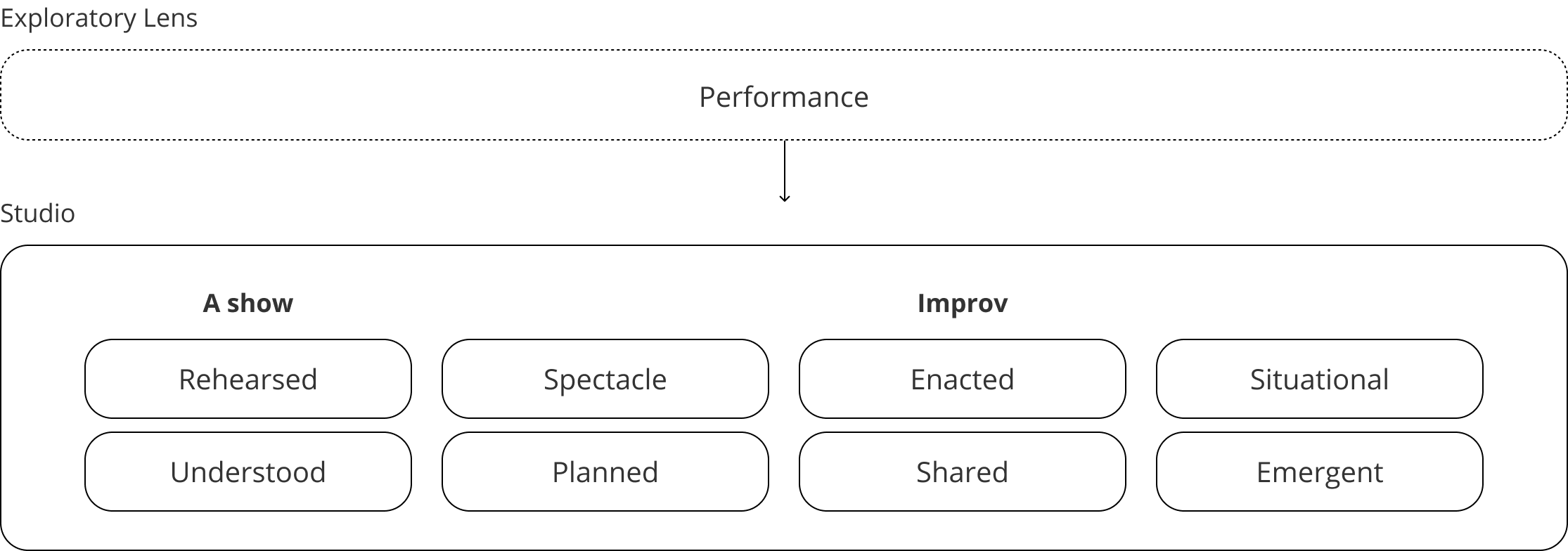
Process work is shared in studio; in a show, the sharing is a sort of justification process that depends on charisma: the audience needs to become convinced that the design direction is a good one. But studio as improv embraces the subjective nature of design criticism, and emphasizes the need for students to do more than simply unveil their work. Conversations become generative, and emerge based on modeling from the instructor and participation from other students. The literal “interruptions” caused by faculty when they draw on a student’s work or invoke moments of fatigue, annoyance or negativity act as creative and productive moments, not moments of one-way assessment. As a result, improvisational performances become enabling, while literal performances are disabling. It can be argued that the fear and terror provoked by a formalized presentation would likely dissipate in a more enacted context where the performers and audience blend into one creative, emergent show.
Risks, rules and identity
Corporations embrace policies and procedures that limit the way employees are allowed to behave, but designers are exempted from a number of these limitations, largely because of how design is viewed as a core driver of innovation. Rejecting convention is considered a business differentiator and a source of value, and designers are viewed as those most prepared to break rules and take risks in order to help businesses conceive of new products and services. In studio education, instructors prepare students for this role by fostering a sense of sanctioned or bounded deviance—by teaching them to take a disruptive stance and view themselves, and their profession, with a sense of exclusivity. This exemplifies Becker’s view of outsiderness. In this section I will show how design schools help students learn a specific language and a way of working that positions them as exempt from the traditional norms of business, prepared to become outsiders inside of corporations.
The pursuit of innovation
Corporations are largely conservative, risk-averse entities. Cyert and March (1963)Cyert, R. M. & March, J. G., 1963. A behavioral theory of the firm. New Jersey: Prentice-Hall. describe how general choice procedure instructs corporations to “Avoid uncertainty. Rather than looking for ways of dealing with uncertainty through certainty equivalents, the firm looks for procedures that minimize the need for predicting uncertain future events” (p. 101)Cyert, R. M. & March, J. G., 1963. A behavioral theory of the firm. New Jersey: Prentice-Hall.. Organizations attempt to control risk; they “impose plans, standard operating procedures, industry tradition, and uncertainty… In short, they achieve a reasonably manageable decision situation by avoiding planning where plans depend on predictions of uncertain future events and by emphasizing planning where the plans can be made self-confirming through some control device” (p. 118)Cyert, R. M. & March, J. G., 1963. A behavioral theory of the firm. New Jersey: Prentice-Hall.. This planning and pursuit of safety through rationality is evidenced through quality-control programs like Six Sigma, which “is an organized, parallel-meso structure to reduce variation in organizational processes” (Schroeder, et al., 2007)Schön, D. A., 1987. Educating the reflective practitioner: Toward a new design for teaching and learning in the professions.. San Francisco: Jossey-Bass. and to structure business operations in predictable ways.
This want for predictability is visible in the production of physical items, as supply chain and distribution forecasting can be optimized, and waste minimized: “the goal is to define the optimal materials acquisition plan, the production schedule, the ordering policies between distribution nodes and the inventory levels for the distribution network such that the profit is maximized” (Perea-López, et al., 2003)Perea-López, E., Ydstie, B. & Grossmann, I. E., 2003. A model predictive control strategy for supply chain optimization. Computers & Chemical Engineering, 27(8-9), pp. 1201-1218.. These values of risk management and risk mitigation have continued in the working context of those who are building digital products, too, as “the degree of risk varies with complexity, size (both in terms of schedule and budget), and location. Scope creep, lack of understanding of problems, ambiguous requirements, lack of resources, hardware, networking, and security issues are some of the common risk elements in software development projects. Therefore, there is a need to manage risk in software development” (Dey, et al., 2007)Dey, P. K., Kinch, J. & Ogunlana, S. O., 2007. Managing risk in software development projects: a case study. Industrial Management and Data Systems, 107(2), pp. 284-303.. Companies that are publicly traded present earnings estimates for upcoming quarters, and are then expected to meet them. Entire corporate workstreams are devoted to minimizing risk, and to risk planning.
A notable exception to risk aversion in corporations is their pursuit of innovation through creativity. In the context of a business, creativity can be thought of as "coming up with fresh ideas for changing products, services, and processes so as to better achieve the organization’s goals" (Amabile, et al., 2005, p. 367)Amabile, T. M., Barsade, S., Mueller, J. & Staw, B., 2005. Affect and Creativity at Work. Administrative Science Quarterly, Volume 50, pp. 367-403., and innovation is “the application of new ideas to the products, processes or any other aspect of a firm’s activities. Innovation is concerned with the process of commercializing or extracting value from ideas” (Rogers, 1998, p. 5)Rogers, M., 1998. The Definition and Measurement of Innovation. Melbourne Institute Working Papers, Volume 10/98.. An innovation is a product, system, or service that has not been seen before, but that is successful in the marketplace. As it is new, it is untested, and therefore innovations carry large amounts of market risk. Innovation activities may cost more than expected or take longer than anticipated, and untested products or services may fail in the market because consumers don’t understand the product or the value it might provide to them. Often, innovation is tied to technological change and computational advancement, and the outcome of innovation may appear strange to consumers (Moore, 1991, p. 31)Moore, G. A., 1991. Crossing the Chasm: Marketing and Selling High-Tech Products to Mainstream Customers. New York: HarperBusiness.; if a large amount of time and effort is placed in creating something new and consumers do not adopt it, those resources could be considered wasted. There is also an opportunity cost of that wasted effort, as resources spent in one area can’t be spent in another.
Yet even with these challenges and considerations, innovation is considered a positive pursuit for businesses. GE’s former CEO Jeffrey Immelt has described innovation as the “only way out of the abyss called commodity hell” (Immelt, et al., 2009)Immelt, J. R., Govindarajan, V. & Trimble, C., 2009. How GE Is Disrupting Itself. Harvard Business Review, 87(10), pp. 56-65.; without innovation, “there are no opportunities for focus or differentiation—it’s solely a cost game—and this is true in a number of bulk commodities” (Porter, 1980, p. 43)Porter, M. E., 1980. Competitive Strategy: Techniques for Analyzing Industries and Competitors. New York: The Free Press.. New products and services offer companies opportunities to expand their offerings, charge a premium, gain market share, and generate publicity. Innovation, then, is considered a strategic part of business; to pursue innovation is an explicit choice made by leadership, one that is acknowledged to carry the risks described above, and those risks are considered acceptable given the potential benefits they may provide. Companies that take those risks may be viewed as visionary; they may also be viewed as “driving markets” rather than following market dynamics (Jaworski, et al., 2000)Jaworski, B., Kohli, A. K. & Sahay, A., 2000. Market-Driven Versus Driving Markets. Journal of the Academy of Marketing Science, 28(1). and pursuing a “blue ocean strategy” (Kim & Mauborgne, 2004)Kim, W. C. & Mauborgne, R., 2004. Blue Ocean Strategy. Harvard Business Review, October.pp. 1-11. of endless opportunity—“uncontested market spaces where the competition is irrelevant.”
Pursuing something untested is, by definition, taking a risk of adoption or of achieving business goals; these pursuits may fail. Even with all of the strategic benefits, the entire pursuit of innovation is a limited part of the activities a company engages in. In the Global Innovation 1000, aggregate R&D spending amounts to roughly 4.5% of revenue, indicating that only a small fraction of organizational resources is allocated to innovation, with the vast majority directed toward business as usual (Jaruzelski, et al., 2018)Jaruzelski, B., Chwalik, R. & Goehle, B., 2018. What the top innovators get right. Strategy+Business, Issue 93.. As a result, being innovative is exclusive. The majority of a company is urged to minimize risk; only a small part of an organization is encouraged and rewarded for pursuing things that have a high likelihood of failure and, by definition, may waste resources.
In summary, businesses are largely risk-averse, yet recognize the need to dedicate some of their resources to pursuing untested ideas, deemed innovations. The people who work on these innovations are encouraged to try things that may fail. Only a small percentage of employees of the larger corporation are permitted to focus on these projects.
Risk-takers and rule-breakers
Designers have tended to see the discipline of design, and themselves, as agents of change—as individuals who can see beyond the way the artificial in culture currently is, and set a vision for a different and unexpected future and a way it could be. Designers make things, but elevate the things and their making through grandiose language and claims. For example, Karim Rashid, a well-known industrial designer, explains that designers “control the machine. At one point the machine controlled us” (Rashid, 2016)Rashid, K., 2016. The Future of Design. Toronto: IIDEXCanada.. His work (primarily in making consumer items like vacuum cleaners) is, as he describes, “about the betterment of our lives poetically, aesthetically, experientially, sensorially, and emotionally.” Paul Rand, the designer responsible for the graphic identity of IBM, UPS, and ABC, describes how “to design is to transform prose into poetry” (Rand, 1993, p. 3)Rand, P., 1993. Design, Form, and Chaos. New Haven: Yale University Press.. Architecture, according to architects, is not simply about buildings; it has been defined by Mies van der Rohe (1947)Mies van der Rohe, L., 1947. Architecture and the Times (1924). In: Mies van der Rohe. New York: The Museum of Modern Art, pp. 186-187. as “the will of an epoch translated into space.” These designers have worked rhetorically to elevate objects, images and buildings to an extraordinarily important level, and in doing so, have elevated the process of creating these artifacts as exclusive.
As described above, this power and influence is valued in business, as risk-taking and nontraditional thinking has become equated to innovation. This is made clear in the messaging from Steve Jobs, who himself became synonymous with understanding and advocating for “good design”:
“Here's to the crazy ones. The misfits. The rebels. The troublemakers. The round pegs in the square holes. The ones who see things differently. They're not fond of rules. And they have no respect for the status quo. You can quote them, disagree with them, glorify or vilify them. About the only thing you can't do is ignore them. Because they change things. They push the human race forward. And while some may see them as the crazy ones, we see genius. Because the people who are crazy enough to think they can change the world, are the ones who do” (Apple, 1997)Apple, 1997. Apple - Think Different. [Online] Available at: https://www.youtube.com/watch?v=5sMBhDv4sik [Accessed 24 April 2026]..
This provocative link between designers and rule-breaking is repeated over and over in the context of business. Versace declared that “I think it's the responsibility of a designer to try to break rules and barriers” (Spindler, 1997)Spindler, A. M., 1997. Gianni Versace, 50, Giant of Contemporary Fashion. The New York Times, 16 July.. Even the most banal change can be viewed as one that takes fearlessness, as is the case with a headphone jack on a phone: “Some people have asked why would we remove the analog headphone jack in the iPhone. I mean, it’s been with us a really long time. I’m sure you know that the source of this mini-phono jack is over a hundred years old, used to help quickly exchange in switchboards. Well, the reason to move on… really comes down to one word: courage. Courage to move on, do something new, that betters all of us. And our team has tremendous courage” (Waddell, 2016)Waddell, K., 2016. Apple’s ‘Courageous’ Leap. [Online] Available at: https://www.[...] [Accessed 24 April 2026]..
By positioning design as a courageous discipline of importance and exclusivity, designers offer a rhetorical stance of otherness: of having tastes and skills that are unique to them, and that others do not possess. Designers are capable, from their vantage outside of society, to see what is current and what is wrong with society. Furniture and consumer electronics designer Dieter Rams explained to executives at Braun that “good designers must always be avant-gardists, always one step ahead of the times. They should—and must—question everything generally thought to be obvious. They must have an intuition for people’s changing attitudes. For the reality in which they live, for their dreams, their desires, their worries, their needs, their living habits. They must also be able to assess realistically the opportunities and bounds of technology” (The Design Museum, 2016)The Design Museum, 2016. Profile: Dieter Rams. [Online] Available at: https://designmuseum.org/designers/dieter-rams [Accessed 26 April 2026].. Designers do more than simply articulate problems; they manifest solutions, and those solutions are amplified through size and scale. In Mies van der Rohe’s career as an architect, he created over thirty major buildings (Mies van der Rohe Society, n.d.)Mies van der Rohe Society, n.d. Mies's works. [Online] Available at: https://www.miessociety.org/mies-works-usa [Accessed 20 April 2026].. Rashid’s products are sold in large stores like Target; design has an inextricable connection to commercialism, in part because of this need for distribution and in part because of its distinct qualities from art: a garbage can designed by Rashid sold 1.5 million units (Hamilton, 2000)Hamilton, W. L., 2000. DESIGN NOTEBOOK; Designers Find You Can't Live On Buzz. The New York Times, 21 September, pp. Section F, Page 1.. Because their creations are produced and considered at a massive scale, items like a garbage can become circular proof of the designer’s value—designers make things, and characterize their process as risky; the things are mass-produced and generate revenue; risk-taking is affirmed as being critical for business success, as are designers as the takers of risk.
A place where rule-breaking behavior is fostered
Businesses are conservative, yet designers have carved out a space where they are permitted to take risks and break rules. They see themselves as outsiders, and they become these outsiders during their education in design studio. Studio is a “place where students are encouraged to be subversive, to look for alternatives, to disrupt normative attitudes and values; a place where being different and going against the grain are valorized and rewarded” (Burgess & Burgess, 2020, p. 167)Burgess, A. & Burgess, L., 2020. Social Class and Art & Design Education: A Significant Omission. In: Debates in Art and Design Education. London: Routledge.; it is a clear example of Becker’s argument about deviance. Becker proposes a sequential model of becoming an outsider (Becker, 1963, p. 22)Becker, H. S., 1963. Outsiders. New York: Free Press., a model that shows a process of cultural movement and identity shift. The model employs a tool of career deviance to explain a sequence of movements from one social position to another (Becker, 1963, p. 25)Becker, H. S., 1963. Outsiders. New York: Free Press.. At its core, to see design studio through a lens of risk-taking is to see it as preparation for a role in professional practice where designers are uniquely positioned to break rules inside of a conservative culture.
One of the initial signs to a student that design school may be unlike their previous educational experiences is when they receive their first assignment. Design projects begin with a project brief that frames the focus of a student’s work. It may describe a way a student is to work or a problem space they are supposed to examine and explore. But a brief is short—often just a page—and is vague. It is reasonable that people who encounter such an ambiguous task may shy away from it; Stein (1974, p. 24)Stein, M. I., 1974. Stimulating Creativity. New York(NY): Academic Press, Inc., referring to this initial engagement with such a brief as a hypothesis-generation state, notes that “to embark on the hypothesis formation stage in the creative process frequently takes much courage and self-confidence, for it may involve a confrontation with the status quo as to the significance of progress and that which is novel. It may involve differing from and deviating from the here and now. These kinds of behaviors cannot occur in tradition-bound, conforming, rigid, and anxious individuals.”
A brief presents constraints, rather than rules; yet even these constraints can be ignored. A fundamental quality of design is reframing, or purposefully shifting boundaries. Reframing is “the act of purposefully shifting the normative frame, often temporarily or in multiple directions at once, in order to see things from a new perspective” (Kolko, 2010)Kolko, J., 2010. Sensemaking and Framing: A Theoretical Reflection on Perspective in Design Synthesis. Montreal, Design Research Society.. For a student, this requires selectively rejecting or accepting what has been assigned to them, and treating rules as flexible. To begin working on a project brief means a student must immediately make some decisions on their own that shape the assignment criteria; they must begin a project by acting as an authority figure—they are already beginning to break rules and they have only just started: “students are forced to take a stance from the earliest stages in an art and design course” (Orr & Shreeve, 2018, p. 115)Orr, S. & Shreeve, A., 2018. Art and Design Pedagogy in Higher Education: Knowledge, values and ambiguity in the creative curriculum. New York: Routledge..
Some project briefs require a student to conduct research, while others encourage them to begin to draw and model new ideas. In each case, a student eventually finds themselves giving form to new ideas through an iterative process. Iteration requires making something, reflecting on what was made, and making it again, differently; it has been observed that creative figures like Leonardo da Vinci and Ludwig Borne suggest coming up with lots of ideas on the way to selecting one idea (Stein, 1974, pp. 194-195)Stein, M. I., 1974. Stimulating Creativity. New York(NY): Academic Press, Inc.. Common to successful creative people is an ability to suspend preconceptions and reframe the problems they inherit. New idea generation depends on questioning the original problem itself, and as Osborn (1953, pp. 300-301)Osborn, A., 1953. Applied Imagination: Principles and Procedures of Creative Thinking. New York: Charles Scribner's Sons. describes, can be cultivated through four principles: deferring criticism, welcoming unexpected ideas, privileging quantity, and combining and improving ideas collaboratively. In studio, the iterative process continues to push away from the instructions provided by the instructor. To begin the process, a student must feel free to make something that is “wrong,” something that does not satisfy the requirements of the assignment. Ideation depends on suspending judgement and generating outlandish ideas—“the wilder the idea, the better,” argues Osborn—as originality often emerges through what first appears mistaken or excessive.
As has been described earlier, critique is a process of publicly commenting on someone else’s creative work. This is a process of pointing out things that are poorly done, calling attention to a mistake, and doing it in a public way, so that others can also see the mistake. This is a behavior that is not encouraged in everyday life, yet faculty view it as important for students to “learn to become critical” (Dannels, 2005, p. 148)Dannels, D. P., 2005. Performing tribal rituals: A genre analysis of "crits" in design studios. Communication Education, Volume 54, p. 136–160.. Instructors teach students to proactively offer criticism, and “students providing feedback to their peers is a key aspect in the development of professional norms that are expected of design graduates” (Healy, 2016, p. 7)Healy, J. P., 2016. The components of the "crit" in art and design education. DOAJ: Directory of Open Access Journals..
As students make sketches, accumulate research, and develop models and prototypes, they are encouraged to externalize their content. What’s more, they are actively encouraged to make a mess, or what is more romantically called a place of “ecological richness,” filled with “Post-it notes, sketches and magazine clips” (Vyas, et al., 2013, p. 416)Vyas, D., van der Veer, G. & Nijholt, A., 2013. Creative practices in the design studio culture: Collaboration and communication. Cognition, Technology and Work, Volume 15, pp. 415-443.. Instructors feel that messiness indicates a sense of hard work and a depth of thinking; it is a sign of a group working cohesively, and shows more than just visible progress on a problem—it shows that students are starting to feel empowered to break away from norms. An office is clean, tidy, and organized; a studio is different, because design is different.
As students work through iterations, they are encouraged to be playful. Ochsner links studio learning to Winnicott’s concept of transitional space—the imaginative realm between reality and fantasy where play and creativity originate. Citing Louis Kahn’s suggestion that a material has a “want” to be part of a design, Ochsner interprets this as a kind of projection, “a kind of apperception—that is, we are conscious of the object as a receptor of contents of our own unconscious” (Ochsner, 2000, p. 196)Ochsner, J. K., 2000. Behind The Mask: A Psychoanalytic Perspective On Interaction In The Design Studio.. Journal of Architectural Education, 53(4), pp. 194-206.. This form of projection requires a suspension of disbelief, an acceptance of the “absurdity” of seeing matter as desiring. The studio, Ochsner argues, cultivates precisely this sensibility: “we try to teach our students to escape from the limits of linear logic and what we and they logically think are the limitations of external reality,” and this occurs by helping students “find a way to discover the freedom experienced in play” (p. 197)Ochsner, J. K., 2000. Behind The Mask: A Psychoanalytic Perspective On Interaction In The Design Studio.. Journal of Architectural Education, 53(4), pp. 194-206.. Being playful allows students to enter a state where time dissolves and focus deepens—a state of “intense experiencing” akin to what children feel in unstructured exploration or adults encounter in creative and spiritual moments. The most important moment of play, Ochsner writes, is when the child surprises themselves, and that’s similar for a student. In the studio, immature, childlike surprise becomes a signal of learning, a moment when discovery transcends instruction.
Students hear of these new rules of studio: of ignoring the assignment, of saying socially inappropriate things, of making a mess, and of acting like a child. What’s more, they see them performed by instructors. In Sawyer’s research (2019)Sawyer, R. K., 2019. Dialogic Status In Design Education: Authority And Peer Relations In Studio Class Conversations. Social Psychology Quarterly, 82(4), pp. 407-430., a group of students discussed work with a professor with a sense of fluidity, suggesting a strong relational foundation between the professor and students; this likely emerged through “modeling,” where an “instructor [offers] both explicit and tacit guidance into the norms of what constitutes 'good design' or productive design practices” (Cennamo & Brandt, 2012, p. 850)Cennamo, K., 2014. In Education We All Want To Be Nice: Lessons Learned From A Multidisciplinary Design Studio. In: Design in Educational Technology. Cham: Springer, pp. 57-73.. They see someone in a position of authority “failing” on purpose through a process of iteration; they see that person offering public, negative criticism; they see that person making a mess; they see that person being playful, verbally, and through their modeled sketching; and they hear that person give them suggestions and then advise them to disregard what was suggested—Orr and Shreeve (2018, p. 119)Orr, S. & Shreeve, A., 2018. Art and Design Pedagogy in Higher Education: Knowledge, values and ambiguity in the creative curriculum. New York: Routledge. indicate that “lecturers will sometimes tell students to ignore their advice.”
For a new student, this is jarring. They see existing rules being broken by an authority figure and with a casualness that is unexpected. Becker describes this as a form of neutralization and, citing Sykes and Matza, likens this to a billiard ball, in which one “sees himself as helplessly propelled into new situations” (Becker, 1963, p. 28)Becker, H. S., 1963. Outsiders. New York: Free Press..
Surrounded by a new set of rules—rules that encourage rule-breaking—a student is likely to then be “commissioned into a nonconforming act.” This is fostered in studio by its permissiveness. Students in conventional courses do not typically ignore assignment requirements, purposefully work inefficiently, or make and celebrate literal messes because their educational context does not demand these activities. Studio does, and when a student commits to these activities (purposefully, or by mistake), they are “caught in the act,” and are encouraged to commit to their new behavior.
Commitment is “the process through which several kinds of interests become bound up with carrying out certain lines of behavior” (Becker, 1963, p. 27)Becker, H. S., 1963. Outsiders. New York: Free Press.. Becker argues that one finds themselves in a new situation that is bounded by different routines and behaviors, and not conforming to those activities will have negative implications. In studio, normal behavior is to break from the traditional norms of education; studio culture in education expects and encourages risk-taking and selectively ignoring the assignment requirements. The “idea of risk-taking as a valued student behavior has been present in Western art and design education for many years” (Orr & Shreeve, 2018, p. 47)Orr, S. & Shreeve, A., 2018. Art and Design Pedagogy in Higher Education: Knowledge, values and ambiguity in the creative curriculum. New York: Routledge.. It is a “valorized practice that is so mainstream within art and design education” that it is rarely questioned. Equally celebrated and rarely challenged is the idea that failure is essential to learning.
Deviance emerges from socially learned behaviors, and “one of the most crucial steps in the process of building a stable pattern of deviant behavior is likely to be the experience of being caught and publicly labeled as a deviant” (Becker, 1963, p. 31)Becker, H. S., 1963. Outsiders. New York: Free Press.. This activates the consequences and makes a change in the individual’s public identity. Circularly, then, the individual begins behaving more like one with the qualities of deviance. Becker argues that deviance is the product of a transaction between someone who is viewed as a rule-breaker, and a group to which that person belongs. Additionally, a deviant act is dependent on how other people react to it, as those reactions (enforcement) are indicative of the group’s values, and those values aren’t applied equally to all group members. So, assessing if an act is deviant depends in part on whether it violates the group’s asserted rule and in part on what other people do about it. Deviance can’t be understood until there has been a response by the social group.
Becker argues that, as rule-breakers become known, they experience the consequences of being publicly identified and labeled as a deviant. In describing the deviant behavior of marijuana users, Becker describes how “changes in group participation and membership lead to changes in level of [marijuana] use… [the user’s] fears are challenged by the sight of others—more experienced users—who apparently feel there is little to no danger and appear to engage in the activity with impunity” (Becker, 1963, p. 66)Becker, H. S., 1963. Outsiders. New York: Free Press.. In the studio, these other users are upperclassmen, their peers, and even their instructors themselves. The public identification of designer-as-deviant is a formalized part of the curriculum of studio, and unlike with marijuana users, the label is a form of objective pride: a student receives a grade, and the grade reflects how willing they were to take risks and bend rules. Failure is “valorized by tutors who might celebrate making mistakes or learning through error” (Orr & Shreeve, 2018, p. 145)Orr, S. & Shreeve, A., 2018. Art and Design Pedagogy in Higher Education: Knowledge, values and ambiguity in the creative curriculum. New York: Routledge.. Those who are more innovative and who push assignments further are graded higher than those who make “safe” or conservative work. The project brief that initiated the work was vague; those who were able to interpret the hidden urge for rule-breaking are rewarded.
An act that might be seen as nonconforming in other situations is taken by a student in pursuit of their self-interests—a good grade, a return on an investment in education, and a promise of a job—and the “deviant act becomes, if not quite proper, at least not quite improper” (Becker, 1963, p. 29)Becker, H. S., 1963. Outsiders. New York: Free Press.. This is the creation of a set of motives and interests, and these are socially learned and transmitted. A student enters studio without a refined sense of their goals, and as Becker describes, they have “no notion of the pleasures to be derived from it” (Becker, 1963, p. 30)Becker, H. S., 1963. Outsiders. New York: Free Press.. Yet over time, “he learns these in the course of interaction with more experienced deviants.” A set of outcomes becomes clearer as a student observes and interacts with practicing professionals as instructors, upperclassmen, and industry guests invited to offer critique and public assessment. The student becomes a participant in the subculture.
A student makes a deviant move, is “caught” by their peers and the instructor, and becomes known for their deviance; they are labeled as a risk-taker, a rule-breaker, and most importantly, a promising designer. They are developing a reputation amongst their cohort for these actions, and they reinforce this reputation by continuing to break rules and take risks, and by adopting the language of deviance. The use of design-specific language is tacit, and students begin to learn the use of metaphors appropriately; when they are able to speak of design, “it is an indication that they have understood and are becoming part of the community of practice” (Orr & Shreeve, 2018, p. 28)Orr, S. & Shreeve, A., 2018. Art and Design Pedagogy in Higher Education: Knowledge, values and ambiguity in the creative curriculum. New York: Routledge.. Being a professional deviant in design studio involves developing a voice and demeanor suited to creative discourse. Through critique, students learn to talk about design—to adopt, adapt, or challenge disciplinary vocabulary, to frame decisions confidently, and to treat their work not as precious but as provisional. They learn to give and receive feedback, to engage in disagreement productively, and to translate conflict into dialogue.
A studio is physically small and emotionally compressed, and “students are aware of what their peers are doing and have opinions about who are the 'good' students in certain dimensions of design skills” (Ashton & Durling, 2000, p. 8)Ashton, P. & Durling, D., 2000. Doing the right thing. Social processes in design learning. The Design Journal, 3(2), pp. 3-14.; a student is “caught as deviant” and is so labeled, publicly, when their work is displayed—and their work, as has been shown above, is nearly always displayed. Yet their deviance is celebrated, as a student is showing that their indoctrination is happening effectively. In professional contexts, ideas rarely advance on merit alone; they must be communicated, defended, and shaped through persuasion. Critique is where students begin to rehearse these rhetorical and political skills. Students want to be deviant successfully by doing the “right thing,” and that thing is “value-loaded—it is created by the group itself and most notably by those who are able to exert influence or leadership” (Ashton & Durling, 2000, p. 12)Ashton, P. & Durling, D., 2000. Doing the right thing. Social processes in design learning. The Design Journal, 3(2), pp. 3-14.. As a result, students learn to tell the story of their work—to present unexpected and norm-breaking ideas persuasively, to manage group dynamics, and to influence how others see and value creative contributions. In doing so, they develop the capacity to guide discussions, build consensus, and integrate competing viewpoints, which are skills essential to design leadership.
If a change in fashion aesthetics or the removal of an adapter from a music device is claimed in industry as risky and is encouraged, students need to learn these demeanors and this type of speaking. Discussing their work, as McDonald et al. (2018)McDonald, J. K., Rich, P. J. & Gubler, N. B., 2018. The perceived value of informal, peer critique in the instructional design studio. TechTrends, Volume 63, p. 149–159. observe, helps students develop professional language, decision-making confidence, and the capacity to frame their work persuasively. Through their talk, gestures, and critiques, they signal belonging to a professional culture. Students learn to talk like designers and to situate their ideas within a broader discourse; “even if studio conversations are just part of the education,” Svensson and Edström (2011, p. 22)Svensson, L. & Edström, A.-M., 2011. The Function Of Art Students' Use Of Studio Conversations In Relation To Their Art Work. International Journal of Education & the Arts, 12(5). describe, “it is the one that is generally considered most important.” Stories are a large part of a claim of legitimacy; Lave and Wenger quote Jordan in showing that “stories, then, are packages of situated knowledge” (Lave & Wenger, 1991, p. 108)Lave, J. & Wenger, E., 1991. Situated Learning: Legitimate Peripheral Participation. Cambridge: Cambridge University Press.. Telling a story is a way of displaying membership, and as educators tell stories of innovation, this helps students enter the social system of design-as-innovation. Conversation in the design studio distributes voice, models professional speaking approaches, and teaches students how to navigate power hierarchies through talk—hierarchies that are common in large corporations.
The confidence students build helps them take leadership roles in the subculture of the studio. Students in studio are encouraged to spend late nights in the space, and this becomes a public display of group membership. These students encourage other students; peer learning is celebrated as a way for students to build a sense of community, and the community in studio is one of irreverence. Studio is insular, and as with marijuana use—which establishes a “pattern of social participation which reduces contacts with nonusers almost to the zero point” (Becker, 1963, p. 68)Becker, H. S., 1963. Outsiders. New York: Free Press.—students are surrounded by those who engage fully in breaking rules and taking risks.
Design school acts as a vehicle for introducing this way of thinking: for encouraging students to view themselves as having strategic and intellectual importance that extends beyond the creation of artifacts and objects, and to view their creative influence as disciplinarily exclusive. Shaffer (2007, p. 121)Shaffer, D. W., 2007. Learning in design. In: Foundations for the future in mathematics education. s.l.:Erlbaum, pp. 99-126. argues that design education is unique in that “students were not merely solving problems; they were engaged in an iterative process of expressing—and thus shaping—their identities,” and those identities are centered around thinking differently from other people and disrupting established ways of working. What’s more, art and design schools present this as being a form of positive disruption: a way of disrupting corporate life as usual, presented as a disruption for the betterment of the organization’s culture and ability to innovate.
Fine (2018, pp. 174-175)Fine, G. A., 2018. Talking Art: The Culture of Practice and the Practice of Culture in MFA Education. Chicago: University of Chicago Press. explains that artists and designers “define themselves as mavericks. Sometimes it seems that anything goes… much tolerance is shown to behaviors that the psychiatrically minded might label ‘acting out.’’’ Faculty allow subversive behavior, and encourage students to “perform the artist role, looking and acting the part.” Studio signals that unique people work in it, and the “ways in which people tend to dress, talk and behave socially are part of the often somewhat bohemian design studio culture” (Fallman, 2007, p. 4)Fallman, D., 2007. Supporting Studio Culture in Design Research. s.l., s.n..
A student is becoming a new type of person, and “being deviant” begins to be more of a defining characteristic than other qualities they possess. As has been described earlier, making things is intertwined with designerly identity; making deviant things further amplifies that connection. From the perspective of one who is labeled as deviant, the roles switch. Those creating the rules may be viewed as outsiders, and that raises a question of “who can, in fact, force others to accept their rules and what are the causes of their success?” (Becker, 1963, p. 17)Becker, H. S., 1963. Outsiders. New York: Free Press.. This is a question of political and economic power, and making rules and applying them is an issue of power differentials. Since rules change, they are the “object of conflict and disagreement, part of the political process of society.”
Becoming designerly is about entering into a new community (Corazzo & Gharib, 2021)Corazzo, J., 2022. Studio Through Studio: a diffractive reading of the educational design studio. Bilbao, Design Research Society.; in the studio, students internalize the culture of design and begin to see themselves as part of that larger community of design practice. Studio “serves as a bridge between academic and professional communities” (Corazzo, 2019, p. 1256)Corazzo, J., 2019. Materialising the studio: A systematic review of the role of the material space of the studio in Art, Design and Architecture Education. The Design Journal, Volume 22, p. 1249–1265.. This is an experience that is not yet part of gaining peripheral participation but is also not a simple duplication of a real-world studio environment. In this context, faculty “broker” interactions between academic studio and post-academic studio, slowly “making explicit tacit rules of design practice for students” (Brandt, et al., 2013)Brandt, C. et al., 2013. A theoretical framework for the studio as a learning environment. International Journal of Technology and Design Education, Volume 23, pp. 329-348.. As students move from peripheral participation toward more central roles, they learn to interpret and inhabit the culture of design. This involves learning tacit expectations: how to explore ideas, respond to feedback, collaborate, and navigate the uncertainty that defines creative work.
The most visible evidence of a student achieving figurative and literal career deviance is securing a job in the field of design. Their “practice” rule-breaking and risk-taking becomes real, with the primary reward of business—compensation—tied directly to their ability to pursue innovation. They are “more likely than ever before to continue… [they] have learned, on the one hand, how to avoid trouble and, on the other hand, a rationale for continuing” (Becker, 1963, p. 39)Becker, H. S., 1963. Outsiders. New York: Free Press..
Over time, these patterns of thought and behavior become embodied habits, marking the shift from being a student who studies design to someone who is a designer. As has been shown here, someone who is a designer is someone who is able to navigate a conservative and risk-averse corporate culture, while still making things that may not work and purposefully breaking rules, in service of remaining an outsider inside. This is analogous to marijuana users, who have learned to “control the drug’s effects while in the company of nonusers, so they can be fooled and the secret successfully kept even though one continues participation with them” (Becker, 1963, p. 70)Becker, H. S., 1963. Outsiders. New York: Free Press.. Different, however, is the ability designers have to “turn on” and “turn off” their risk-taking in industry. They become organizationally fluid, able to work within the corporate machine as necessary or to act out when the expectation is to be visibly, actively innovative.
Summary
Corporations generally depend on predictability, procedure, and risk reduction, but innovation creates a narrow exception in which deviance is viewed as valuable—but only for a small minority. Design education prepares students to represent that minority by asking them to reinterpret assignments, accept failure, give and receive criticism, perform confidence, and treat constraints as negotiable. Through this process, students are labeled and rewarded as designers when they show a willingness to violate ordinary educational and organizational norms. Becker’s account of deviance makes visible that this is not just a method of teaching creativity. It is a process of identity formation: students learn to see themselves as outsiders, acquire the language and demeanor of a subculture, and enter professional practice prepared to occupy an unusual corporate role, one in which they are hired to challenge the rules of the very institutions that employ them.
When looked at through a lens of risks, rules, and identity, it becomes clear that studio teaches students to become sanctioned risk-takers and rule-breakers; students build an identity that’s focused around innovation:

Conclusion
In this document, I’ve explored the educational design studio through a variety of lenses, each of which examines studio pedagogy differently.
Some of these lenses highlight or showcase qualities of studio teaching and learning that are considered to be core and non-negotiable, and call into question the assumptions that underlie these characterizations. For example, that there exists a relationship between creativity and design education is broadly embraced, but the nature of the relationship itself can be construed in different ways. Traditional positioning of creativity in studio pedagogy treats it as a way of giving form to ideas. More recent representations of creativity show it as a form of problem solving, and as a driver of business innovation. Each of these points to a larger phenomenon of imprinting: that a formalized design school has a sort of DNA, and instills a specific way of working and thinking into the students that attend.
I’ve shown that the process of critique has been viewed as an underpinning of much of design pedagogy, treated as an unassailable fundamental. As a technique, it can serve many goals, such as assessment, support, industry preparation, and community development. As a teaching philosophy, critique centers an assumption that ideas can always be improved, that students should hold ideas loosely, and that ideas are never owned, only shared. Students often view their work as extensions of themselves, and as a result, critique can feel overwhelmingly personal. As a result, students may defend themselves against the approach, and if critique is studio pedagogy, these students risk missing out on a great deal of the instructor’s strategy for teaching and learning.
Other lenses I’ve shared look at the way design studio education extends beyond a set of activities or a room where the activities are performed, existing in more conceptual and abstract structures. Studio can be viewed as a place where creative output becomes a shared and public resource, informed by the unique qualities of privacy and territory. And, it can be thought of as a place where power is exerted over students through implicit and explicit control over their time, where hard work and long hours are celebrated as core parts of being a designer. In both cases, studio becomes a place where a certain type of identity is fostered.
A different set of lenses interrogate design studio education as a construct that is less about designing and more about having social experiences. Through a lens of dramaturgy, design studio becomes a performance. Performance may be taken literally, mapping the various people and attributes in studio to those in a stage show. It can also be used figuratively as a way of discussing the improvisational nature of studio conversation and activity, a view of performance that is generative.
Finally, I have explored studio through a lens of deviance, showing that it is an opportunity for students to learn to feel rebellious and to gain an outsider status to the corporate structures they will soon find themselves in when they graduate. They learn to view themselves and the profession of design as elitist and exclusive, and this view is largely encouraged by industry’s focus on innovation and the relationship that has been established between innovation and design.
This table summarizes the various approaches described above:
| Lens | Studio is… |
| Historic orientations of practice | A way of instilling in students a particular definition of design, a way of working, and a set of creative priorities |
| Demeanors and goals of criticism | An expansive practice of judgement, where ideas are not owned, concepts can always be improved, and students learn to separate themselves from their creative work |
| Place, space and privacy | A set of tensions between learning and working publicly and privately |
| Time, labor and presence | An indoctrination process, teaching students to equate long hours of hard work with success and designerly growth |
| Performance | A show that treats teaching and learning as both transactional and improvisational |
| Risks, rules and identity | A set of experiences where creative rule-breaking is fostered and design is equated to innovation and business success |
Future investigation
Relying on any one of these lenses in isolation oversimplifies the reality of studio. Studio is a messy mixture of all of these different ways of thinking. By thinking of studio more broadly, I have been able to identify my interests for further exploration, research, and analysis.
Consider this as an aggregate of the concepts discussed in this text, where items below the dotted line constitute the focus of my future exploration:
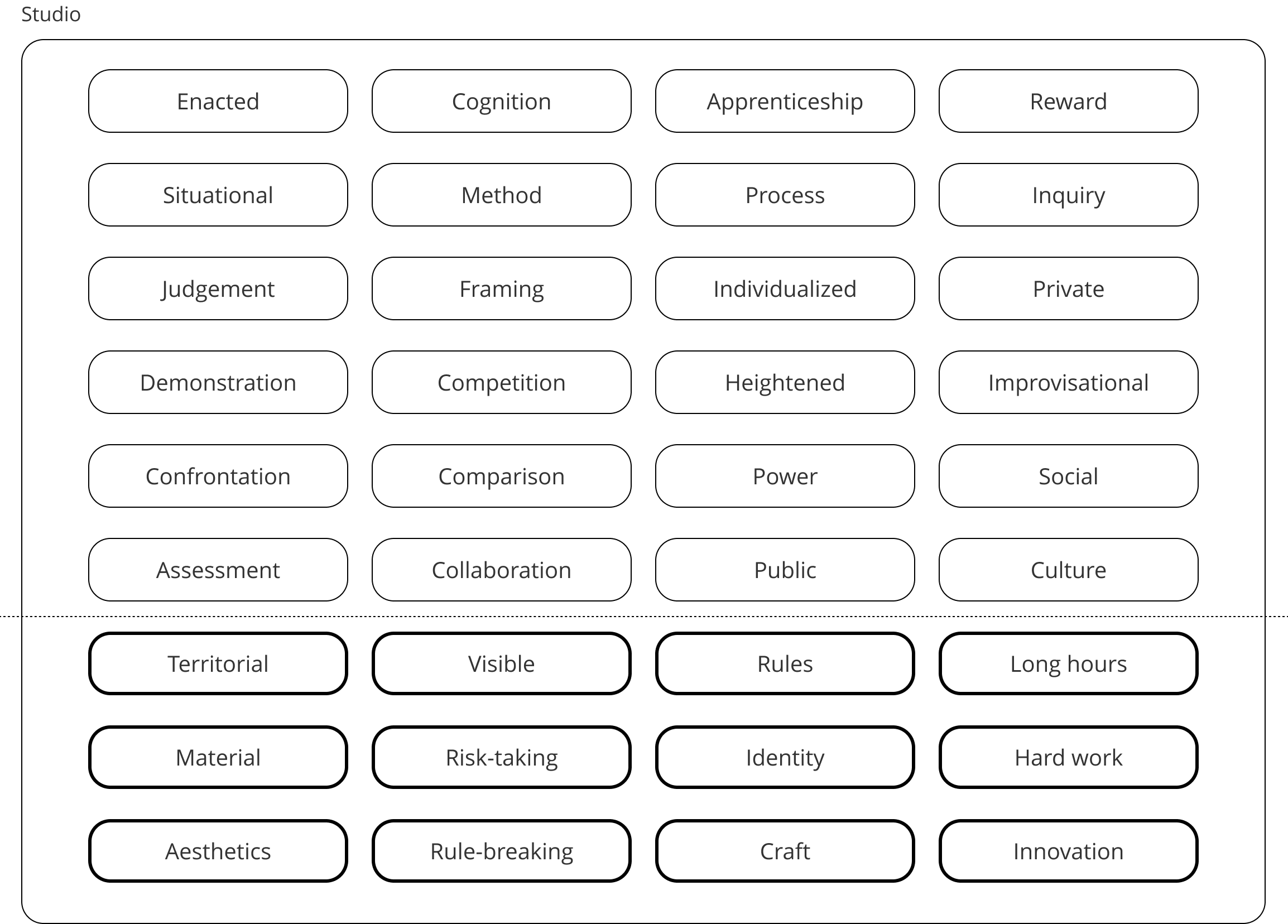
I’m drawn to two main questions. First, why has novelty and innovation become a priority, and what are the implications of celebrating when students achieve ability in innovation? As an alternative, studio might be recentered around material and craft; what does that mean, given that what is made has changed since the days of Bauhaus?
Designers increasingly make software, policies, and strategies—things with no physical form—but these things still have materiality, and manipulating that material requires workmanship and craft. Learning to manipulate those materials requires a playful experimentation and reflective practice. Students may be better served by aiming that experimentation and practice at understanding the limitations of material, as with Eames and bent plywood, but not necessarily with the goal of creating something innovative or novel.
Next, as risk-taking implies something may be lost and something may be gained, what is at stake in giving form to ideas in a studio context? Education is an isolated environment, and while it is expensive to attend design school, there is little potential for unexpected financial or physical harm. When educators, students and scholars describe risk-taking, are they referring to social risks? Risk of unnecessary toil and opportunity cost of studio work? Risks of identity? The language is large, but is left undefined, making it difficult to make purposeful, strategic decisions about pedagogy development.
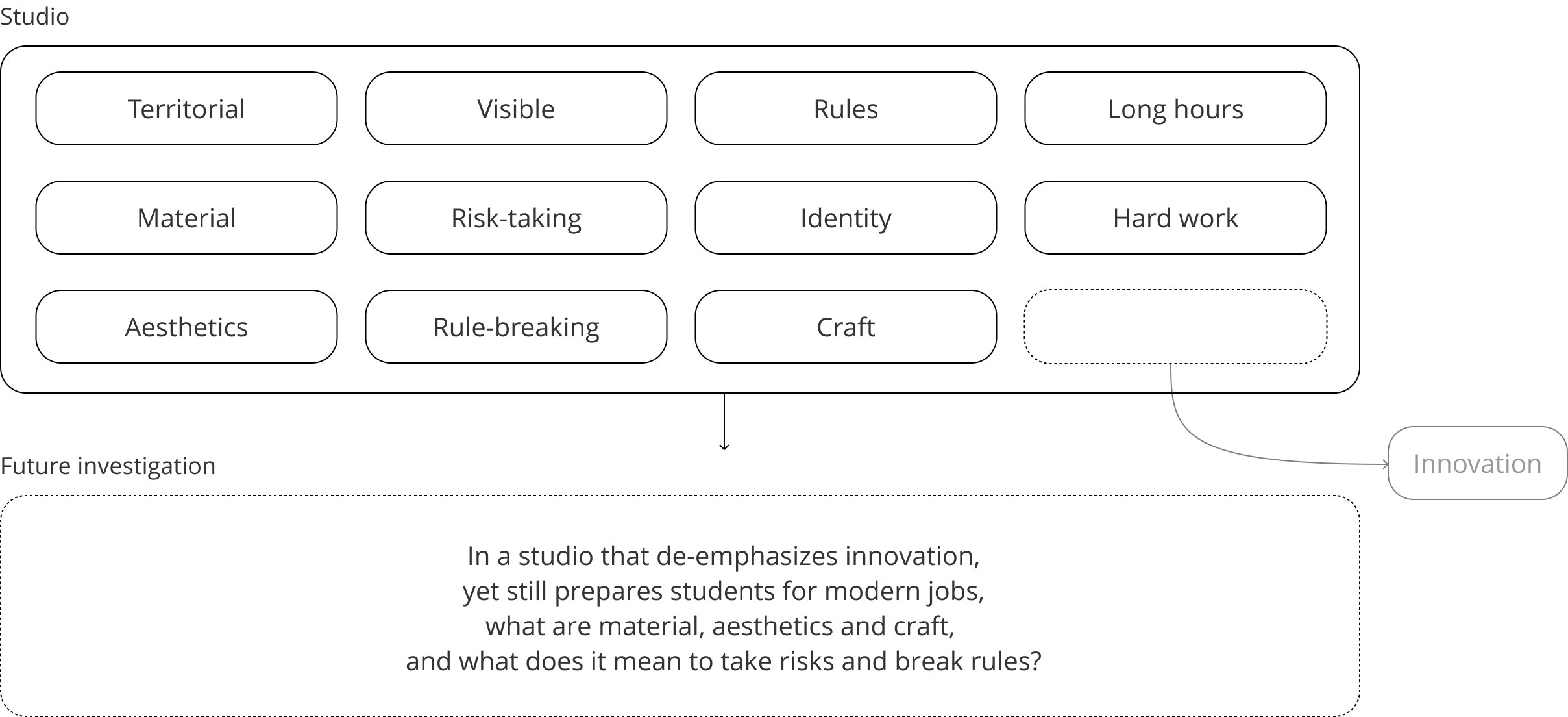
Words like risk, rules, failure, and fear are “large” words which are used consistently in scholarly literature and in popular design and business articles. This elevated language impacts students in studio, as pedagogical structures have emerged related to these words and ideas. These words are often related to how creativity intertwines with innovation and novelty, and how much of studio is centered around giving form to new ideas. Students are encouraged to spend an inordinate amount of time learning to make new things, things that are innovative, and with this in mind, studio is a place where students work long hours to show things people haven’t seen before; students learn to break rules and ignore norms that stand in their way, all in pursuit of giving form to something novel.
In the remainder of my doctoral work, I want to understand the relationship between risk, rules, and craft in the context of gaining creative confidence with materiality, not creative confidence with innovation. I will question the value of teaching innovation in studio, and explore if learning to work more “modern material”—materials related to strategy, rather than artifacts—might be an alternative to learning to pursue novelty. I will define what risks and rule-breaking mean if innovation is removed from the conversation of studio, and how these things might show up in a modern studio pedagogy that remains focused around career preparation.
References
- Adams, R., Forin, T. R. & Joslyn, C. H., 2017. Approaches to Coaching Students in Design Reviews. Columbus, American Society For Engineering Education.
- Al Maani, D. & Roberts, J. A., 2023. An attempt to understand the design studio as a distinctive pedagogical setting. The International Journal of Design Education, Volume 17, p. 31–44.
- Alexander, C., 1971. Notes on the Synthesis of Form. Boston: Harvard University Press.
- Amabile, T. M., Barsade, S., Mueller, J. & Staw, B., 2005. Affect and Creativity at Work. Administrative Science Quarterly, Volume 50, pp. 367-403.
- Anthony, K., 2011. Design Studios. In: T. Banerjee & A. Loukaitou-Sideris, eds. Companion to Urban Design. New York: Routledge, pp. 223-237.
- Apple, 1997. Apple - Think Different. [Online] Available at: https://www.youtube.com/watch?v=5sMBhDv4sik [Accessed 24 April 2026].
- Arvola, M. & Artman, H., 2008. Studio life: The construction of digital design competence. Nordic Journal of Digital Literacy, 3(2).
- Ashton, P. & Durling, D., 2000. Doing the right thing. Social processes in design learning. The Design Journal, 3(2), pp. 3-14.
- Becker, H. S., 1963. Outsiders. New York: Free Press.
- Blair, B., 2007. At the end of a huge crit in the summer, it was crap I’d worked really hard but all she said was fine and I was gutted. Art Design & Communication in Higher Education, Volume 5, p. 83–95.
- Brandt, C. et al., 2013. A theoretical framework for the studio as a learning environment. International Journal of Technology and Design Education, Volume 23, pp. 329-348.
- Brinck, I. & Reddy, V., 2019. Dialogue In The Making: Emotional Engagement With Materials. Phenomenology and the Cognitive Sciences, July, 19(1), pp. 23-45.
- Broadhead, S. J., 2018. Friendship, Discourse And Belonging In The Studio: The Experiences Of 'Non-Traditional' Students In Design Higher Education. In: Continuity and Discontinuity in Learning Careers. s.l.:Brill, pp. 17-28.
- Brown, G., 2009. Claiming A Corner At Work: Measuring Employee Territoriality In Their Workspaces. Journal of Environmental Psychology, 29(1), pp. 44-52.
- Brown, G. & Robinson, S. L., 2007. The dysfunction of territoriality in organizations. In: Research companion to the dysfunctional workplace: Management challenges and symptoms. s.l.:Edward Elgar Publishing, pp. 252-267.
- Buchanan, R., 1992. Wicked Problems in Design Thinking. Design Issues, 8(2), p. 5–21.
- Burgess, A. & Burgess, L., 2020. Social Class and Art & Design Education: A Significant Omission. In: Debates in Art and Design Education. London: Routledge.
- Cai, H. & Khan, S., 2010. The Common First Year Studio In A Hot-Desking Age: An Explorative Study On The Studio Environment And Learning. Journal for Education in the Built Environment, 5(2), pp. 39-64.
- Cennamo, K., 2014. In Education We All Want To Be Nice: Lessons Learned From A Multidisciplinary Design Studio. In: Design in Educational Technology. Cham: Springer, pp. 57-73.
- Cennamo, K. & Brandt, C., 2012. The "right kind of telling": Knowledge building in the academic design studio. Educational Technology Research and Development, Volume 60, p. 839–858.
- Cennamo, K. S., Brandt, C. B. & Scott, B., 2010. Adapting the Studio to Design-Based Disciplines: Research-Based Strategies for Effective Practice. Blacksburg, s.n., pp. 2-3.
- Comrey, A. L., 1993. Joy Paul Guilford. Biographical Memoirs, Volume 62, p. 199.
- Corazzo, J., 2019. Materialising the studio: A systematic review of the role of the material space of the studio in Art, Design and Architecture Education. The Design Journal, Volume 22, p. 1249–1265.
- Corazzo, J., 2020. In The Midst Of Things: A Spatial Account Of Teaching In The Design Studio. Lisbon, Taylor & Francis, pp. 93-100.
- Corazzo, J., 2022. Studio Through Studio: a diffractive reading of the educational design studio. Bilbao, Design Research Society.
- Corazzo, J. & Gharib, L., 2021. Everyday Routines and Material Practices in the Design Studio: Why Informal Pedagogy Matters. Design and Technology Education: An International Journal, 26(4), pp. 144-164.
- Cossentino, J., 2002. Importing Artistry: further lessons from the design studio. Reflective Practice, 3(1), pp. 39-52.
- Crolla, K., Hodgson, P. & Ho, A. W. Y., 2019. ‘Peer Critique’ in Debate: A pedagogical tool for teaching Architectural Design Studio. International Journal for the Scholarship of Teaching and Learning, Volume 13.
- Cross, N., 1982. Designerly Ways of Knowing. Design Studies, 3(4), pp. 221-227.
- Cross, N., 1997. Creativity in Design: Analyzing and Modeling the Creative Leap. Leonardo, 30(4), pp. 311-317.
- Cross, N. & Dorst, K., 2001. Creativity in the Design Process: Co-Evolution of Problem–Solution. Design Studies, 22(5), pp. 425-437.
- Cyert, R. M. & March, J. G., 1963. A behavioral theory of the firm. New Jersey: Prentice-Hall.
- Dannels, D. P., 2005. Performing tribal rituals: A genre analysis of "crits" in design studios. Communication Education, Volume 54, p. 136–160.
- Dannels, D. P., Housley Gaffney, A. & Norris Martin, K., 2008. Beyond Content, Deeper Than Delivery: What Critique Feedback Reveals About Communication Expectations in Design Education. International Journal for the Scholarship of Teaching and Learning, Volume 2, p. Article 12.
- de Bono, E., 1967. The Use of Lateral Thinking: Break the stranglehold of logical thinking. Middlesex: Penguin Books Ltd..
- Demirkan, H. & Demirbas, O. O., 2000. Privacy dimensions: A case study in the interior architecture design studio. Journal of Environmental Psychology, 20(1).
- Design Council, n.d. Framework for Innovation. [Online] Available at: https://www.designcouncil.org.uk/our-resources/framework-for-innovation/ [Accessed 3 May 2026].
- Design Q & A. 1972. [Film] Directed by Charles Eames, Ray Eames. s.l.: Herman Miller.
- Dey, P. K., Kinch, J. & Ogunlana, S. O., 2007. Managing risk in software development projects: a case study. Industrial Management and Data Systems, 107(2), pp. 284-303.
- DiSalvo, C., 2022. Design as Democratic Inquiry. Cambridge: MIT Press.
- Doblin, J., 1987. A short, grandiose theory of design. STA Design Journal, pp. 6-15.
- Dorst, K. & Valkenburg, R., 1998. The reflective practice of design teams. Design Studies, 19(3), pp. 249-271.
- Dourish, P. & Bell, G., 2014. Divining a digital future: Mess and Mythology in Ubiquitous Computing. Cambridge: MIT Press.
- Esposito, F. & Becker, T., 2023. The Time of Politics, the Politics of Time, and Politicized Time: an Introduction to Chronopolitics. History and Theory, Volume 62, p. 3–23.
- Fallman, D., 2007. Supporting Studio Culture in Design Research. s.l., s.n.
- Findeli, A., 1990. Moholy-Nagy's Design Pedagogy in Chicago. Design Issues, 7(1), pp. 4-19.
- Fine, G. A., 1990. Organizational Time: Temporal Demands and the Experience of Work in Restaurant Kitchens. Social Forces, 69(1), pp. 95-114.
- Fine, G. A., 2018. Talking Art: The Culture of Practice and the Practice of Culture in MFA Education. Chicago: University of Chicago Press.
- Fleming, D., 1998. Design Talk: Constructing The Object in Studio Conversations. Design Issues, 14(2), pp. 41-62.
- Forlano, L. & Smith, S., 2018. Critique as collaboration in design anthropology. Journal of Business Anthropology, Volume 7, p. 279–300.
- Goffman, E., 1956. The presentation of self in everyday life. Monograph No. 2 ed. Edinburgh: University of Edinburgh Social Science Research Centre.
- Goffman, E., 1966. Behavior in Public Places: Notes on the Social Organization of Gatherings. New York: Free Press.
- Goldschmidt, G., Hochman, H. & Dafni, I., 2010. The design studio "crit": Teacher–student communication. Artificial Intelligence for Engineering Design, Analysis and Manufacturing, Volume 24, p. 285–302.
- Goree, S., Doosti, B., Crandall, D. & Su, N. M., 2021. Investigating the Homogenization of Web Design: A Mixed-Methods Approach. Virtual, ACM.
- Gray, C. M., 2013. Informal peer critique and the negotiation of habitus in a design studio. Art Design & Communication in Higher Education, Volume 12, p. 195–209.
- Guilford, J., 1950. Creativity. American Psychologist, 5(9), pp. 444-454.
- Guilford, J., 1967. The Nature of Human Intelligence. New York: McGraw-Hill.
- Hamilton, W. L., 2000. DESIGN NOTEBOOK; Designers Find You Can't Live On Buzz. The New York Times, 21 September, pp. Section F, Page 1.
- Harrison, S. & Dourish, P., 1996. Re-Place-ing Space: The Roles of Place and Space in Collaborative Systems. Bston, ACM, pp. 67-76.
- Harvard University, n.d. Design Thinking and Innovation. [Online] Available at: https://pll.harvard.edu/course/design-thinking-and-innovation [Accessed 6 May 2026].
- Healy, J. P., 2016. The components of the "crit" in art and design education. DOAJ: Directory of Open Access Journals.
- Hill, C. C., 2007. Climate in the Interior Design Studio: Implications for Design Education. Journal of Interior Design, 33(2), pp. 37-52.
- Hill, G., 2016. Drawn together: student views of group work in design studio. Journal of Architectural and Planning Research, 33(4), pp. 293-308.
- Hochman, E. S., 1997. Bauhaus: Crucible of Modernism. New York: Fromm International.
- Hokanson, B., 2012. The Design Critique as a Model for Distributed Learning. In: The Next Generation of Distance Education. Boston: Springer, pp. 71-82.
- IDEO, 2025. The 7 Steps of the Design Thinking Process. [Online] Available at: https://www.ideou.com/blogs/inspiration/design-thinking-process [Accessed 2 May 2026].
- IDEO, n.d. Design Thinking. [Online] Available at: https://www.ideou.com/pages/design-thinking [Accessed 2 May 2026].
- Immelt, J. R., Govindarajan, V. & Trimble, C., 2009. How GE Is Disrupting Itself. Harvard Business Review, 87(10), pp. 56-65.
- Jaruzelski, B., Chwalik, R. & Goehle, B., 2018. What the top innovators get right. Strategy+Business, Issue 93.
- Jaworski, B., Kohli, A. K. & Sahay, A., 2000. Market-Driven Versus Driving Markets. Journal of the Academy of Marketing Science, 28(1).
- Jones, D., 2022. Exploring Studio Proximities: Space, Time, Being. Bilbao, Design Research Society.
- Jones, J. C., 1992. Design Methods. 2 ed. New York: Wiley.
- Karabulut, S. E. & Celikoglu, O. M., 2019. An Ethnography Of The Design Studio: Exploring Social Interactions And Performances In Studio Environment Through Goffman’s Dramaturgical Approach. Ankara, Design Research Society.
- Kim, W. C. & Mauborgne, R., 2004. Blue Ocean Strategy. Harvard Business Review, October.pp. 1-11.
- Kleinfield, N., 1985. Industrial Design Comes Of Age. The New York Times, 10 March, pp. Section 3, Page 4.
- Kolko, J., 2010. Sensemaking and Framing: A Theoretical Reflection on Perspective in Design Synthesis. Montreal, Design Research Society.
- Kolko, J., 2011. Craftsmanship. Interactions Magazine, 18(6), pp. 78-81.
- Kolko, J., 2011. Endless nights: learning from design studio critique. Interactions Magazine, 18(2), pp. 80-81.
- Kolko, J., 2014. Well-Designed. Boston: Harvard Business Review Press.
- Kolko, J., 2015. Design Thinking Comes of Age. Harvard Business Review, Volume September, pp. 2-7.
- Lave, J. & Wenger, E., 1991. Situated Learning: Legitimate Peripheral Participation. Cambridge: Cambridge University Press.
- Leonard, D. & Rayport, J. F., 1997. Spark Innovation Through Empathic Design. Harvard Business Review, Volume November-December, pp. 102-113.
- Loy, J. & Ancher, S., 2013. Creative Camaraderie: Promoting A Shared Design Culture For Staff And Students. Dublin, Griffith University, pp. 550-555.
- Margolin, V., 2002. The Politics of the Artificial: Essays on Design and Design Studies. Chicago: University of Chicago Press.
- Martin, J., Feldman, M. S., Hatch, M. J. & Sitkin, S. B., 1983. The uniqueness paradox in organizational stories. Administrative Science Quarterly, Volume 28.
- McCullough, M., 1998. Abstracting Craft: The Practiced Digital Hand. Cambridge: MIT Press.
- McDonald, J. K., Rich, P. J. & Gubler, N. B., 2018. The perceived value of informal, peer critique in the instructional design studio. TechTrends, Volume 63, p. 149–159.
- Mewburn, I., 2012. Lost in translation: Reconsidering reflective practice and design studio pedagogy. Arts and Humanities in Higher Education, Volume 11, p. 363–379.
- Mies van der Rohe Society, n.d. Mies's works. [Online] Available at: https://www.miessociety.org/mies-works-usa [Accessed 20 April 2026].
- Mies van der Rohe, L., 1947. Architecture and the Times (1924). In: Mies van der Rohe. New York: The Museum of Modern Art, pp. 186-187.
- MIT Management Executive Education, n.d. Mastering Design Thinking. [Online] Available at: https://executive-ed.mit.edu/mastering-design-thinking [Accessed 6 May 2026].
- Modell, M. G. & Gray, C. M., 2011. Searching For Personal Territory In A Human-Computer Interaction Design Studio. Journal for Education in the Built Environment, 6(2), pp. 54-78.
- Mohanani, R., Turhan, B. & Ralph, P., 2019. Requirements Framing Affects Design Creativity. IEEE Transactions on Software Engineering, April, 47(5), pp. 936-947.
- Mohedas, I., Daly, S. R. & Sienko, K. H., 2014. Design Ethnography in Capstone Design: Investigating Student Use and Perceptions. International Journal of Engineering Education, 30(4), pp. 888-900.
- Moore, G. A., 1991. Crossing the Chasm: Marketing and Selling High-Tech Products to Mainstream Customers. New York: HarperBusiness.
- Murphy, K. M., 2004. Imagination as Joint Activity: The Case of Architectural Interaction. Mind, Culture and Activity, 11(4), pp. 267-278.
- Murphy, K. M., 2005. Collaborative imagining: The interactive use of gestures, talk, and graphic representation in architectural practice. Semiotica, 2005(156), pp. 113-145.
- Murphy, K. M., 2011. Building Stories: The Embodied Narrative of What Might Come to Pass. In: Embodied Interaction: Language and body in the Material World. Cambridge: Cambridge University Press, pp. 243-253.
- Murphy, K. M., Ivarsson, J. & Lymer, G., 2012. Embodied reasoning in architectural critique. Design Studies, Volume 33, p. 530–556.
- Narváez, L. M. J., 2000. Design's Own Knowledge. Design Issues, 16(1), pp. 36-51.
- Nussbaum, B., 2004. The Power of Design: IDEO refined good design by creating experiences, not just products. Now it’s changing the way companies innovate.. BusinessWeek, 16 May.
- Ochsner, J. K., 2000. Behind The Mask: A Psychoanalytic Perspective On Interaction In The Design Studio.. Journal of Architectural Education, 53(4), pp. 194-206.
- Oo, T. Z., Kadyirov, T., Kadyjrova, L. & Józsa, K., 2025. Enhancing design skills in art and design education. Frontiers in Education.
- Orlikowski, W. J. & Yates, J., 2002. It’s about time: temporal structuring in organizations. Organization Science, Volume 13, p. 684–700.
- Orr, S. & Bloxham, S., 2012. Making judgements about students making work: Lecturers’ assessment practices in art and design. Arts and Humanities in Higher Education, December, 12(2-3), pp. 234-253.
- Orr, S. & Shreeve, A., 2018. Art and Design Pedagogy in Higher Education: Knowledge, values and ambiguity in the creative curriculum. New York: Routledge.
- Osborn, A., 1953. Applied Imagination: Principles and Procedures of Creative Thinking. New York: Charles Scribner's Sons.
- Percy, C., 2004. Critical absence versus critical engagement: Problematics of the crit in design learning and teaching. Art Design & Communication in Higher Education, Volume 2, p. 143–154.
- Perea-López, E., Ydstie, B. & Grossmann, I. E., 2003. A model predictive control strategy for supply chain optimization. Computers & Chemical Engineering, 27(8-9), pp. 1201-1218.
- Phelan, A., 1981. The Bauhaus and Studio Art Education. Art Education, 34(5), pp. 6-13.
- Pivonka, A., Makary, L. & Gray, C. M., 2022. Organizing Metaphors for Design Methods in Intermediate HCI Education. Virtual, Design Research Society.
- Porter, M. E., 1980. Competitive Strategy: Techniques for Analyzing Industries and Competitors. New York: The Free Press.
- Pye, D., 1995. The Nature and Art of Workmanship. London: The Herbert Press.
- Radzikowska, M., Ruecker, S. & Roberts-Smith, J., 2019. Forget To Clean Up When You're Done.. Ankara, s.n.
- Rand, P., 1993. Design, Form, and Chaos. New Haven: Yale University Press.
- Rashid, K., 2016. The Future of Design. Toronto: IIDEXCanada.
- Rauth, I., Köppen, E., Jobst, B. & Meinel, C., 2010. Design Thinking: An Educational Model towards Creative Confidence. Kobe, Design Society.
- Reddy, M. C., Dourish, P. & Pratt, W., 2006. Temporality in Medical Work: Time also Matters. Computer Supported Cooperative Work (CSCW), Volume 15, p. 29–53.
- Rodgers, P. A. & Anusas, M., 2008. Ethnography and Design. Barcelona, Design Society, pp. 186-191.
- Roethel, K., 2010. Stanford's design school promotes creativity. SFGate, 26 November.
- Rogers, M., 1998. The Definition and Measurement of Innovation. Melbourne Institute Working Papers, Volume 10/98.
- Rosa, C. & Ferreira, J., 2023. The distant studio: a survey of design students’ experience with distance educational formats. International Journal of Technology and Design Education, Volume 33, p. 2019–2043.
- Runco, M. A. & Jaeger, G. J., 2012. The Standard Definition of Creativity. Creativity Research Journal, 24(1), pp. 92-96.
- Salazar, S. M., 2014. Educating Artists: Theory and Practice in College Studio Art. Art Education, 67(5), pp. 32-39.
- Sara, R. & Parnell, R., 2013. Fear and learning in the architectural crit. Field, Volume 5, p. 101–126.
- Sawyer, R. K., 2011. What makes good teachers great? The artful balance of structure and improvisation. In: Structure and improvisation in creative teaching. New York: Cambridge University Press, pp. 1-24.
- Sawyer, R. K., 2017. Teaching creativity in art and design studio classes: A systematic literature review. Educational Research Review, Volume 22, pp. 99-113.
- Sawyer, R. K., 2019. Dialogic Status In Design Education: Authority And Peer Relations In Studio Class Conversations. Social Psychology Quarterly, 82(4), pp. 407-430.
- Schmidt, H. G. et al., 2015. On the Use and Misuse of Lectures in Higher Education. Health Professions Education, 1(1), pp. 12-18.
- Schön, D. A., 1987. Educating the reflective practitioner: Toward a new design for teaching and learning in the professions.. San Francisco: Jossey-Bass.
- Schroeder, R. G., Linderman, K., Liedtke, C. & Choo, A. S., 2007. Six Sigma: Definition and underlying theory. Journal of Operations Management, Volume 26, pp. 536-554.
- Shaffer, D. W., 1997. Design, Collaboration and Computation: The Design Studio as a Model for Computer Supported Collaboration in Mathematics. Toronto, Ontario Institute for Studies in Education, pp. 249-255.
- Shaffer, D. W., 2007. Learning in design. In: Foundations for the future in mathematics education. s.l.:Erlbaum, pp. 99-126.
- Sharma, S., 2014. In the Meantime: Temporality and Cultural Politics. Durham and London: Duke University Press.
- Silvia, P. J. & Beaty, R. E., 2012. Why Do Ideas Get More Creative Across Time? An Executive Interpretation of the Serial Order Effect in Divergent Thinking Tasks. Psychology of Aesthetics, Creativity, and the Arts, 6(4), pp. 309-319.
- Simmonds, R., 1980. Limitations in the decision strategies of design students. IPC Business Press, 1(6), pp. 358-364.
- Simon, H. A., 1988. The Science of Design: Creating the Artificial. Design Issues, 4(1/2), pp. 67-82.
- Simon, H. A., 1996. The Sciences of the Artificial. 3 ed. Chicago: MIT Press.
- Simon, H. A. & Newell, A., 1976. Computer Science as Empirical Inquiry: Symbols and Search. Communications of the ACM, 19(3), pp. 113-126.
- Slovic, P., 1995. The Construction of Preference. American Psychologist, May, 50(5), pp. 364-371.
- Spindler, A. M., 1997. Gianni Versace, 50, Giant of Contemporary Fashion. The New York Times, 16 July.
- Stanford d.school, n.d. Innovate. [Online] Available at: https://dschool.stanford.edu/innovate [Accessed 6 May 2026].
- Stein, M. I., 1974. Stimulating Creativity. New York(NY): Academic Press, Inc.
- Stults, R., 2009. Media Space, After 20 Years. In: S. Harrison, ed. Media Space 20+ Years of Mediated Life. London: Springer, pp. 233-259.
- Svensson, L. & Edström, A.-M., 2011. The Function Of Art Students' Use Of Studio Conversations In Relation To Their Art Work. International Journal of Education & the Arts, 12(5).
- Tan, L., Kocsis, A. & Burry, J., 2023. Advancing Donald Schon's Reflective Practitioner: Where to Next?. Design Issues, 39(3), pp. 3-18.
- The Design Museum, 2016. Profile: Dieter Rams. [Online] Available at: https://designmuseum.org/designers/dieter-rams [Accessed 26 April 2026].
- The Rowena Group, 2026. History. [Online] Available at: https://www.rowenagroup.org/history [Accessed 1 May 2026].
- Thompson, E. P., 1967. Time, Work-Discipline, and Industrial Capitalism. Past and Present, Volume 38, pp. 56-97.
- Thoring, K., Desmet, P. & Badke-Schaub, P., 2018. Creative Environments For Design Education And Practice: A Typology Of Creative Spaces. Design Studies, Volume 56, pp. 54-83.
- UC Irvine Division of Continuing Education, n.d. ACP Creativity & Product Development. [Online] Available at: https://ce.uci.edu/programs/international/acp/creativity-product-development [Accessed 6 May 2026].
- Vallée-Tourangeau, F., Green, A., March, P. L. & Steffensen, S. V., 2024. Objects as knowledge: A case study of outsight. Possibility Studies & Society, 3(3).
- Vidler, A. & Wigley, M., 2004. In: M. Chadwick, ed. Back to School: Architectural Education - The Information and the Argument. s.l.:Academy Press, pp. 13-23.
- Vinsel, A., Brown, B. B., Altman, I. & Foss, C., 1980. Privacy regulation, territorial displays, and effectiveness of individual functioning. Journal of Personality and Social Psychology, 39(6), pp. 1104-1115.
- Vyas, D., van der Veer, G. & Nijholt, A., 2013. Creative practices in the design studio culture: Collaboration and communication. Cognition, Technology and Work, Volume 15, pp. 415-443.
- Waddell, K., 2016. Apple’s ‘Courageous’ Leap. [Online] Available at: https://www.theatlantic.com/technology/archive/2016/09/apples-courageous-leap/499082/ [Accessed 24 April 2026].
- Webster, H., 2006. A Foucauldian look at the Design Jury. Art, Design & Communication in Higher Education, 5(1), pp. 5-19.
- Webster, H., 2006. Power, Freedom, and Resistance: Excavating the Design Jury. International Journal of Art & Design Education, 25(3), pp. 286-296.
- Webster, H., 2007. The Analytics of Power. Journal of Architectural Education, Volume 60, p. 21–27.
- Webster, H., 2008. Architectural Education after Schön: Cracks, Blurs, Boundaries and Beyond. Journal for Education in the Built Environment, 3(2), pp. 63-74.
- Wick, R. K. & Grawe, G. D., 2000. Teaching At The Bauhaus. Ostfildern-Ruit: Hatje Cantz Publishers.
- Williams, A., Ostwald, M. & Askland, H. H., 2010. The Design Studio, Models of Creativity and the Education of Future Designers. Aarhus, DESIRE Network., pp. 131-137.
- Williams, J., 2017. Design Studio: A Community Of Practitioners?. Charette, 4(1), pp. 88-100.
- Wylant, B., 2008. Design Thinking and the Experiment of Innovation. Design Issues, 24(2), pp. 3-14.