
An emerging thesis argument
I'm in the (very) preliminary stages of creating an outline for my thesis proposal, which I'll coordinate and formally propose after advancement. The research question to be addressed is about the demeanor and qualities of a designer that is formed during design education; design education imprints a certain way of being, doing, and thinking, and this thesis will explore what those qualities are and how they shape the designer that pops out the other end of the educational machine.
I have a skeleton of an argument; the logic looks like this:
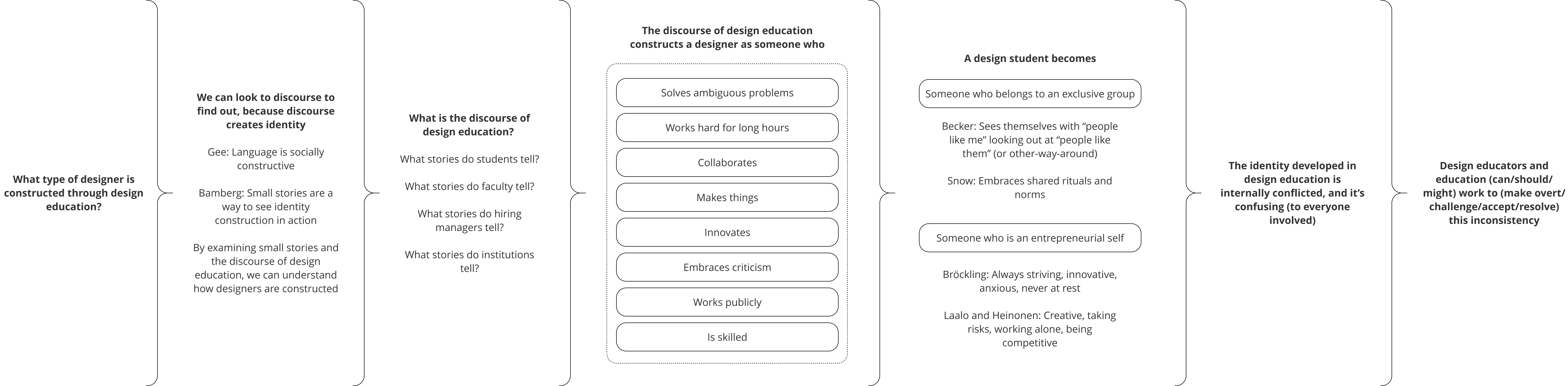
This is a sketch of my main argument in brief:
In this thesis, I will advance a claim that the discourse of design education is internally inconsistent: it simultaneously works to bring a student into a group that sees creativity as a shared, social activity, while constructing a highly self-sufficient designer who understands design, and themselves, as entrepreneurial. This impacts the way design students develop a creative identity.
I will illustrate how the language of design education labels a student as a “real designer” when they engage in particular behaviors and rituals in studio that are largely shared and social. Many of these are focused on working publicly: sharing their work, continually, and offering and accepting criticism in unique styles and formats. Students learn to see themselves as part of an exclusive group that trusts one-another and that views themselves as uniquely prepared to take on creative challenges, together.
I will also show that design education is a place of subjectification, where the pedagogical constructs of studio are presented as purposefully encouraging entrepreneurialism: a successful design student is someone who has the skills to be creatively self-governing, and who, while using those skills to create marketable innovations, takes risks, solves problems methodically, and acts independently. This subjectification comes loaded with beneficial claims—being employable and holding creative power through self-expression—as well as negative qualities, such as anxiety, fear, and feeling a need to hide.
I will illustrate how the language of design education simultaneously imprints both a social construction of a creative self and an entrepreneurial creative self. Design students describe encountering an entrepreneurial framing at the same time as participating in discourse of communal participation in a cohort of creatives, as well as the free and open exchange of ideas; faculty simultaneously argue that this communal quality is fundamental to being a successful designer, while adamantly prescribing creative individualism as the key to success. This incongruity is likely disorienting for students, and this thesis encourages instructors to reconsider how they work to develop creative confidence as constructed with entrepreneurial qualities in mind, yet foster the communal support claimed as fundamental to their values of open collaboration.
My research and interpretation supports this; I'll lean on (among others) Gee and Bamberg to show the focus on discourse and language, and Becker and Bröckling to argue a confusion between a designerly self and an entrepreneurial subject.