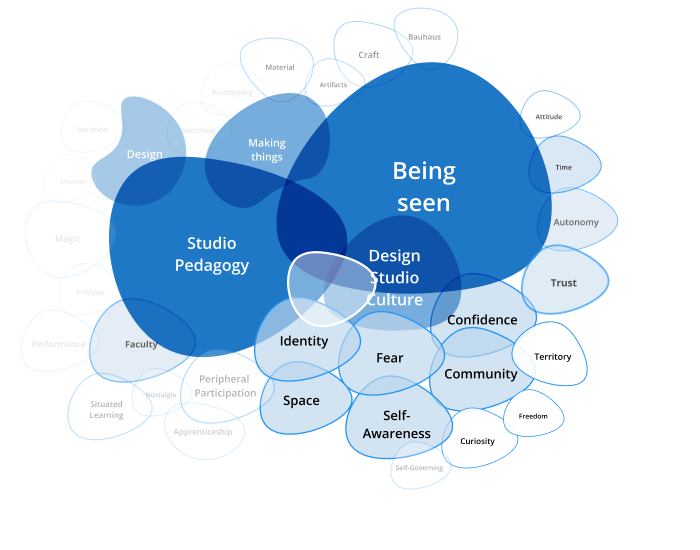
It’s been a few months since I reflected on the space of inquiry of my research, so here’s an update. (This diagram may be past its prime here, or maybe it needs some form of simplification, but anyway…)
My focus has [Evolved? Shifted? Focused?] into the area of how students understand themselves and their studio experiences, and how these things relate to studio pedagogy and studio culture. I think there’s a meaningful disconnect between what we’ve been teaching and how we’ve been teaching it, what students come to studio equipped to learn and how they come equipped to learn it, the role of the faculty and the studio community, and the development of designerly identity.
I don’t know what that disconnect is crisply, but I think I know what the pieces are. This is raw and full of all sorts of sweeping generalizations and assumptions:
- Students come to college with a lot to say, and are scared to say it. They have seen that social media can amplify their voices, and they want to be a part of that social story, but have seen what happens when you fuck up—you get trashed in public, and it has meaningful and lasting repercussions. If every time I made something, thousands of people I’ve never met told me it sucked, I would either stop making it or stop showing it to people or both. But I think that, by and large, “the kids today generation Z whatever” have bottled up all sorts of opinions and perspectives.
- The language and concepts of design have become a normal part of culture for younger students. They are used to making and changing and remixing and looking and judging. The words of cropping and publishing and gradients are part of their vocabulary and mental constructs of things. They understand that when you take some raw video, you need to do things to it to make it ready for people to see it, and understand it, and react to it. They intimately know “user-centered” (at least in a broad sense) and absolutely know consumer culture, for better or worse.
- They also suck at articulating themselves. They have things to say and no way to say them. They have a stunted critical vocabulary. They can’t solve problems. They break down in the face of ambiguity and challenge. They can’t idle and marinate on an idea for more than thirty seconds. They are sensitive, so so so sensitive.
- And man do they struggle with being seen.
So that’s a student story.
- The faculty are teaching what they learned, and are aware that it isn’t working for these students. They have created little stopgaps here and there, and some are able to change their in-class curriculum with more ability than others, but they say over and over that they struggle to get students to lean-in, to engage in a collaborative process, to iterate, to be public, to be seen, to make things, to form an opinion, to share an opinion, to hear other people give their opinion.
- They are also seeing the design profession implode, or at least implode from the way they understand it and have viewed it. Everyone decided that user experience and strategy and product and design thinking were the thing, and now those jobs are gone and those skills were maybe pretty thin to begin with. The basics of industrial design and graphic design are still there, but I don’t know how many of those jobs exist either, and that’s not really what seems to be attracting students, at least not according to faculty.
- The things the faculty feel make up a studio are disappearing, too. Physical space is basically a thing of the past, because of The Administration. Classes are short and huge because of The Administration. Grading has to be objective because of The Administration. There’s at least a strawman from them and me of this big nameless thing screwing everything up.
And,
- School is stupidly expensive and everyone knows it. The alternative bootcamp mess went away which is great, but there aren’t a lot of alternative alternatives which is not great.
- There’s AI and that’s some sort of thing.
So:
Learning to make things is the most important way for people to understand that they have some modicum of control over the world around them.
Design amplifies that control.
Learning to design has always required critique, iteration, reflective practice, collaboration, comparison, community, space, time, craft, autonomy, comfort with ambiguity, living with and in subjectivity.
Those things don’t work or aren’t available.
And “are we sure?” and “if so, now what” is my space of inquiry.
I think a big part of the research I’ve done, and will keep doing, is seeing if any of these Big Giant Assumptions are actually correct, and adding fidelity and nuance to them. The other big part of it is probably figuring out what to do about it.
Study one, Hiring for Creativity, helped paint a context of the industry as a mess, and hiring managers’ views that junior designers aren’t ready to do much of anything. This theory paper helped refine my understanding of that and having the revision of it accepted for publication helped me feel like there's a there there.
Study two, on faculty studio sentiment, shaped my understanding of fear of being seen.
Study three, on how students experience studio, is going to fill in a lot of the way students are considering their experiences.
And then hopefully something useful, or at least interesting, pops out the other end.